Results by title
4127 books match the query 'Science' and 6 start with a non-letter
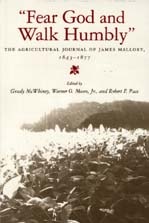
"Fear God and Walk Humbly"
The Agricultural Journal of James Mallory, 1843-1877James Mallory
University of Alabama Press, 1997
Most inhabitants of the Old South, especially the plain folk, devoted more time to leisurely activities—drinking, gambling, hunting, fishing, and just loafing—than did James Mallory, a workaholic agriculturalist, who experimented with new plants, orchards, and manures, as well as the latest farming equipment and techniques. A Whig and a Unionist, a temperance man and a peace lover, ambitious yet caring, business-minded and progressive, he supported railroad construction as well as formal education, even for girls. His cotton production—four bales per field hand in 1850, nearly twice the average for the best cotton lands in southern Alabama and Georgia--tells more about Mallory's steady work habits than about his class status.
But his most obvious eccentricity—what gave him reason to be remembered—was that nearly every day from 1843 until his death in 1877, Mallory kept a detailed journal of local, national, and often foreign news, agricultural activities, the weather, and especially events involving his family, relatives, slaves, and neighbors in Talladega County, Alabama. Mallory's journal spans three major periods of the South's history--the boom years before the Civil War, the rise and collapse of the Confederacy, and the period of Reconstruction after the Civil War. He owned slaves and raised cotton, but Mallory was never more than a hardworking farmer, who described agriculture in poetical language as “the greatest [interest] of all.”
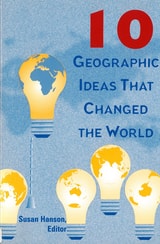
10 Geographic Ideas That Changed the World
Hanson, Susan
Rutgers University Press, 1997
The contributors, who include several past presidents of the Association of American Geographers, members of the National Academy of Sciences, and authors of major works in the discipline, are: Elizabeth K. Burns, Patricia Gober, Anne Godlewska, Michael F. Goodchild, Susan Hanson, Robert W. Kates, John R. Mather, William B. Meyer, Mark Monmonier, Edward Relph, Edward J. Taaffe, and B. L. Turner, II.

2002 Guide to the History of Science
Edited by Roger Turner
University of Chicago Press, 2002
5 Years of 4th Genre
Martha Bates
Michigan State University Press, 2006
In 1999, Michigan State University Press launched Fourth Genre: Explorations in Creative Nonfiction, a journal that began with and has maintained a devotion to publishing notable, innovative work in nonfiction. The title reflects an intent to give nonfiction its due as a literary genre—to give writers of the 'fourth genre' a showcase for their work and to give readers a place to find the liveliest and most creative works in the form.
Given the genre's flexibility and expansiveness, journal editors Michael Steinberg and David Cooper have welcomed a variety of works— ranging from personal essays and memoirs to literary journalism and personal criticism. The essays are lyrical, self-interrogative, meditative, and reflective, as well as expository, analytical, exploratory, or whimsical. In short, Fourth Genre encourages a writer- to-reader conversation, one that explores the markers and boundaries of literary/creative nonfiction.
Since its inaugural issue, contributors have earned many literary awards: 5 Notable Essays of the Year (Best American Essay); the Lowell Thomas Travel Journalism Award; Notable Essay of the Year (Best American Travel Writing); and 4 Pushcart Prizes. Five Years of 4th Genre is a celebration of this significant literary journal. Culling a selection of some of the most creative of Fourth Genre’s first five years—the Pushcart winners are here, as well as those essays that are unique, those that tell us something new, those that startle us, and those that touch our hearts —this volume presents a representative sampling.
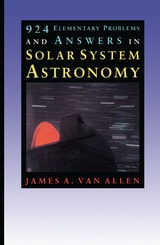
924 Elementary Problems and Answers in Solar System Astronomy
Van Allen, James A.
University of Iowa Press, 1993
This challenging collection of problems is organized into seven carefully crafted, thoughtful chapters on the Sun and the nature of the solar system; the motion of the planets; the Sun, Earth, and Moon; the sky as observed from the rotating, revolving Earth; other planets, their satellites, their rings; asteroids, comets, and meteoroids; and the radiations and telescopes. From question 1, "List characteristics of the solar system that are major clues in devising a hypothesis of its origin and evolution," through question 924, "Give a brief list of the contributions of radio and radar technologies in lunar and planetary astronomy," the problems range in difficulty from ones requiring only simple knowledge to ones requiring significant understanding and analysis. Many of the answers, in turn, illuminate the questions by providing basic explanations of the concepts involved.
Pioneer 10 and 11 are now halfway to the edge of the solar system. All beginning and advanced students of astronomy and their instructors as well as all dedicated amateurs can join James Van Allen on this journey by exploring the questions and answers in this stimulating book.
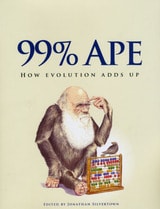
99% Ape
How Evolution Adds UpEdited by Jonathan Silvertown
University of Chicago Press, 2009
In his lifetime, Charles Darwin was roundly mocked for suggesting that humans were descended from apes, and even in our own day, the teaching of evolution remains controversial. But in the century and a half since the publication of On the Origin of Species, our increasingly sophisticated understanding of genetics has borne out Darwin’s theory: humans share 99% of their genes with chimps (and many even with grapes!).
99% Ape offers an accessible, straightforward introduction to evolution, beginning with Darwin’s discoveries and continuing through the latest genetic discoveries. Edited by Jonathan Silvertown, the volume brings together experts in a variety of fields pertinent to evolution, from paleobiology to planetary science, comparative anatomy to zoology, and even—for a discussion of legal battles surrounding the teaching of evolution—law. Interwoven with these varied accounts of evolution and its impact are vignettes from Darwin’s life that illustrate the continuity of thought that links Darwin’s work to today’s cutting-edge research.
Beautifully illustrated, 99% Ape is a perfect companion to the upcoming celebration of Darwin’s bicentennial and a bracing reminder of the important role evolution still has to play in our understanding of our origins—and our possible futures.