Results by title
24 books match the query 'Variation'

Appalachian Englishes in the Twenty-First Century
Kirk Hazen
West Virginia University Press, 2020
A portal to the language scholarship of the last thirty years, Appalachian Englishes in the Twenty-First Century translates state-of-the-art research for a nonspecialist audience, while setting the agenda for further study of language in one of America’s most recognized regions.

Capital Choices
Sectoral Politics and the Variation of Sovereign WealthJuergen Braunstein
University of Michigan Press, 2019
Sovereign wealth funds are state-controlled pools of capital that hold financial and real assets, including shares of state enterprises, and manage them to grow the nation’s base of sovereign wealth. The dramatic rise of sovereign wealth funds (SWFs) in both number and size—this group is now larger than the size of global private equity and hedge funds, combined—and the fact that most are located in non-OECD countries, has raised concern about the direction of capitalism. Yet SWFs are not a homogenous group of actors. Why do some countries with large current account surpluses, notably China, create SWFs while others, such as Switzerland and Germany, do not? Why do other countries with no macroeconomic justification, such as Senegal and Turkey, create SWFs? And why do countries with similar macroeconomic features, such as Kuwait and Qatar or Singapore and Hong Kong, choose different types of SWFs?
Capital Choices analyzes the creation of different SWFs from a comparative political economy perspective, arguing that different state-society structures at the sectoral level are the drivers for SWF variation. Juergen Braunstein focuses on the early formation period of SWFs, a critical but little understood area given the high levels of political sensitivity and lack of transparency that surround SWF creation. Braunstein’s novel analytical framework provides practical lessons for the business and finance organizations and policymakers of countries that have created, or are planning to create, SWFs.

Capital Choices
Sectoral Politics and the Variation of Sovereign WealthJuergen Braunstein
University of Michigan Press, 2022
Sovereign wealth funds are state-controlled pools of capital that hold financial and real assets, including shares of state enterprises, and manage them to grow the nation’s base of sovereign wealth. The dramatic rise of sovereign wealth funds (SWFs) in both number and size—this group is now larger than the size of global private equity and hedge funds, combined—and the fact that most are located in non-OECD countries, has raised concern about the direction of capitalism. Yet SWFs are not a homogenous group of actors. Why do some countries with large current account surpluses, notably China, create SWFs while others, such as Switzerland and Germany, do not? Why do other countries with no macroeconomic justification, such as Senegal and Turkey, create SWFs? And why do countries with similar macroeconomic features, such as Kuwait and Qatar or Singapore and Hong Kong, choose different types of SWFs?
Capital Choices analyzes the creation of different SWFs from a comparative political economy perspective, arguing that different state-society structures at the sectoral level are the drivers for SWF variation. Juergen Braunstein focuses on the early formation period of SWFs, a critical but little understood area given the high levels of political sensitivity and lack of transparency that surround SWF creation. Braunstein’s novel analytical framework provides practical lessons for the business and finance organizations and policymakers of countries that have created, or are planning to create, SWFs.

Contemporary Advances in Theoretical and Applied Spanish Linguistic Variation
Juan J. Colomina-Almiñana
The Ohio State University Press, 2017
This volume makes three major contributions to Hispanic sociolinguistics. First, it covers variation in less commonly studied varieties, which are new areas of interest in a broader world where certain minorities and their languages are crucial. Second, it offers recent and innovative approaches to variation coming from formal theories in order to spark a debate about methodology that is more comprehensive of the diverse approaches to variation currently practiced in the field. Finally, it includes chapters that combine quantitative and qualitative analysis of different linguistic variables.
Diversity in Language
Perspectives and ImplicationsEdited by Yoshiko Matsumoto, David Oshima, Orrin Robinson, and Peter Sells
CSLI, 2007

Figures of Speech
Six Histories of Language and Identity in the Age of RevolutionsTim Cassedy
University of Iowa Press, 2018
Tim Cassedy’s fascinating study examines the role that language played at the turn of the nineteenth century as a marker of one’s identity. During this time of revolution (U.S., French, and Haitian) and globalization, language served as a way to categorize people within a world that appeared more diverse than ever. Linguistic differences, especially among English-speakers, seemed to validate the emerging national, racial, local, and regional identity categories that took shape in this new world order.
Focusing on six eccentric characters of the time—from the woman known as “Princess Caraboo” to wordsmith Noah Webster—Cassedy shows how each put language at the center of their identities and lived out the possibilities of their era’s linguistic ideas. The result is a highly entertaining and equally informative look at how perceptions about who spoke what language—and how they spoke it—determined the shape of communities in the British American colonies and beyond.
This engagingly written story is sure to appeal to historians of literature, culture, and communication; to linguists and book historians; and to general readers interested in how ideas about English developed in the early United States and throughout the English-speaking world.

Ghost Stories for Darwin
The Science of Variation and the Politics of DiversityBanu Subramaniam
University of Illinois Press, 2014
Subramaniam reveals the histories of eugenics and genetics and their impact on the metaphorical understandings of difference and diversity that permeate common understandings of differences among people exist in contexts that seem distant from the so-called objective hard sciences. Journeying into interdisciplinary areas that range from the social history of plants to speculative fiction, Subramaniam uncovers key relationships between the life sciences, women's studies, evolutionary and invasive biology, and the history of ecology, and how ideas of diversity and difference emerged and persist in each field.

Heartland English
Variation and Transition in the American MidwestTimothy C. Frazer
University of Alabama Press, 1993
Mapping the Diverse Voices of America's Linguistic Heartland.
Heartland English is the first book-length scholarly treatment of English spoken in the Midwest, or the northern interior of the continental United States. For generations, the American Midwest has been portrayed as the home of a single, uniform variety of "standard" American English. Heartland English: Variation and Transition in the American Midwest challenges that assumption through the first book-length scholarly examination of the rich linguistic diversity that exists across the region. Bringing together the work of leading dialectologists and language scholars, editor Timothy C. Frazer presents a groundbreaking exploration of how history, migration, settlement patterns, geography, culture, and social change have shaped the spoken language of the Midwest.
Covering communities across the northern interior of the United States, the volume reveals a complex linguistic landscape marked by regional dialect boundaries, evolving pronunciations, distinctive vocabulary, and shifting patterns of speech. Rather than viewing Midwestern English as a static or homogeneous dialect, the contributors demonstrate how linguistic variation reflects the movement of peoples, the influence of neighboring regions, and the ongoing transformation of American society.
Drawing on research in dialect geography, sociolinguistics, historical linguistics, and language variation studies, Heartland English offers valuable insights into the ways language both shapes and reflects regional identity. The collection examines how speakers perceive dialect differences, how those differences develop over time, and why the Midwest remains one of the most important regions for understanding the evolution of American English. As a landmark contribution to the study of language in North America, the book continues to serve as an essential resource for scholars investigating the relationship between language, culture, and place.
A Publication in the Centennial Series of the American Dialect Society in celebration of the beginning of its second century of research into language variation in America.
Language Diversity in the Classroom
From Intention to PracticeEdited by Geneva Smitherman and Victor Villanueva. Foreword by Suresh Canagarajah
Southern Illinois University Press, 2003
It’s no secret that, in most American classrooms, students are expected to master standardized American English and the conventions of Edited American English if they wish to succeed. Language Diversity in the Classroom: From Intention to Practice works to realign these conceptions through a series of provocative yet evenhanded essays that explore the ways we have enacted and continue to enact our beliefs in the integrity of the many languages and Englishes that arise both in the classroom and in professional communities.
Edited by Geneva Smitherman and Victor Villanueva, the collection was motivated by a survey project on language awareness commissioned by the National Council of Teachers of English and the Conference on College Composition and Communication.
All actively involved in supporting diversity in education, the contributors address the major issues inherent in linguistically diverse classrooms: language and racism, language and nationalism, and the challenges in teaching writing while respecting and celebrating students’ own languages. Offering historical and pedagogical perspectives on language awareness and language diversity, the essays reveal the nationalism implicit in the concept of a “standard English,” advocate alternative training and teaching practices for instructors at all levels, and promote the respect and importance of the country’s diverse dialects, languages, and literatures.
Contributors include Geneva Smitherman, Victor Villanueva, Elaine Richardson, Victoria Cliett, Arnetha F. Ball, Rashidah Jammi` Muhammad, Kim Brian Lovejoy, Gail Y. Okawa, Jan Swearingen, and Dave Pruett.
The volume also includes a foreword by Suresh Canagarajah and a substantial bibliography of resources about bilingualism and language diversity.
Language Variety in the South Revisited
Cynthia Bernstein
University of Alabama Press, 1994
Top linguists from diverse fields address language varieties in the South.
Language Variety in the South
Perspectives in Black and WhiteMichael B. Montgomery
University of Alabama Press, 1986

Lexical Change and Variation in the Southeastern United States, 1930-1990
Ellen Johnson
University of Alabama Press, 1996
This book discusses words used in the Southeast and how they have changed
during the 20th century. It also describes how the lexicon varies according
to the speaker's age, race, education, sex, and place of residence
(urban versus rural; coastal versus piedmont versus mountain). Data collected
in the 1930s as part of the Linguistic Atlas of the Middle and South Atlantic
States project were compared with data collected in 1990 from similar speakers
in the same communities.
The results show that region was the most important
factor in differentiating dialects in the 1930s but that it is the least
important element in the 1990s, with age, education, race, and age all
showing about the same influence on the use of vocabulary. An appendix
contains a tally of the responses given by 78 speakers to 150 questions
about vocabulary items, along with speakers' commentary. Results
from the 1930s may be compared to those from 1990, making this a treasure
trove for anyone interested in regional terms or in how our speech is changing
as the South moves from an agricultural economy through industrialization
and into the information age.
Linguistic Diversity in Space and Time
Johanna Nichols
University of Chicago Press, 1992
"An awe-inspiring book, unequalled in scope, originality, and the range of language data considered."—Anna Siewierska, Linguistics
"Fascinating. . . . A brilliant pioneering study."—Journal of Indo-European Studies
"A superbly reasoned book."—John A. C. Greppin, Times Literary Supplement
Mexican Americans and Language
Del dicho al hechoGlenn A. Martínez
University of Arizona Press, 2006
This book offers an overview of some of the central issues in the Mexican American language experience, describing it in terms of both bilingualism and minority status. It is the first book to focus on the historical, social, political, and structural aspects of multiple languages in the Mexican American experience and to address the principles and methods of applied sociolinguistic research in the Mexican American community. Spanish and non-Spanish speakers in the Mexican American community share a common set of social and ethnic bonds. They also share a common experience of bilingualism.
As Martínez observes, the ideas that have been constructed around bilingualism are as important to understanding the Mexican American language experience as bilingualism itself. Mexican Americans and Language gives students the background they need to respond to the multiple social problems that can result from the language differences that exist in the Mexican American community. By showing students how to go from word to deed (del dicho al hecho), it reinforces the importance of language for their community, and for their own lives and futures.

Multiplicity in Unity
Plant Subindividual Variation and Interactions with AnimalsCarlos M. Herrera
University of Chicago Press, 2009
Plants produce a considerable number of structures of one kind, like leaves, flowers, fruits, and seeds, and this reiteration is a quintessential feature of the body plan of higher plants. But since not all structures of the same kind produced by a plant are identical—for instance, different branches on a plant may be male or female, leaf sizes in the sun differ from those in the shade, and fruit sizes can vary depending on patterns of physiological allocation among branches—a single plant genotype generally produces a multiplicity of phenotypic versions of the same organ.
Multiplicity in Unity uses this subindividual variation to deepen our understanding of the ecological and evolutionary factors involved in plant-animal interactions. On one hand, phenotypic variation at the subindividual scale has diverse ecological implications for animals that eat plants. On the other hand, by choosing which plants to consume, these animals may constrain or modify plant ontogenetic patterns, developmental stability, and the extent to which feasible phenotypic variants are expressed by individuals.
An innovative study of the ecology, morphology, and evolution of modular organisms, Multiplicity in Unity addresses a topic central to our understanding of the diversity of life and the ways in which organisms have coevolved to cope with variable environments.
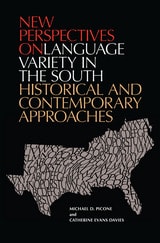
New Perspectives on Language Variety in the South
Historical and Contemporary ApproachesMichael D. Picone
University of Alabama Press, 2015
Beginning with an introduction to American Indian languages of the Southeast, five fascinating essays discuss indigenous languages, including Caddo, Ofo, and Timucua, and evidence for the connection between the Pre-Columbian Southeast and the Caribbean.
Five essays explore the earlier Englishes of the South, covering topics such as the eighteenth century as the key period in the differentiation of Southern American English and the use of new quantitative methods to trace the transfer of linguistic features from England to America. They examine a range of linguistic resources, such as plantation overseers’ writings, modern blues lyrics, linguistic databases, and lexical and locutional compilations that reveal the region’s distinctive dialectal traditions.
New Perspectives on Language Variety in the South: Historical and Contemporary Approaches widens the scope of inquiry into the linguistic influences of the African diaspora as evidenced in primary sources and records. A comprehensive essay redefines the varieties of French in Louisiana, tracing the pathway from Colonial Louisiana to the emergence of Plantation Society French in a diglossic relationship with Louisiana Creole. A further essay maps the shift from French to English in family documents.
An assortment of essays on English in the contemporary South touch on an array of compelling topics from discourse strategies to dialectal emblems of identity to stereotypes in popular perception.
Essays about recent Latino immigrants to the South bring the collection into the twenty-first century, taking into account the dramatic increase in the population of Spanish speakers and illuminating the purported role of “Spanglish,” the bilingual lives of Spanish-speaking Latinos in Mississippi, and the existence of regional Spanish dialectal diversity.

Optimizing Structure in Context
Scrambling and Information StructureHye-Won Choi
CSLI, 1999
Out of the Mouths of Slaves
African American Language and Educational MalpracticeBy John Baugh
University of Texas Press, 1999
Winner, A Choice Outstanding Academic Book
When the Oakland, California, school board called African American English "Ebonics" and claimed that it "is not a black dialect or any dialect of English," they reignited a debate over language, race, and culture that reaches back to the era of slavery in the United States. In this book, John Baugh, an authority on African American English, sets new parameters for the debate by dissecting and challenging many of the prevailing myths about African American language and its place in American society.
Baugh's inquiry ranges from the origins of African American English among slaves and their descendants to its recent adoption by standard English speakers of various races. Some of the topics he considers include practices and malpractices for educating language minority students, linguistic discrimination in the administration of justice, cross-cultural communication between Blacks and whites, and specific linguistic aspects of African American English. This detailed overview of the main points of debate about African American language will be important reading for both scholars and the concerned public.

Scribal Memory and Word Selection
Text Criticism of the Hebrew BibleRaymond F. Person Jr.
SBL Press, 2023
What were ancient scribes doing when they copied a manuscript of a literary work? This question is especially problematic when we realize that ancient scribes preserved different versions of the same literary texts. In Scribal Memory and Word Selection: Text Criticism of the Hebrew Bible, Raymond F. Person Jr. draws from studies of how words are selected in everyday conversation to illustrate that the same word-selection mechanisms were at work in scribal memory. Using examples from manuscripts of the Hebrew Bible, Person provides new ways of understanding the cognitive-linguistic mechanisms at work during the composition/transmission of texts. Person reveals that, while our modern perspective may consider textual variants to be different literary texts, from the perspective of the ancient scribes and their audiences, these variants could still be understood as the same literary text.

Sociolinguistic Variation
Data, Theory, and AnalysisEdited by Jennifer Arnold, Renee Blake, and Brad Davidson
CSLI, 1996
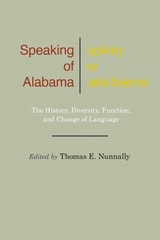
Speaking of Alabama
The History, Diversity, Function, and Change of LanguageEdited by Thomas E. Nunnally
University of Alabama Press, 2019
Thomas E. Nunnally’s fascinating volume presents essays by linguists who examine with affection and curiosity the speech varieties occurring both past and present across Alabama. Taken together, the accounts in this volume offer an engaging view of the major features that characterize Alabama’s unique brand of southern English.
Written in an accessible manner for general readers and scholars alike, Speaking of Alabama includes such subjects as the special linguistic features of the Southern drawl, the “phonetic divide” between north and south Alabama, “code-switching” by African American speakers in Alabama, pejorative attitudes by Alabama speakers toward their own native speech, the influence of foreign languages on Alabama speech to the vibrant history and continuing influence of non-English languages in the state, as well as ongoing changes in Alabama’s dialects.
Adding to these studies is a foreword by Walt Wolfram and an afterword by Michael B. Montgomery, both renowned experts in southern English, which place both the methodologies and the findings of the volume into their larger contexts and point researchers to needed work ahead in Alabama, the South, and beyond. The volume also contains a number of useful appendices, including a guide to the sounds of Southern English, a glossary of linguistic terms, and online sources for further study.
Language, as presented in this collection, is never abstract but always examined in the context of its speakers’ day-to-day lives, the driving force for their communication needs and choices. Whether specialist or general reader, Alabamian or non-Alabamian, all readers will come away from these accounts with a deepened understanding of how language functions between individuals, within communities, and across regions, and will gain a new respect for the driving forces behind language variation and language change.

The Alchemy of English
The Spread, Functions, and Models of Non-native EnglishesBraj Kachru
University of Illinois Press, 1990
of an entire field, rather than merely the fruitful exploration of a topic.
. . . [Kachru] is to be congratulated for having taken us as far as he
already has and for doing so in so stimulating and so productive a fashion."
-- World Englishes
"A potent addition to theoretical, sociolinguistic, attitudinal
and methodological explorations vis-à-vis the spread and functions
of, and innovations in, English from the viewpoint of a non-Western scholar."
-- The Language Teacher
Winner of the Joint First Prize, Duke of Edinburgh English Language
Book Competition of the English-Speaking Union of the Commonwealth, 1987

Understanding Language Structure, Interaction, and Variation
An Introduction to Applied Linguistics and Sociolinguistics for NonspecialistsSalvatore Attardo and Steven Brown
University of Michigan Press, 2027
In the age of Artificial Intelligence hallucinations and slop, the need for a clear, accessible, uncluttered, and authoritative textbook is more important than ever. The fourth edition of Understanding Language Structure, Interaction, and Variation retains the informal and reader-friendly style of previous editions and has been substantively updated and rewritten to incorporate recent scholarship throughout. Language is important for a number of fields, including teaching, psychology, sociology, and anthropology. The wide coverage of language structure, sociolinguistics, language acquisition, and grammar makes this book suitable for pre-service teachers, undergraduates, and graduate students who need some exposure to linguistics, but do not need highly technical training in formal linguistics.
This extensively classroom-tested book is organized for use in a semester or can be customized for shorter terms by omitting chapters after the foundational core provided by chapters 1–3. The encyclopedic nature of the book, which includes a glossary and an index, make it appropriate for self-study and any reader who is interested in the study of language.
Readers of the fourth edition of Understanding Language Structure, Interaction, and Variation will find:
- Expanded coverage of Prosody, the phonetic alphabet, African American Language, neurodiversity and language, English as a world language, and English as a lingua franca;
- New content on biolinguistics, translanguaging, enregisterment, indexicality, the semiotic turn in sociolinguistics, code-meshing, complex dynamic systems theory, and personality theory in SLA;
- A thorough overview of the basics of English grammar.

What's Your Sign for Pizza?
An Introduction to Variation in American Sign LanguageCeil Lucas
Gallaudet University Press, 2019
What’s Your Sign for Pizza? derives from an extensive seven-year research project in which more than 200 Deaf ASL users representing different ages, genders, and ethnic groups from seven different regions were filmed sharing their signs for everyday vocabulary. The film clips form a supplemental resource to the text and are referenced in their relevant chapters. The text begins with an explanation of the basic concepts of language and the structure of sign language. Each part of the text concludes with questions for discussion, and the final section offers three supplemental readings that provide further information on variation in both spoken and signed languages. What’s Your Sign for Pizza also briefly sketches the development of ASL, which explains the relationships between language varieties throughout the country.
The videos are available online at www.youtube.com/GallaudetUniversityPress.