Results by title
7 books match the query 'Kayaking'
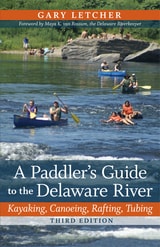
A Paddler's Guide to the Delaware River
Kayaking, Canoeing, Rafting, TubingLetcher, Gary
Rutgers University Press, 2012
When Henry Hudson explored the Delaware River in 1609, he dubbed it “one of the finest, best, and pleasantest rivers in the world.” Today, those same qualities make the Delaware one of the most popular rivers for recreational use in the United States. Although in places a near-wilderness, the Delaware is easily accessible to millions of residents. On any summer day there may be thousands of people rushing down its exciting rapids or lazing through its serene eddies.
A Paddler’s Guide to the Delaware River is an indispensable resource for anyone who wants to experience the Delaware River in a kayak, canoe, raft, or tube—or, for that matter, an automobile or an armchair. Reading the book is like travelling down the river with an experienced guide. It charts the non-tidal Delaware 200 miles from Hancock, New York, to Trenton, New Jersey, describing access points, rapids, natural features, villages, historical sites, campgrounds, outfitters, and restaurants. The Delaware comes alive as the author introduces some of the people, places, events, and controversies that have marked the river from earliest times to the present day.
Completely revised, the third edition offers:
- An overview of the river including watershed, history, place names, paddlecraft, safety, and fishing.
- The River Guide: ten sections that can each be paddled in one day (about 20 miles), with a mile-by-mile account of rapids, access, natural features, historic sites, and other features.
- All new maps, with names for virtually every rapid, eddy, and other river feature, plus detailed diagrams for routes through even the most severe rapids.
- Features in the River Guide highlight the people, events, natural history, and communities that define the river experience, such as Tom Quick, the infamous “avenger of the Delaware”; the mysterious migration of eels, the battle over Tocks Island Dam; and many others.
- Appendices of Important Contacts, Outfitters and Campgrounds, River Trip Checklists, and more.
Whether you are a novice out for an afternoon float, a seasoned adventurer on an overnight expedition, or a resident fascinated by the lore of the Delaware Valley, this book is an invaluable guide.
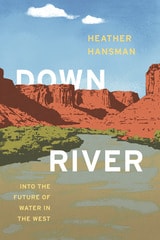
Downriver
Into the Future of Water in the WestHeather Hansman
University of Chicago Press, 2019
The Green River, the most significant tributary of the Colorado River, runs 730 miles from the glaciers of Wyoming to the desert canyons of Utah. Over its course, it meanders through ranches, cities, national parks, endangered fish habitats, and some of the most significant natural gas fields in the country, as it provides water for 33 million people. Stopped up by dams, slaked off by irrigation, and dried up by cities, the Green is crucial, overused, and at-risk, now more than ever.
Fights over the river’s water, and what’s going to happen to it in the future, are longstanding, intractable, and only getting worse as the West gets hotter and drier and more people depend on the river with each passing year. As a former raft guide and an environmental reporter, Heather Hansman knew these fights were happening, but she felt driven to see them from a different perspective—from the river itself. So she set out on a journey, in a one-person inflatable pack raft, to paddle the river from source to confluence and see what the experience might teach her. Mixing lyrical accounts of quiet paddling through breathtaking beauty with nights spent camping solo and lively discussions with farmers, city officials, and other people met along the way, Downriver is the story of that journey, a foray into the present—and future—of water in the West.
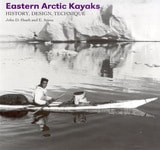
Eastern Arctic Kayaks
History, Design, TechniqueJohn Heath
University of Alaska Press, 2004
Eastern Arctic Kayaks is the product of years of kayak study by two of the world's experts. Combining analyses of form and function with historical background and illustrations of kayaking techniques, this volume is a storehouse of information for recreational kayakers and scholarly readers alike.
Drawing from his vast practical experience and extensive study of museum specimens, John D. Heath offers a comprehensive overview of the evolution and construction of Greenland kayaks supplemented with an illustrated series of rolling and sculling techniques. E. Arima examines kayaks of the eastern Canadian Arctic, covering woodworking tools, construction techniques, and the treatment of skins for the kayak cover.
Core chapters on Greenland and eastern Canada are accompanied by essential articles by Greg Stamer on the use of the Greenland paddle and two studies of kayaks in European museums by Harvey Golden and Hugh Collings. A valuable excerpt from John Brand's Little Kayak Book series makes this British publication available to American readers for the first time.
Lavishly illustrated with drawings and historic photographs, Eastern Arctic Kayaks is a landmark study in the history of watercraft--an essential resource for recreational kayakers and maritime historians and for anyone interested in northern Native material culture.
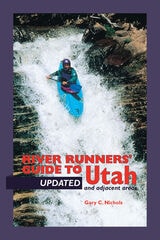
River Runners' Guide To Utah and Adjacent Areas
Gary C Nichols
University of Utah Press, 1986
A fully revised and updated edition of Gary Nichols’ widely used guide to river running in Utah. Major changes have occurred on Big and Little Cottonwood Creeks, which have many new drops with dangerous hydraulics. This edition accounts for these and other alterations in the state’s waterways over the past fifteen years. Also, several of the original river access points are now on private land. Alternative access points are presented and users are alerted to the necessity of requesting permission. All this and much more will once again make A River Runners’ Guide to Utah and Adjacent Areas the one source for vital and reliable information on more than ninety river trips for beginner and expert alike. It includes:
-Over 90 river trips with descriptions and maps
-Location of access and take-out points
-Instructions for all skill levels
-Ratings of all waterways by levels of difficulty
-Identification of danger areas and obstacles
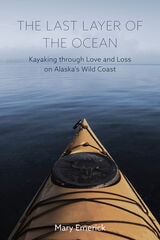
The Last Layer of the Ocean
Kayaking through Love and Loss on Alaska's Wild CoastMary Emerick
Oregon State University Press, 2021
The year Emerick turned 38, the suicide of a stranger compelled her to uproot her life and strike out for Alaska, taking a chance on love and home. She learned how to travel in a small yellow kayak along the rugged coast, contending with gales, high seas, and bears. She pondered the different meanings of home from the perspectives of people who were born along Alaska’s coast, the first peoples who had been there for generations, newcomers who chose this place for themselves, and the many who would eventually, inevitably leave. When she married a man from another island, convinced that love would stick, she soon learned that marriage is just as difficult to navigate as the ocean.
Divided into sections detailing the main kayaking strokes, with each stroke serving as metaphor for the lives we all pass through and the tools needed to stay afloat, this eloquent memoir speaks to the human need for connection—connection to place and to our fellow travelers casting their bubbles of light in the depths.
Trails of Little Rock
Hiking, Biking, and Kayaking Trails in Little RockJohnnie Chamberlin
Parkhurst Brothers, Inc., 2009
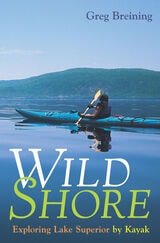
Wild Shore
Exploring Lake Superior By KayakGreg Breining
University of Minnesota Press, 2002
A real-life adventure and journey of discovery on the greatest of the Great Lakes
Over two years, Greg Breining set out to circle Lake Superior by kayak. Paddling more than one thousand miles, he camped on the lake’s islands and shorelines, visited its places of rare beauty and solitude, experienced its wildly varied moods, and explored remote historic sites and isolated communities. The result is Wild Shore, a tale of outdoor adventure, colorful characters, memorable stories, and personal discovery.