Results by title
3027 books match the query 'Sociology' and 9 start with a non-letter
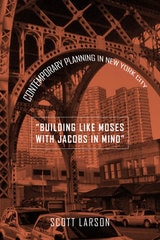
"Building Like Moses with Jacobs in Mind"
Contemporary Planning in New York CityScott Larson
Temple University Press, 2013
The antagonism between urbanist and writer Jane Jacobs and master builder Robert Moses may frame debates over urban form, but in "Building Like Moses with Jacobs in Mind," Scott Larson aims to use the Moses-Jacobs rivalry as a means for examining and understanding the New York City administration's redevelopment strategies and actions. By showing how the Bloomberg administration's plans borrow selectively from Moses' and Jacobs' writing, Larson lays bare the contradictions buried in such rhetoric and argues that there can be no equitable solution to the social and economic goals for redevelopment in New York City with such a strategy.
"Building Like Moses with Jacobs in Mind" offers a lively critique that shows how the legacies of these two planners have been interpreted—and reinterpreted—over time and with the evolution of urban space. Ultimately, he makes the case that neither figure offers a meaningful model for addressing stubborn problems—poverty, lack of affordable housing, and segregation along class and racial lines—that continue to vex today's cities.
"Do You Know...?"
The Jazz Repertoire in ActionRobert R. Faulkner and Howard S. Becker
University of Chicago Press, 2009
Every night, somewhere in the world, three or four musicians will climb on stage together. Whether the gig is at a jazz club, a bar, or a bar mitzvah, the performance never begins with a note, but with a question. The trumpet player might turn to the bassist and ask, “Do you know ‘Body and Soul’?”—and from there the subtle craft of playing the jazz repertoire is tested in front of a live audience. These ordinary musicians may never have played together—they may never have met—so how do they smoothly put on a show without getting booed offstage.
In “Do You Know . . . ?” Robert R. Faulkner and Howard S. Becker—both jazz musicians with decades of experience performing—present the view from the bandstand, revealing the array of skills necessary for working musicians to do their jobs. While learning songs from sheet music or by ear helps, the jobbing musician’s lexicon is dauntingly massive: hundreds of thousands of tunes from jazz classics and pop standards to more exotic fare. Since it is impossible for anyone to memorize all of these songs, Faulkner and Becker show that musicians collectively negotiate and improvise their way to a successful performance. Players must explore each others’ areas of expertise, develop an ability to fake their way through unfamiliar territory, and respond to the unpredictable demands of their audience—whether an unexpected gang of polka fanatics or a tipsy father of the bride with an obscure favorite song.
“Do You Know . . . ?” dishes out entertaining stories and sharp insights drawn from the authors’ own experiences and observations as well as interviews with a range of musicians. Faulkner and Becker’s vivid, detailed portrait of the musician at work holds valuable lessons for anyone who has to think on the spot or under a spotlight.

"I Didn't Divorce My Kids!"
How Fathers Deal With Family Break-upsGerhard Amendt
Campus Verlag, 2008
Amendt’s incisive look at divided families also explores the impact that a single-parent household has on children’s well-being, criticizing the American tendency to over-pathologize normal reactions to familial upheaval. Even the most civilized of divorces, Amendt argues, can cause rage, sadness, potential health problems, and behavioral disturbances in otherwise well-adjusted children. The broad spectrum of experiences recounted in “I Didn’t Divorce My Kids!” will be essential reading for anyone interested in, or personally shaped by, the changing face of the modern family.
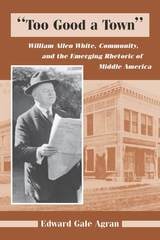
"Too Good a Town"
William Allen White, Community, and the Emerging Rhetoric of Middle AmericaEdward G. Agran
University of Arkansas Press, 1999
For fifty years, William Allen White, first as a reporter and later as the long-time editor of the Emporia Gazette, wrote of his small town and its Mid-American values. By tailoring his writing to the emerging urban middle class of the early twentieth century, he won his “gospel of Emporia” a nationwide audience and left a lasting impact on he way America defines itself.
Investigating White’s life and his extensive writings, Edward Gale Agran explores the dynamic thought of one of America’s best-read and most-respected social commentators. Agran shows clearly how White honed his style and transformed the myth of conquering the western frontier into what became the twentieth-century ideal of community building.
Once a confidante of and advisor to Theodore Roosevelt, White addressed, and reflected in his work, all the great social and political oscillations of his time—urbanization and industrialism, populism, and progressivism, isolationism internationalism, Prohibition, and New Deal reform. Again and again, he asked the question “What’s the matter?” about his times and townspeople, then found the middle ground. With great care and discernment, Agran gathers the man strains of White’s messages, demonstrating one writer’s pivotal contribution to our idea of what it means to be an American.
"We Live in the Shadow"
Inner-City Kids Tell Their Stories through PhotographsElaine Bell Kaplan
Temple University Press, 2013
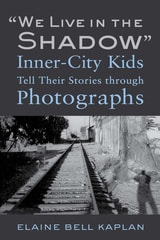
Looking at their photo of railroad tracks, a group of preteen students in South Central Los Angeles see either "a way out of the ghetto," or a "dirty, bad environment." Such are the impressions expressed in the poignant "We Live in the Shadow": Inner-City Kids Tell Their Stories through Photographs.
In Elaine Bell Kaplan's perceptive book, at-risk youth were given five-dollar cameras to tell stories about their world. Their photos and stories show us their response to negative inner-city teen images. We follow them into their schools, and we hear about their creative coping strategies. While these kids see South Central as dangerous, they also see themselves as confident enough to not let the inner city take them down. They refuse to be labeled as "ghetto thugs," as outsiders sometimes do. These outsiders include police, teachers, and other groups representing the institutional voices governing their daily lives.
The kids in "We Live in the Shadow": Inner-City Kids Tell Their Stories through Photographs have developed a multilayered view of society. This impressive book gives voice to their resilience.
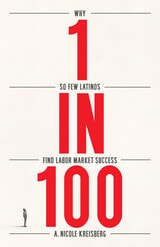
1 in 100
Why So Few Latinos Find Labor Market SuccessA. Nicole Kreisberg
University of Chicago Press, 2027
A behind-the-scenes look at why Latinos—the largest immigrant group in the United States—make up a staggeringly low percentage of the elite US labor force.
Carla, Douglas, and Isabel each migrated to the United States from Latin American countries before they were teenagers. Each had big dreams—in medicine, business, and government—and each did what they were told to do to achieve their goals: work hard, stay in school, and follow the rules. Yet none of them reached the top of the labor market, and they are far from alone. Only one out of one hundred Latino immigrants who arrives in the United States as children will ever secure a job that requires a college degree and pays high wages.
In 1 in 100, sociologist A. Nicole Kreisberg explains why Latinos are more likely to have difficulty finding success in the labor market. Despite increasing access to higher education, Latino immigrant youth seldom land high-paying jobs, but not because of individual failure. Instead, these slim odds are the result of immigration laws, schools, and workplaces that interact in ways that systematically disadvantage so many Latinos. Kreisberg finds that stereotypes about Latino immigrants are activated in US schools, exacerbated in US colleges, and reinforced by employers’ hiring decisions. And because most Americans cannot tell who is and who isn’t an immigrant, the stereotypes harming immigrants often spill over to the 68 million Latinos living in the United States, including those who are US citizens.
By tracing the school-to-work trajectories of child-arriving Latino immigrants and native-born Latinos, alongside the gatekeepers who structure their opportunities, 1 in 100 shows that the 99 who struggle are not the exception—they are the unfortunate norm.
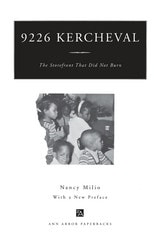
9226 Kercheval
The Storefront that Did Not Burn, With a New PrefaceNancy Milio
University of Michigan Press, 2000
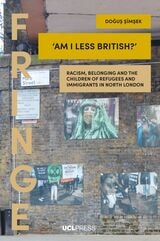
‘Am I Less British?’
Racism, Belonging, and the Children of Refugees and Immigrants in North LondonDogus Simsek
University College London, 2024
‘Am I Less British?’ focuses on the children of refugees and immigrants from Turkey in North London. Providing a rich ethnography of the lives of the children, the book studies their sense of identity and belonging, and their transnational experiences. It aims to understand how the children position themselves within a range of locations (London, North London, and Turkey), where they face class hierarchy, racism, and discrimination. Dogus Simsek explores how these children think about their sense of belonging within the contemporary political context in Britain and Turkey. De-identifying themselves from national identities and holding onto their oppressed identities appear as new forms of resistance in response to racism and exclusion.
The experiences of the young people reflect the complexity of their lives in changing political and social circumstances across the borders of nation-states, as well as the importance of other categories of identity, including local identities. Overall, the book argues that the intersections of local, national, and transnational approaches, the political context through which the lives of young people are framed, and their sophisticated engagement with ideas of race, class, ethnicity, and gender, are crucial to understanding their identity formation.
“Weltbeziehung”
The Study of our Relationship to the WorldEdited by Bettina Hollstein, Hartmut Rosa, and Jörg Rüpke
Campus Verlag, 2023
Human beings are always and essentially placed and situated in a world to which they relate, and it is this relationship that defines them. This book describes the historical and cultural variety of self-world-relations of this kind and revolves around aspects and dimensions of what Hartmut Rosa has gathered under the term “Weltbeziehung” (relationship to the world), expanding on his theory on resonance.
This book starts from this innovative approach to discuss socially relevant questions and conceptions of the present, like property, progress, or markets and then contrasts them with non-Western or non-modern forms of “Weltbeziehungen” like specific conceptions of virtue or fatalistic practices. In an effort to overcome Eurocentric biases, the book also includes studies about the decolonization of research in India and the role of markets in China. In addition, comparisons across time help to further refine our understanding of “Weltbeziehungen.” Finally, the volume’s contributions discuss a number of challenges and practical problems of the contemporary world such as the migration crises, sharing practices, or knowledge production in light of this conception.