Results by title
2194 books match the query 'Women's Studies' and 14 start with a non-letter
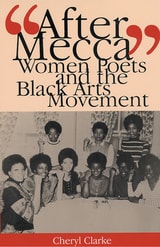
"After Mecca"
Women Poets and the Black Arts MovementClarke, Cheryl
Rutgers University Press, 2004
In "After Mecca," Cheryl Clarke explores the relationship between the Black Arts Movement and black women writers of the period. Poems by Gwendolyn Brooks, Ntozake Shange, Audre Lorde, Nikki Giovanni, Sonia Sanchez, Jayne Cortez, Alice Walker, and others chart the emergence of a new and distinct black poetry and its relationship to the black community's struggle for rights and liberation. Clarke also traces the contributions of these poets to the development of feminism and lesbian-feminism, and the legacy they left for others to build on.
She argues that whether black women poets of the time were writing from within the movement or writing against it, virtually all were responding to it. Using the trope of "Mecca," she explores the ways in which these writers were turning away from white, western society to create a new literacy of blackness.
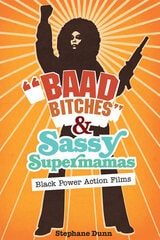
"Baad Bitches" and Sassy Supermamas
Black Power Action FilmsStephane Dunn
University of Illinois Press, 2008
Blaxploitation action narratives as well as politically radical films like Sweet Sweetback's Baadasssss Song typically portrayed black women as trifling "bitches" compared to the supermacho black male heroes. But starting in 1973, the emergence of "baad bitches" and "sassy supermamas" reversed the trend as self-assured, empowered, and tough black women took the lead in the films Cleopatra Jones, Coffy, and Foxy Brown.
Stephane Dunn unpacks the intersecting racial, sexual, and gender politics underlying the representations of racialized bodies, masculinities, and femininities in early 1970s black action films, with particular focus on the representation of black femininity. Recognizing a distinct moment in the history of African American representation in popular cinema, Dunn analyzes how it emerged from a radical political era influenced by the Black Power movement and feminism. Dunn also engages blaxploitation's legacy in contemporary hip-hop culture, as suggested by the music’s disturbing gender politics and the "baad bitch daughters" of Foxy Brown and Cleopatra Jones, rappers Foxy Brown and Lil' Kim.
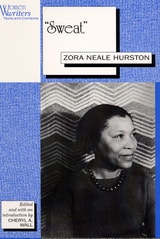
"Sweat"
Written by Zora Neale HurstonWall, Cheryl A
Rutgers University Press, 1997
Now frequently anthologized, Zora Neale Hurston's short story "Sweat" was first published in Firell, a legendary literary magazine of the Harlem Renaissance, whose sole issue appeared in November 1926. Among contributions by Gwendolyn Bennett, Countee Cullen, Langston Hughes, and Wallace Thurman, "Sweat" stood out both for its artistic accomplishment and its exploration of rural Southern black life. In "Sweat" Hurston claimed the voice that animates her mature fiction, notably the 1937 novel Their Eyes Were Watching God; the themes of marital conflict and the development of spiritual consciousness were introduced as well. "Sweat" exemplifies Hurston's lifelong concern with women's relation to language and the literary possibilities of black vernacular.
This casebook for the story includes an introduction by the editor, a chronology of the author's life, the authoritative text of "Sweat," and a second story, "The Gilded Six-Bits." Published in 1932, this second story was written after Hurston had spent years conducting fieldwork in the Southern United States. The volume also includes Hurston's groundbreaking 1934 essay, "Characteristics of Negro Expression," and excerpts from her autobiography, Dust Tracks on a Road. An article by folklorist Roger Abrahams provides additional cultural contexts for the story, as do selected blues and spirituals. Critical commentary comes from Alice Walker, who led the recovery of Hurston's work in the 1970s, Robert Hemenway, Henry Louis Gates, Gayl Jones, John Lowe, Kathryn Seidel, and Mary Helen Washington.
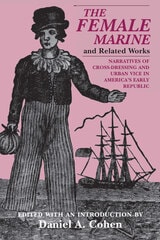
"The Female Marine" and Related Works
Narratives of Cross-Dressing and Urban Vice in America's Early RepublicDaniel A. Cohen
University of Massachusetts Press, 1997
The alternately racy and moralistic narrative recounts the adventures of a young woman from rural Massachusetts who is seduced by a false-hearted lover, flees to Boston, and is entrapped in a brothel. She eventually escapes by disguising herself as a man and serves with distinction on board the U.S. frigate Constitution during the War of 1812. After subsequent onshore adventures in and out of male dress, she is happily married to a wealthy New York gentleman.
In his introduction, Daniel A. Cohen situates the story in both its literary and historical contexts. He explains how the tale draws upon a number of popular Anglo-American literary genres, including the female warrior narrative, the sentimental novel, and the urban exposé. He then explores how The Female Marine reflects early-nineteenth-century anxieties concerning changing gender norms, the expansion of urban prostitution, the growth of Boston's African American community, and feelings of guilt aroused by New England's notoriously unpatriotic activities during the War of 1812.
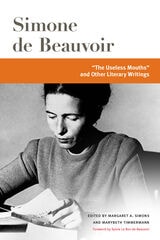
"The Useless Mouths" and Other Literary Writings
Simone de Beauvoir; Edited by Margaret A. Simons and Marybeth Timmermann; Foreword by Sylvie Le Bon de Beauvoir
University of Illinois Press, 2021
The volume begins with a new translation of the 1945 play The Useless Mouths, written in Paris during the Nazi occupation. Other pieces were discovered after Beauvoir's death in 1986, such as the 1965 short novel "Misunderstanding in Moscow," involving an elderly French couple who confront their fears of aging. Two additional previously unknown texts include the fragmentary "Notes for a Novel," which contains the seed of what she later would call "the problem of the Other," and a lecture on postwar French theater titled Existentialist Theater. The collection notably includes the eagerly awaited translation of Beauvoir's contribution to a 1965 debate among Jean-Paul Sartre and other French writers and intellectuals, "What Can Literature Do?"
Prefaces to well-known works such as Bluebeard and Other Fairy Tales,La Bâtarde, and James Joyce in Paris: His Final Years are also available in English for the first time, alongside essays and other short articles. A landmark contribution to Beauvoir studies and French literary studies, the volume includes informative and engaging introductory essays by prominent and rising scholars.
Contributors are Meryl Altman, Elizabeth Fallaize, Alison S. Fell, Sarah Gendron, Dennis A. Gilbert, Laura Hengehold, Eleanore Holveck, Terry Keefe, J. Debbie Mann, Frederick M. Morrison, Catherine Naji, Justine Sarrot, Liz Stanley, Ursula Tidd, and Veronique Zaytzeff.
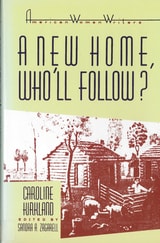
'A New Home, Who Will Follow?' by Caroline Kirkland
Zagarell, Sandra A
Rutgers University Press, 1990
A New Home is a vivid contribution to a new kind of narrative developed during the antebellum period, ethnographic fiction. Kirkland highlights the importance and the drama of local practices and everyday life in Montacute. She traces the way two groups of settlers slowly adjust to each other - the old hands and the newcomers from the East;. Dramatizing differences of class and culture, she also shows how the groups finally form a genuine community and a new, diverse culture. Kirkland also gives ethnographic fiction an original twist: she satirizes the provincialism and the rigidity of both groups of settlers.
After writing A New Home, Kirkland became a professional literary woman, working as an editor as well as a writer. In her introduction, Sandra Zagarell explores the implications of Kirkland's writing and professional career for our understanding of women, writing, and the world of literature in antebellum America.
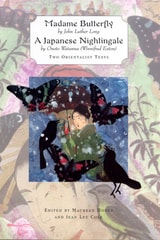
'Madame Butterfly' and 'A Japanese Nightingale'
Two Orientalist TextsCole, Jean Lee
Rutgers University Press, 2002
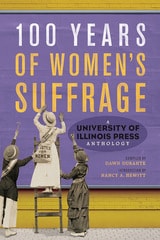
100 Years of Women's Suffrage
A University of Illinois Press AnthologyCompiled by Dawn Durante. Introduction by Nancy A. Hewitt
University of Illinois Press, 2019
A curation of important scholarship on a pivotal historical moment, 100 Years of Women’s Suffrage captures the complex and enduring struggle for fair and equal voting rights.
Contributors: Laura L. Behling, Erin Cassese, Mary Chapman, M. Margaret Conway, Carolyn Daniels, Bonnie Thornton Dill, Ellen Carol DuBois, Julie A. Gallagher, Barbara Green, Nancy A. Hewitt, Leonie Huddy, Kimberly Jensen, Mary-Kate Lizotte, Lady Constance Lytton, and Andrea G. Radke-Moss

20th-Century Italian Women Writers
The Feminine ExperienceAlba Amoia
Southern Illinois University Press, 1996
As an international scholar and resident of Italy who has observed and shared the experiences of Italian women for the past twenty years, Alba Amoia has positioned herself perfectly to report to English-speaking audiences the great range and variety of writing produced by twentieth-century Italian women. Her personal contact with many of the authors she discusses lends further immediacy to her study.
Rather than focusing exclusively on contemporary living authors, Amoia discusses writers from the early part of the twentieth century as well, linking them with later writers spanning twentieth-century Italy’s literary movements and political, social, and economic developments. Yet the connections and contradictions that bind and divide these women are only beginning to be established because Italy is still a splintered country in which perceptions of Italian women as a historical group have only begun to crystallize. While feminine voices resound on the Italian literary scene, only recently has feminine authority made itself felt in the professional and institutional worlds.
The eleven writers in this volume criticize the female role in Italian society, externalize women’s unconscious needs, and offer unusual examples of feminine creativity. Amoia provides a critical treatment of each author, incorporating the accepted opinion of Italian and other critics. She isolates recurrent and fundamental themes in each author’s literary career: linguistic repression by males, personal frustration in the realm of "householditude," and disorientation within Italy’s unbalanced institutions and hierarchies still strongly anchored in archaic structures.
Amoia begins her discussion with two illustrious predecessors of Italy’s contemporary women writers: the 1926 Nobel Prize winner Grazia Deledda and the premier literary feminist Sibilla Aleramo. Continuing in chronological order, Amoia discusses Gianna Manzini, Lalla Romano, Elsa Morante, Natalia Ginzburg, Rosetta Loy, and Dacia Maraini. Amoia concludes her exploration of Italian women writers with three journalists: Matilde Serao, Oriana Fallaci, and Camilla Cederna.
Essentially, Amoia has provided a collection of succinct and accessible monographs featuring pertinent biographical information and extensive bibliographies. She discusses each author’s most representative works, seeking to give readers both a sense of these women as writers and an understanding of their significance in the male-dominated literary scene.
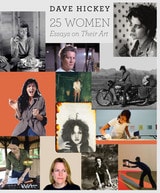
25 Women
Essays on Their ArtDave Hickey
University of Chicago Press, 2015
25 Women will not disappoint. The book collects Hickey’s best and most important writing about female artists from the past twenty years. But this is far more than a compilation: Hickey has revised each essay, bringing them up to date and drawing out common themes. Written in Hickey’s trademark style—accessible, witty, and powerfully illuminating—25 Women analyzes the work of Joan Mitchell, Bridget Riley, Fiona Rae, Lynda Benglis, Karen Carson, and many others. Hickey discusses their work as work, bringing politics and gender into the discussion only where it seems warranted by the art itself. The resulting book is not only a deep engagement with some of the most influential and innovative contemporary artists, but also a reflection on the life and role of the critic: the decisions, judgments, politics, and ethics that critics negotiate throughout their careers in the art world.
Always engaging, often controversial, and never dull, Dave Hickey is a writer who gets people excited—and talking—about art. 25 Women will thrill his many fans, and make him plenty of new ones.
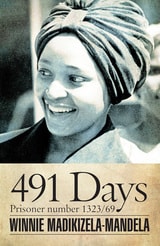
491 Days
Prisoner Number 1323/69Winnie Madikizela-Mandela
Ohio University Press, 2014
On a freezing winter’s night, a few hours before dawn on May 12, 1969, South African security police stormed the Soweto home of Winnie Madikizela-Mandela, activist and wife of the imprisoned Nelson Mandela, and arrested her in the presence of her two young daughters, then aged nine and ten.
Rounded up in a group of other antiapartheid activists under Section 6 of the Terrorism Act, designed for the security police to hold and interrogate people for as long as they wanted, she was taken away. She had no idea where they were taking her or what would happen to her children. For Winnie Mandela, this was the start of 491 days of detention and two trials.
Forty-one years after Winnie Mandela’s release on September 14, 1970, Greta Soggot, the widow of one of the defense attorneys from the 1969–70 trials, handed her a stack of papers that included a journal and notes she had written while in detention, most of the time in solitary confinement. Their reappearance brought back to Winnie vivid and horrifying memories and uncovered for the rest of us a unique and personal slice of South Africa’s history.
491 Days: Prisoner Number 1323/69 shares with the world Winnie Mandela’s moving and compelling journal along with some of the letters written between several affected parties at the time, including Winnie and Nelson Mandela, himself then a prisoner on Robben Island for nearly seven years.
Readers will gain insight into the brutality she experienced and her depths of despair, as well as her resilience and defiance under extreme pressure. This young wife and mother emerged after 491 days in detention unbowed and determined to continue the struggle for freedom.
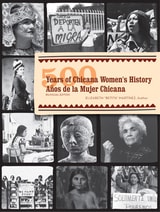
500 Years of Chicana Women's History / 500 Años de la Mujer Chicana
Bilingual EditionMartínez, Elizabeth "
Rutgers University Press, 2008
The history of Mexican Americans spans more than five centuries and varies from region to region across the United States. Yet most of our history books devote at most a chapter to Chicano history, with even less attention to the story of Chicanas.
500 Years of Chicana Women’s History offers a powerful antidote to this omission with a vivid, pictorial account of struggle and survival, resilience and achievement, discrimination and identity. The bilingual text, along with hundreds of photos and other images, ranges from female-centered stories of pre-Columbian Mexico to profiles of contemporary social justice activists, labor leaders, youth organizers, artists, and environmentalists, among others. With a distinguished, seventeen-member advisory board, the book presents a remarkable combination of scholarship and youthful appeal.
In the section on jobs held by Mexicanas under U.S. rule in the 1800s, for example, readers learn about flamboyant Doña Tules, who owned a popular gambling saloon in Santa Fe, and Eulalia Arrilla de Pérez, a respected curandera (healer) in the San Diego area. Also covered are the “repatriation” campaigns” of the Midwest during the Depression that deported both adults and children, 75 percent of whom were U.S.–born and knew nothing of Mexico. Other stories include those of the garment, laundry, and cannery worker strikes, told from the perspective of Chicanas on the ground.
From the women who fought and died in the Mexican Revolution to those marching with their young children today for immigrant rights, every story draws inspiration. Like the editor’s previous book, 500 Years of Chicano History (still in print after 30 years), this thoroughly enriching view of Chicana women’s history promises to become a classic.
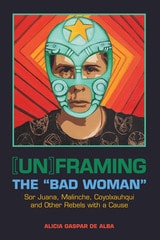
[Un]framing the "Bad Woman"
Sor Juana, Malinche, Coyolxauhqui, and Other Rebels with a CauseBy Alicia Gaspar de Alba
University of Texas Press, 2014
“What the women I write about have in common is that they are all rebels with a cause, and I see myself represented in their mirror,” asserts Alicia Gaspar de Alba. Looking back across a career in which she has written novels, poems, and scholarly works about Sor Juana Inés de la Cruz, la Malinche, Coyolxauhqui, the murdered women of Juárez, the Salem witches, and Chicana lesbian feminists, Gaspar de Alba realized that what links these historically and socially diverse figures is that they all fall into the category of “bad women,” as defined by their place, culture, and time, and all have been punished as well as remembered for rebelling against the “frames” imposed on them by capitalist patriarchal discourses.
In [Un]Framing the “Bad Woman,” Gaspar de Alba revisits and expands several of her published articles and presents three new essays to analyze how specific brown/female bodies have been framed by racial, social, cultural, sexual, national/regional, historical, and religious discourses of identity—as well as how Chicanas can be liberated from these frames. Employing interdisciplinary methodologies of activist scholarship that draw from art, literature, history, politics, popular culture, and feminist theory, she shows how the “bad women” who interest her are transgressive bodies that refuse to cooperate with patriarchal dictates about what constitutes a “good woman” and that queer/alter the male-centric and heteronormative history, politics, and consciousness of Chicano/Mexicano culture. By “unframing” these bad women and rewriting their stories within a revolutionary frame, Gaspar de Alba offers her compañeras and fellow luchadoras empowering models of struggle, resistance, and rebirth.
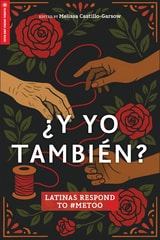
¿Y Yo También?
Latinas Respond to #MeTooMelissa Castillo-Garsow
Rutgers University Press, 2027
¿Y Yo También? brings together a diverse range of Latina voices to address the under-representation of Latinx voices in the #MeToo movement and discussions of sexual violence. Through scholarly analysis of literature, media, podcasting, film, art, and testimonio alongside memoir, poetry, a short play, and personal essays, the authors address varied Latina experiences of sexual assault and harassment. These authors grapple with these traumas alongside their intersectional contexts, including U.S. imperialism in Puerto Rico, race, sexuality, indigeneity, religion, the publication landscape, and more. Ultimately, each contribution sheds light on the lack of scholarly and media attention to the realities of Latinas and sexual assault but also chart pathways toward individual and community healing. This is a volume that is intellectually rigorous yet deeply accessible—suited for academics, college-level students, creatives, performers, practitioners, activists, and general readers alike.