Results by title
159 books match the query 'Academic writing' and 10 start with a
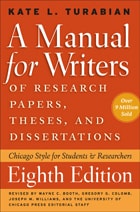
A Manual for Writers of Research Papers, Theses, and Dissertations, Eighth Edition
Chicago Style for Students and ResearchersKate L. Turabian
University of Chicago Press, 2013
A little more than seventy-five years ago, Kate L. Turabian drafted a set of guidelines to help students understand how to write, cite, and formally submit research writing. Seven editions and more than nine million copies later, the name Turabian has become synonymous with best practices in research writing and style. Her Manual for Writers continues to be the gold standard for generations of college and graduate students in virtually all academic disciplines. Now in its eighth edition, A Manual for Writers of Research Papers, Theses, and Dissertations has been fully revised to meet the needs of today’s writers and researchers.
The Manual retains its familiar three-part structure, beginning with an overview of the steps in the research and writing process, including formulating questions, reading critically, building arguments, and revising drafts. Part II provides an overview of citation practices with detailed information on the two main scholarly citation styles (notes-bibliography and author-date), an array of source types with contemporary examples, and detailed guidance on citing online resources.
The final section treats all matters of editorial style, with advice on punctuation, capitalization, spelling, abbreviations, table formatting, and the use of quotations. Style and citation recommendations have been revised throughout to reflect the sixteenth edition of The Chicago Manual of Style. With an appendix on paper format and submission that has been vetted by dissertation officials from across the country and a bibliography with the most up-to-date listing of critical resources available, A Manual for Writers remains the essential resource for students and their teachers.
[more]
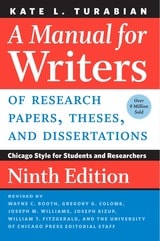
A Manual for Writers of Research Papers, Theses, and Dissertations, Ninth Edition
Chicago Style for Students and ResearchersKate L. Turabian
University of Chicago Press, 2018
When Kate L. Turabian first put her famous guidelines to paper, she could hardly have imagined the world in which today’s students would be conducting research. Yet while the ways in which we research and compose papers may have changed, the fundamentals remain the same: writers need to have a strong research question, construct an evidence-based argument, cite their sources, and structure their work in a logical way. A Manual for Writers of Research Papers, Theses, and Dissertations—also known as “Turabian”—remains one of the most popular books for writers because of its timeless focus on achieving these goals.
This new edition filters decades of expertise into modern standards. While previous editions incorporated digital forms of research and writing, this edition goes even further to build information literacy, recognizing that most students will be doing their work largely or entirely online and on screens. Chapters include updated advice on finding, evaluating, and citing a wide range of digital sources and also recognize the evolving use of software for citation management, graphics, and paper format and submission. The ninth edition is fully aligned with the recently released Chicago Manual of Style, 17th edition, as well as with the latest edition of The Craft of Research.
Teachers and users of the previous editions will recognize the familiar three-part structure. Part 1 covers every step of the research and writing process, including drafting and revising. Part 2 offers a comprehensive guide to Chicago’s two methods of source citation: notes-bibliography and author-date. Part 3 gets into matters of editorial style and the correct way to present quotations and visual material. A Manual for Writers also covers an issue familiar to writers of all levels: how to conquer the fear of tackling a major writing project.
Through eight decades and millions of copies, A Manual for Writers has helped generations shape their ideas into compelling research papers. This new edition will continue to be the gold standard for college and graduate students in virtually all academic disciplines.
- Bestselling, trusted, and time-tested advice for writing research papers
- The best interpretation of Chicago style for higher education students and researchers
- Definitive, clear, and easy to read, with plenty of examples
- Shows how to compose a strong research question, construct an evidence-based argument, cite sources, and structure work in a logical way
- Essential for anyone interested in learning about research
- Everything any student or teacher needs to know concerning paper writing
[more]
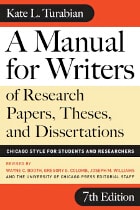
A Manual for Writers of Research Papers, Theses, and Dissertations, Seventh Edition
Chicago Style for Students and ResearchersKate L. Turabian
University of Chicago Press, 2007
Dewey. Bellow. Strauss. Friedman. The University of Chicago has been the home of some of the most important thinkers of the modern age. But perhaps no name has been spoken with more respect than Turabian. The dissertation secretary at Chicago for decades, Kate Turabian literally wrote the book on the successful completion and submission of the student paper. Her Manual for Writers of Research Papers, Theses, and Dissertations, created from her years of experience with research projects across all fields, has sold more than seven million copies since it was first published in 1937.
Now, with this seventh edition, Turabian’s Manual has undergone its most extensive revision, ensuring that it will remain the most valuable handbook for writers at every level—from first-year undergraduates, to dissertation writers apprehensively submitting final manuscripts, to senior scholars who may be old hands at research and writing but less familiar with new media citation styles. Gregory G. Colomb, Joseph M. Williams, and the late Wayne C. Booth—the gifted team behind The Craft of Research—and the University of Chicago Press Editorial Staff combined their wide-ranging expertise to remake this classic resource. They preserve Turabian’s clear and practical advice while fully embracing the new modes of research, writing, and source citation brought about by the age of the Internet.
Booth, Colomb, and Williams significantly expand the scope of previous editions by creating a guide, generous in length and tone, to the art of research and writing. Growing out of the authors’ best-selling Craft of Research, this new section provides students with an overview of every step of the research and writing process, from formulating the right questions to reading critically to building arguments and revising drafts. This leads naturally to the second part of the Manual for Writers, which offers an authoritative overview of citation practices in scholarly writing, as well as detailed information on the two main citation styles (“notes-bibliography” and “author-date”). This section has been fully revised to reflect the recommendations of the fifteenth edition of The Chicago Manual of Style and to present an expanded array of source types and updated examples, including guidance on citing electronic sources.
The final section of the book treats issues of style—the details that go into making a strong paper. Here writers will find advice on a wide range of topics, including punctuation, table formatting, and use of quotations. The appendix draws together everything writers need to know about formatting research papers, theses, and dissertations and preparing them for submission. This material has been thoroughly vetted by dissertation officials at colleges and universities across the country.
This seventh edition of Turabian’s Manual for Writers of Research Papers, Theses, and Dissertations is a classic reference revised for a new age. It is tailored to a new generation of writers using tools its original author could not have imagined—while retaining the clarity and authority that generations of scholars have come to associate with the name Turabian.
[more]
A Manual for Writers of Term Papers, Theses, and Dissertations
Kate L. Turabian evised by John Grossman and Alice Bennett
University of Chicago Press, 1996
For close to sixty years Kate L. Turabian's Manual for Writers has offered comprehensive and detailed guidance to authors of research papers—term papers, theses, and dissertations. Now the editors of The Chicago Manual of Style have revised Turabian's Manual to bring the details of style into conformity with the fourteenth edition of The Chicago Manual. This new edition of Turabian also reflects the way students work today, taking into account the role of personal computers in the preparation and presentation of their papers.
The familiar organization of this popular book remains largely unchanged. Chapter 1 describes the parts of a long formal paper. Chapters 2-5 introduce the mechanics of writing style, from abbreviations to quotations. Chapters 6 and 7 show how to prepare and refer to tables and illustrations. The section on documentation, chapters 8-12, describes two of the most commonly used systems of citation; these chapters provide many examples including guidance on how to cite electronic documents. Chapter 13, on manuscript preparation, shows how to take advantage of word processing software to present the elements of a paper clearly and effectively. Chapter 14 offers more than two dozen sample pages illustrating ways of formatting some of the complex features found in many research papers.
Authoritative, comprehensive, easy to use, and filled with good sense, this new edition will be the standard for yet another generation of students and their teachers.
Kate Turabian (1893-1987) was dissertation secretary at the University of Chicago from 1930 to 1958. This manual and her Student's Guide for Writing College Papers made her name so well known that she has become "part of the folklore of American higher education" (Quill and Scroll).
[more]
A Writer's Guide to Mindful Reading
Ellen C. Carillo
University Press of Colorado, 2017
A Writer's Guide to Mindful Reading develops and enacts the mindful reading pedagogy described in Ellen C. Carillo's scholarly monograph Securing a Place for Reading in Composition: The Importance of Teaching for Transfer (Utah State UP). Offering a comprehensive approach to literacy instruction by focusing on reading and writing, A Writer's Guide to Mindful Reading supports students as they become more reflective, deliberate, and mindful readers and writers by working within a metacognitive framework. The reading selections, assignments, and activities in this innovative textbook move students toward this goal by providing opportunities to apply and reflect on multiple ways of reading and writing, positioning students to develop a metacognitive awareness crucial to transferring what they learn about reading and writing to other courses and contexts. Because many of the difficulties that students encounter when writing are related to the difficulties posed by reading complex texts, A Writer's Guide to Mindful Reading gives instructors the tools to help students develop a repertoire of reading strategies that will help them become stronger readers and—by extension—stronger writers.
[more]
Academic Writing for Graduate Students, 3rd Edition
Essential Tasks and SkillsJohn M. Swales & Christine B. Feak
University of Michigan Press, 2012
Like its predecessor, the third edition of Academic Writing for Graduate Students explains understanding the intended audience, the purpose of the paper, and academic genres; includes the use of task-based methodology, analytic group discussion, and genre consciousness-raising; shows how to write summaries and critiques; features Language Focus sections that address linguistic elements as they affect the wider rhetorical objectives; and helps students position themselves as junior scholars in their academic communities.
Among the many changes in the third edition:
*newer, longer, and more authentic texts and examples
*greater discipline variety in texts (added texts from hard sciences and engineering)
*more in-depth treatment of research articles
*greater emphasis on vocabulary issues
*revised flow-of-ideas section
*additional tasks that require students to do their own research
*more corpus-informed content
*binding that allows the book to lay flat when open.
The Commentary (teacher's notes and key) (978-0-472-03506-9) has been revised expanded.
[more]
Academic and Professional Writing in an Age of Accountability
Edited by Shirley Wilson Logan and Wayne H. Slater, with an Afterword by Jessica Enoch and Scott Wible
Southern Illinois University Press, 2018
What current theoretical frameworks inform academic and professional writing? What does research tell us about the effectiveness of academic and professional writing programs? What do we know about existing best practices? What are the current guidelines and procedures in evaluating a program’s effectiveness? What are the possibilities in regard to future research and changes to best practices in these programs in an age of accountability? Editors Shirley Wilson Logan and Wayne H. Slater bring together leading scholars in rhetoric and composition to consider the history, trends, and future of academic and professional writing in higher education through the lens of these five central questions.
The first two essays in the book provide a history of the academic and professional writing program at the University of Maryland. Subsequent essays explore successes and challenges in the establishment and development of writing programs at four other major institutions, identify the features of language that facilitate academic and professional communication, look at the ways digital practices in academic and professional writing have shaped how writers compose and respond to texts, and examine the role of assessment in curriculum and pedagogy. An afterword by distinguished rhetoric and composition scholars Jessica Enoch and Scott Wible offers perspectives on the future of academic and professional writing.
This collection takes stock of the historical, rhetorical, linguistic, digital, and evaluative aspects of the teaching of writing in higher education. Among the critical issues addressed are how university writing programs were first established and what early challenges they faced, where writing programs were housed and who administered them, how the language backgrounds of composition students inform the way writing is taught, the ways in which current writing technologies create new digital environments, and how student learning and programmatic outcomes should be assessed.
[more]
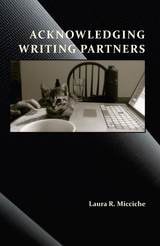
Acknowledging Writing Partners
Laura Micciche
University Press of Colorado, 2017
Acknowledging Writing Partners treats the genre of written acknowledgements as a lens for viewing writing as a practice of indebted partnerships. Like new media scholars who have argued that studying ubiquitous technologies such as the pencil reveals the mundane and profound ways in which writing is always mediated by tools, Laura R. Micciche argues that writing activities are frequently mediated by human and non-human others, advancing a view of composing that accounts for partners who emerge in acknowledgements: feelings, animals, and random material phenomena. Acknowledgements are micro economies of debt and praise; they reveal writing's connectedness, often repressed by the argument or set of propositions that follow. Micciche suggests new methods for studying and theorizing writing that take into account the whole surround of writing. In doing so, Micciche asks what difference this economy makes to dominant conceptions of writers and writing as well as to pedagogical principles that inform writing instruction—and what difference it make to writers.
[more]
Adapting VALUEs
Tracing the Life of a Rubric through Institutional EthnographyJennifer Grouling
University Press of Colorado, 2023
Adapting VALUEs traces the use of the American Association of Colleges and Universities' VALUE rubric for written communication at two small universities. Through the lens of institutional ethnography, Jennifer Grouling examines how faculty and administrators adapted the rubric for their own purposes and writing programs. Throughout the book, Grouling explores the ways in which faculty members' interactions on committees, views of the classroom, disciplinary affiliation, and racial privilege impacted their views of this national rubric. Overall, Adapting VALUEs offers valuable insights into the power of the rubric as both a national and a local text that dictates pedagogical and administrative practice.
[more]
Alien Forms and Minor Genres
A Speculative Handbook of Academic LaborTina Chen
Duke University Press, 2026
Alien Forms and Minor Genres speculates about how and why academia cultivates, manages, and rewards academic labor. Examining these issues within the context of the multidisciplinary field of Global Asias, Tina Chen tracks the diverse trajectories of research creation to delineate capaciously-imagined forms of scholarly labor and demonstrate their constructed value. She uses an experimental structure, setting examples of intellectual work in academia such as the book proposal, the lesson plan, and the syllabi against more in-depth genre criticism of research and service activities. By giving readers a look behind the curtain at these routine parts of academia and exploring the potential for alternative genres in intellectual inquiry, Chen reconceptualizes the nature, function, and praxis of scholarly work, showing how processes of academic labor are critical to creating and advancing scholarly knowledge.
[more]