Results by title
131 books match the query 'Baseball' and 6 start with a
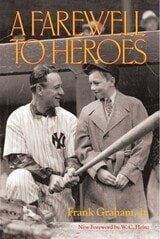
A Farewell to Heroes
Frank Graham Jr. Foreword by W.C. Heinz
Southern Illinois University Press, 2003
Originally published in 1981 and long out of print, this dual autobiography covers five unforgettable decades of the New York sporting life from 1915 to 1965. Told initially from the point of view of Frank Graham, premier sportswriter for TheNew York Sun, A Farewell to Heroes also includes the chronicles of Frank, Jr., who picks up the narrative as he becomes a sports journalist in his own right.
Frank Graham, Sr., was a self-taught writer known for his uncanny ability to capture the high drama of a game-winning play or the color of a fight mob’s conversation in spare, straightforward prose. As a reporter, he covered the rough-and-tumble Giants of John McGraw’s day and continued through boxing’s greatest era, spanning the reigns of Jack Dempsey and Joe Louis.
As the younger Frank tells more of the story, we watch Lou Gehrig take Babe Ruth’s place as the Yankees’ star and then trace his glorious career to its tragic conclusion. We see firsthand the legendary Branch Rickey and Jackie Robinson and boxing’s brief but golden age on television in the 1950s.
Aided by sixteen photographs and preserving the most masterful of his father’s writing while adding to it the best of his own, Frank Graham, Jr., has given the sports fan A Farewell to Heroes, perhaps the ultimate sports reminiscence of a time when the romance of sport gave life a golden hue, when heroes still roamed the earth.
“In what he calls this ‘kind of dual autobiography,’ he is his father’s son, having learned to look and listen as his father did and still go his own way,” says W. C. Heinz, longtime sportswriter for The New York Sun, in his new foreword to this paperback edition.
A History of Badger Baseball
The Rise and Fall of America's Pastime at the University of WisconsinSteven D. Schmitt
University of Wisconsin Press, 2017
There is painful history here, too. African Americans played on Wisconsin's first Big Ten championship team in 1902, including team captain Julian Ware, but there were none on the team between 1904 and 1960. Heartbreaking to many fans was the 1991 decision to discontinue baseball as a varsity sport at the university. Today, Wisconsin is the only member of the Big Ten conference without a men's baseball team.
Appendixes provide details of team records and coaches, All Big Ten and All American selections, Badgers in the major leagues, and Badgers in the amateur free-agent draft.
A People's History of Baseball
Mitchell Nathanson
University of Illinois Press, 2012
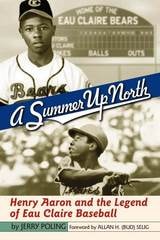
A Summer Up North
Henry Aaron and the Legend of Eau Claire BaseballJerry Poling
University of Wisconsin Press, 2002
June 12, 1952—only a local sportswriter showed up at the Eau Claire airport to greet a newly signed eighteen-year-old shortstop from Alabama toting a cardboard suitcase. "I was scared as hell," said Henry Aaron, recalling his arrival as the new recruit on the city’s Class C minor league baseball team.
Forty-two years later, as Aaron approached the stadium where the Eau Claire Bears once played, an estimated five thousand people surrounded a newly raised bronze statue of a young "Hank" Aaron at bat. "I had goosebumps," he said later. "A lot of things happened to me in my twenty-three years as a ballplayer, but nothing touched me more than that day in Eau Claire." For the people of Eau Claire, Aaron’s summer two years before his Major League debut with the Milwaukee Braves symbolizes a magical time, when baseball fans in a small city in northern Wisconsin could live a part of the dream.

As American as Mom, Baseball, and Apple Pie
Constructing Community in Contemporary American Horror FictionLinda J. Holland-Toll
University of Wisconsin Press, 2001
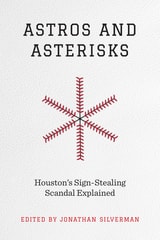
Astros and Asterisks
Houston's Sign-Stealing Scandal ExplainedEdited by Jonathan Silverman
University of Texas Press, 2023
An in-depth and multiperspectival look at the Astros’ sign-stealing scandal and its roots in the culture of baseball fandom.
In 2017 the Houston Astros won their first World Series title, a particularly uplifting victory for the city following Hurricane Harvey. But two years later, the feel-good energy was gone after The Athletic revealed that the Astros had stolen signs from opposing catchers during their championship season, perhaps even during the playoffs and World Series. Their methods were at once high-tech and crude: staff took video of opponents’ pitching signals and transmitted the footage in real time to the Astros’ dugout, where players banged on trash cans to signal to their teammates at bat which pitches were coming their way. Wry observers labeled them the Asterisks, pointing to the title that no longer seemed so earned.
Astros and Asterisks examines the scandal from historical, journalistic, legal, ethical, and cultural perspectives. Authors delve into the Astros’ winning-above-all attitude, cultivated by a former McKinsey consultant; the significance of hiring a pitcher recently suspended for domestic abuse; the career-ending effects of the Astros’ transgression on opposing players; and the ethically fraught choices necessary to participate in sign-stealing. Ultimately, it links the Astros’ choices to the sporting world’s obsession with analytics. What emerges is a sobering tale about the impact of new technology on a game whose romanticized image feels increasingly incongruous with its reality in the era of big data and video.