Results by title
81 books match the query 'Boston' and 6 start with a
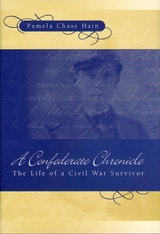
A Confederate Chronicle
The Life of a Civil War SurvivorPamela Chase Hain
University of Missouri Press, 2005
A Confederate Chronicle presents the remarkable life of Thomas L. Wragg, who served in both the Confederate army and navy and endured incarceration as a prisoner of war. After the war, he undertook a series of jobs, eventually becoming a physician. In 1889, he died tragically at the hands of a man who mistakenly thought he was defending his family’s honor. Pamela Chase Hain uses Wragg’s letters home to his family, friends, and fiancée, as well as his naval notebook and newspaper articles, to give readers direct insight into his life and the lives of those around him.
The son of a respected Savannah physician, Wragg was born into a life of wealth and privilege. A nonconscripted soldier, he left home at eighteen to join the front lines in Virginia. From there, he sent letters home describing the maneuverings of General Joseph E. Johnston’s army in and around Harpers Ferry and Winchester, culminating with the Battle of Bull Run.
In the fall of 1862, Wragg joined the Confederate Navy and trained on the ironclad CSS Georgia before transferring to the CSS Atlanta. Hain uses the notebook that he kept during his training in ordnance and gunnery to provide a rare glimpse into the naval and artillery practices at the time. This notebook also provides evidence of a fledgling Confederate naval “school” prior to the one established on the James River on the CSS Patrick Henry.
The crew of the unfortunate Atlanta was captured on the ship’s maiden voyage, and evidence in the Wragg family papers suggests the capture was not the result of bad luck, as has been claimed. Wragg and the other officers were sent to Fort Warren Prison in Boston Harbor for fifteen months. Wragg’s POW letters reveal the isolation and sense of abandonment the prisoners felt as they waited in hopes of an exchange. The correspondence between Wragg and his fiancée, Josie, after the war illustrates not only the mores of nineteenth-century courtship but also the difficulty of adjustment that many Confederate war veterans faced.
Sadly, Wragg’s life was cut short after he became a successful doctor in Quincy, Florida. Cover-up and intrigue by influential citizens prevented Wragg’s wife from bringing the murderer to justice. A Confederate Chronicle offers an unprecedented look at how the Civil War affected the gentry class of the South. It gives readers a personal view into one man’s struggle with the chaos of life during and after the war, as well as into the struggles of the general society.
[more]
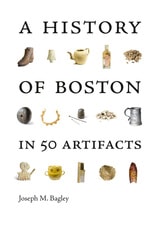
A History of Boston in 50 Artifacts
Joseph M. Bagley
University Press of New England, 2016
History is right under our feet; we just need to dig a little to find it. Though not the most popular construction project, Boston’s Big Dig has contributed more to our understanding and appreciation of the city’s archaeological history than any other recent event. Joseph M. Bagley, city archaeologist of Boston, uncovers a fascinating hodgepodge of history—from ancient fishing grounds to Jazz Age red-light districts—that will surprise and delight even longtime residents. Each artifact is shown in full color and accompanied by description of the item’s significance to its site location and the larger history of the city. From cannonballs to drinking cups and from ancient spears to chinaware, A History of Boston in 50 Artifacts offers a unique and accessible introduction to Boston’s history and physical culture while revealing the ways objects can offer a tantalizing entrée into our past. Packed with vivid descriptions and art, this lively history of Boston will appeal to all manner of readers, locals and visitors alike.
[more]
A History of Boston in 50 Artifacts
Joseph M. Bagley
Brandeis University Press, 2021
A new edition of a bestselling book looking at the history of Boston through fifty artifacts.
Joseph M. Bagley, the city archaeologist of Boston, uncovers a fascinating hodgepodge of history—from ancient fishing grounds to Jazz Age red-light districts—that will surprise and delight even longtime residents. Each artifact is shown in full color with a description of the item’s significance to its site location and Boston’s larger history. From cannonballs to drinking cups and from ancient spears to chinaware, A History of Boston in 50 Artifacts offers a unique and accessible introduction to Boston’s history and physical culture while revealing the ways objects can offer a tantalizing entrée into our past. Packed with vivid descriptions and art, this lively history of Boston will appeal to all manner of readers, locals, and visitors alike. This new edition showcases an important fact which has come to light since its first publication, that a chapter about a cat has now been shown to be a dog, thus demonstrating the perils of the archaeologist.
Joseph M. Bagley, the city archaeologist of Boston, uncovers a fascinating hodgepodge of history—from ancient fishing grounds to Jazz Age red-light districts—that will surprise and delight even longtime residents. Each artifact is shown in full color with a description of the item’s significance to its site location and Boston’s larger history. From cannonballs to drinking cups and from ancient spears to chinaware, A History of Boston in 50 Artifacts offers a unique and accessible introduction to Boston’s history and physical culture while revealing the ways objects can offer a tantalizing entrée into our past. Packed with vivid descriptions and art, this lively history of Boston will appeal to all manner of readers, locals, and visitors alike. This new edition showcases an important fact which has come to light since its first publication, that a chapter about a cat has now been shown to be a dog, thus demonstrating the perils of the archaeologist.
[more]
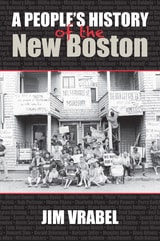
A People's History of the New Boston
Jim Vrabel
University of Massachusetts Press, 2014
Although Boston today is a vibrant and thriving city, it was anything but that in the years following World War II. By 1950 it had lost a quarter of its tax base over the previous twenty-five years, and during the 1950s it would lose residents faster than any other major city in the country.
Credit for the city's turnaround since that time is often given to a select group of people, all of them men, all of them white, and most of them well off. In fact, a large group of community activists, many of them women, people of color, and not very well off, were also responsible for creating the Boston so many enjoy today. This book provides a grassroots perspective on the tumultuous 1960s and 1970s, when residents of the city's neighborhoods engaged in an era of activism and protest unprecedented in Boston since the American Revolution.
Using interviews with many of those activists, contemporary news accounts, and historical sources, Jim Vrabel describes the demonstrations, sit-ins, picket lines, boycotts, and contentious negotiations through which residents exerted their influence on the city that was being rebuilt around them. He includes case histories of the fights against urban renewal, highway construction, and airport expansion; for civil rights, school desegregation, and welfare reform; and over Vietnam and busing. He also profiles a diverse group of activists from all over the city, including Ruth Batson, Anna DeFronzo, Moe Gillen, Mel King, Henry Lee, and Paula Oyola. Vrabel tallies the wins and losses of these neighborhood Davids as they took on the Goliaths of the time, including Boston's mayors. He shows how much of the legacy of that activism remains in Boston today.
[more]
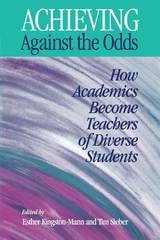
Achieving Against The Odds
edited by Esther Kingston-Mann and Tim Sieber
Temple University Press, 2001
"High school was like a penance imposed for some unknown sin. Everything I ever learned that was important was learned outside of school. So I never thought to associate schools with learning." (Amy, UMass Boston student)
Today's diverse and financially burdened students enter higher education eager to succeed at institutions originally designed for culturally homogenous and predominantly white middle-class populations. They are expected to learn from faculty trained primarily as researchers. Unsurprisingly, student dropout and faculty burnout rates are high, leading some conservatives to demand that higher education purge itself of "unqualified" students and teachers. But, as Achieving Against the Odds demonstrates, new and better solutions emerge once we assume that both faculty and students still possess a mutual potential for learning when they meet in the college classroom.
This collection -- drawing on the experiences of faculty at the University of Massachusetts-Boston -- documents a complex and challenging process of pedagogical transformation. The contributors come from a wide range of disciplines -- American studies, anthropology, Asian American studies, English, ESL, history, language, political science, psychology, sociology, and theology. Like their students, they bring a variety of backgrounds into the classroom -- as people of color, women, gays, working class people, and "foreigners" of one sort or another. Together they have engaged in an exciting struggle to devise pedagogies which respond to the needs and life experiences of their students and to draw each of them into a dialogue with the content and methodology of their disciplines. Courageously airing their own mistakes and weaknesses alongside their breakthroughs, they illuminate for the reader a process of teaching transformation by which discipline-trained scholars discover how to promote the learning of diverse students.
As one reads their essays, one is struck by how much these faculty have benefited from the insights they have gleaned from colleagues as well as students. Through argument and examples, personal revelation and references as well as students. Through argument and examples, personal revelation and references to authority, they draw the reader into their community. This is a book to inspire and enlighten everyone interested in making higher education more truly democratic, inclusive and intellectually challenging for today's students.
[more]
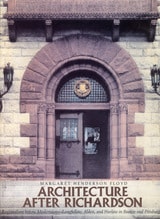
Architecture after Richardson
Regionalism before Modernism--Longfellow, Alden, and Harlow in Boston and PittsburghMargaret Henderson Floyd
University of Chicago Press, 1994
Most histories of American architecture after H. H. Richardson have emphasized the work of Louis Sullivan and Frank Lloyd Wright in the Middle West. By examining instead the legacy of three highly successful architects who were in practice simultaneously in New England and Western Pennsylvania from 1886 into the 1920s, Margaret Henderson Floyd underscores the architectural significance of another part of the nation.
Floyd critically' assesses the careers, works, and patronage of Alexander Wadsworth Longfellow, Frank Ellis Alden, and Alfred Branch Harlow. Longfellow and Alden were senior draftsmen in H. H. Richardson's office, and Harlow worked with McKim, Mead & White in New York, Newport, and Boston. After Richardson's death, the three set up their own practice with offices in Boston and Pittsburgh, and these offices eventually became two separate practices. Over the years, their commissions included scores of city and country residences for the elite of both regions as well as major institutional and business buildings such as those at Harvard and Radcliffe, the Cambridge City Hall, and Pittsburgh's Duquesne Club and Carnegie Institute.
Placing these architects in a broader context of American architectural and landscape history, Floyd uncovers a strong cultural affinity between turn-of-the-century Boston and Pittsburgh. She also reveals an unsuspected link between the path of modernism from Richardson to Wright and the evolution of anti-modern imagery manifested in regionalism. Floyd thus combines her analysis of the work of Longfellow, Alden, and Harlow with a critique of mid-twentieth-century historiography to expose connections between New England regionalism, the arts and crafts movement, and such innovators as Frank Lloyd Wright and Buckminster Fuller.
[more]