Results by title
86 books match the query 'Chile' and 6 start with a

A Queer Mother For The Nation
The State And Gabriela MistralLicia Fiol-Matta
University of Minnesota Press, 2002
Chilean writer Gabriela Mistral (1889-1957), the first Latin American to win theNobel Prize for Literature, was a poetic idol for generations of Latin Americans who viewed her as Womanhood incarnate, the national schoolteacher-mother. How this distinctly masculine woman who never gave birth came to occupy this role, and what Mistral’s image, poetry, and life have to say about the relations-and realities-of race, gender, and sexual politics in her time, are the questions Licia Fiol-Matta pursues in this book, recreating the story of a woman whose misrepresentation is at least as intriguing, and as instructive, as her fame.
A Queer Mother for the Nation weaves a nuanced understanding of how Mistral cooperated with authority and fashioned herself as the figure of Motherhood in collaboration with the state. Drawing on Mistral’s little-known political and social essays, her correspondence and photographs, Fiol-Matta reconstructs Mistral’s relationship to state politics. Her work questions the notion of queer bodies as outlaws, and insists on the many ways in which queer subjects have participated in and sustained the normative discourses they seem to rebel against
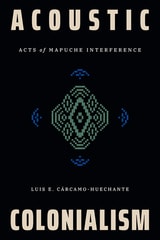
Acoustic Colonialism
Acts of Mapuche InterferenceLuis E. Cárcamo-Huechante
Duke University Press, 2025
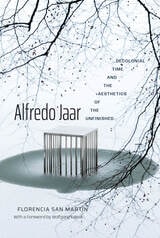
Alfredo Jaar
Decolonial Time and the Aesthetics of the UnfinishedFlorencia San Martin. With a Foreword by Wolfgang Kaleck.
Duke University Press, 2026
In Alfredo Jaar, Florencia San Martín analyzes the work of the prominent Chilean-born artist Alfredo Jaar, whose work challenges the linear and triumphalist temporality of Western modernity that obscures the violence of colonization and globalization. San Martín argues that Jaar’s work represents decolonial time, exposing the limits of the violent systems we inhabit. His art, she maintains, is informed by and responds to two interconnected historical events relevant to his own life: the US-backed military coup that established Pinochet’s dictatorship in Chile and the implementation around the world of the corollary neoliberal economic system. San Martín explores the key themes in Jaar’s artistic practice—mourning, accountability, and failure—which situates the victims of the Chilean regime in a global context, directly confronts the architects of atrocity, and questions how ideas of diversity and inclusion have been co-opted by modern neoliberal discourses. Alfredo Jaar enables us to reimagine art history, offering a fresh paradigm with which to think about global contemporary art.
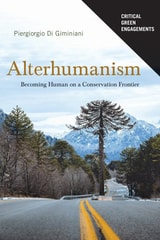
Alterhumanism
Becoming Human on a Conservation FrontierPiergiorgio Di Giminiani
University of Arizona Press, 2025

Art Against Dictatorship
Making and Exporting Arpilleras Under PinochetBy Jacqueline Adams
University of Texas Press, 2013
Art can be a powerful avenue of resistance to oppressive governments. During the dictatorship of Augusto Pinochet in Chile, some of the country’s least powerful citizens—impoverished women living in Santiago’s shantytowns—spotlighted the government’s failings and use of violence by creating and selling arpilleras, appliquéd pictures in cloth that portrayed the unemployment, poverty, and repression that they endured, their work to make ends meet, and their varied forms of protest. Smuggled out of Chile by human rights organizations, the arpilleras raised international awareness of the Pinochet regime’s abuses while providing income for the arpillera makers and creating a network of solidarity between the people of Chile and sympathizers throughout the world.
Using the Chilean arpilleras as a case study, this book explores how dissident art can be produced under dictatorship, when freedom of expression is absent and repression rife, and the consequences of its production for the resistance and for the artists. Taking a sociological approach based on interviews, participant observation, archival research, and analysis of a visual database, Jacqueline Adams examines the emergence of the arpilleras and then traces their journey from the workshops and homes in which they were made, to the human rights organizations that exported them, and on to sellers and buyers abroad, as well as in Chile. She then presents the perspectives of the arpillera makers and human rights organization staff, who discuss how the arpilleras strengthened the resistance and empowered the women who made them.
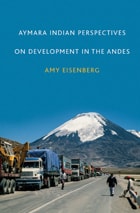
Aymara Indian Perspectives on Development in the Andes
Amy Eisenberg
University of Alabama Press, 2013
Aymara Indians are a geographically isolated, indigenous people living in the Andes Mountains near Chile’s Atacama Desert, one of the most arid regions of the world. As rapid economic growth in the area has begun to divert scarce water to hydroelectric and agricultural projects, the Aymara struggle to maintain their sustainable and traditional systems of water use, agriculture, and pastoralism.
In Aymara Indian Perspectives on Development in the Andes, Amy Eisenberg provides a detailed exploration of the ethnoecological dimensions of the tension between the Aymara, whose economic, spiritual, and social life are inextricably tied to land and water, and three major challenges: the paving of Chile Highway 11, the diversion of the Altiplano waters of the Río Lauca for irrigation and power-generation, and Chilean national park policies regarding Aymara communities, their natural resources, and cultural properties within Parque Nacional Lauca, the International Biosphere Reserve.
Pursuing collaborative research, Eisenberg performed ethnographic interviews with Aymara people in more than sixteen Andean villages, some at altitudes of 4,600 meters. Drawing upon botany, agriculture, natural history, physical and cultural geography, history, archaeology, and social and environmental impact assessment, she presents deep, multifaceted insights from the Aymara’s point of view.
Illustrated with maps and dramatic photographs by John Amato, Aymara Indian Perspectives on Development in the Andes provides an account of indigenous perspectives and concerns related to economic development that will be invaluable to scholars and policy-makers in the fields of natural and cultural resource preservation in and beyond Chile.