Results by title
145 books match the query 'Classical' and 9 start with a
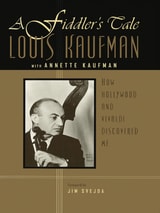
A Fiddler's Tale
How Hollywood and Vivaldi Discovered MeLouis Kaufman with Annette Kaufman; Foreword by Jim Svejda
University of Wisconsin Press, 2003
Once called by the New York Times "a violinist's violinist and a musician's musician," Louis Kaufman was born in 1905 in Portland, Oregon. He studied violin with Franz Kneisl at New York's Institute of Musical Art. He was the original violist of the Musical Art Quartet (1926-1933) and won the Naumburg Award in 1928, the year of his American solo recital debut in New York's Town Hall.
During these early years, he played chamber music with Pablo Casals, Mischa Elman, Jascha Heifetz, Fritz Kreisler, Gregor Piatigorsky, and Efrem Zimbalist, among others. After performing the violin solos for Ernst Lubitsch's 1934 film The Merry Widow, Kaufman became the most sought after violin soloist in Hollywood, playing in some 500 films, including Casablanca, Gone with the Wind, The Diary of Anne Frank, Wuthering Heights, The Grapes of Wrath, and Spartacus. He worked closely with Robert Russell Bennett, Bernard Herrmann, Erich Wolfgang Korngold, Alfred Newman, Miklós Rózsa, Max Steiner, Franz Waxman, and Victor Young.
Extraordinary as it seems today, Kaufman was largely responsible for bringing the once-forgotten music of Antonio Vivaldi to its current popularity worldwide among both classical musicians and the general population of music lovers.
The book includes a music CD with Kaufman’s performances of Vivaldi’s Concerto 2 of op. 9, Havanaise by Camille Saint Saëns, Nocturne for Violin and Piano by Aaron Copland, Much Ado about Nothing Suite for violin and piano by Erich Wolfgang Korngold, and Smoke Gets in Your Eyes by Jerome Kern, among other favorites.
A Florentine Chansonnier from the Time of Lorenzo the Magnificent
Edited by Howard M. Brown
University of Chicago Press, 1983
A New-World Collection of Polyphony for Holy Week and the Salve Service
Guatemala City, Cathedral Archive, Music MS 4Edited by Robert J. Snow
University of Chicago Press, 1996
Shortly after 1600, the organist and choir director of the cathedral collected, organized, and copied into choirbooks all of the then-extant music used by the choir. The manuscript presented here in modern edition, one of at least five choirbooks prepared at the time, contains a number of otherwise unknown works by such major Old World composers as Francisco Guerrero and Cristóbal de Morales. Significant works by Hernando Franco and Pedro Bermúdez, choirmasters of the Guatemala City Cathedral, are also included. The manuscript presents a unified repertory for Holy Week and for the Salve services in Lent, including four settings of the Passion, for which the Spanish were famous throughout Christendom. Some of the works predate the sixteenth-century reform of the Roman Breviary and Missal, among them the original versions of several Vespers hymns and Magnificat settings by Guerrero that are otherwise known only in later versions found in Spanish sources. An extensive historical introduction by Robert J. Snow discusses the formation of the cathedral's musical repertory and illuminates both Old and New World practices of sixteenth-century Spanish liturgical music.
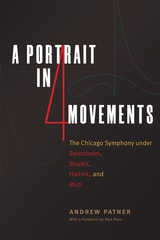
A Portrait in Four Movements
The Chicago Symphony under Barenboim, Boulez, Haitink, and MutiAndrew Patner
University of Chicago Press, 2019
The Chicago Symphony Orchestra has been led by a storied group of conductors. And from 1994 to 2015, through the best work of Daniel Barenboim, Pierre Boulez, Bernard Haitink, and Riccardo Muti, Andrew Patner was right there. As a classical music critic for the Chicago Sun-Times and WFMT radio, Patner was able to trace the arc of the CSO’s changing repertories, all while cultivating a deep rapport with its four principal conductors.
This book assembles Patner’s reviews of the concerts given by the CSO during this time, as well as transcripts of his remarkable radio interviews with these colossal figures. These pages hold tidbits for the curious, such as Patner’s “driving survey” that playfully ranks the Maestri he knew on a scale of “total comfort” to “fright level five,” and the observation that Muti appears to be a southpaw on the baseball field. Moving easily between registers, they also open revealing windows onto the sometimes difficult pasts that brought these conductors to music in the first place, including Boulez’s and Haitink’s heartbreaking experiences of Nazi occupation in their native countries as children. Throughout, these reviews and interviews are threaded together with insights about the power of music and the techniques behind it—from the conductors’ varied approaches to research, preparing scores, and interacting with other musicians, to how the sound and personality of the orchestra evolved over time, to the ways that we can all learn to listen better and hear more in the music we love. Featuring a foreword by fellow critic Alex Ross on the ethos and humor that informed Patner’s writing, as well as an introduction and extensive historical commentary by musicologist Douglas W. Shadle, this book offers a rich portrait of the musical life of Chicago through the eyes and ears of one of its most beloved critics.
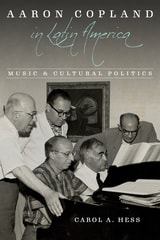
Aaron Copland in Latin America
Music and Cultural PoliticsCarol A. Hess
University of Illinois Press, 2023

Aaron Jay Kernis
Leta E. Miller
University of Illinois Press, 2014
The first full-length biography of the Pulitzer Prize-winning composer
Winner of both the Pulitzer Prize and the Grawemeyer Award, Aaron Jay Kernis achieved recognition as one of the leading composers of his generation while still in his thirties. Since then his eloquent yet accessible style, emphasis on melody, and willingness to engage popular as well as classical forms has brought him widespread acclaim and admiring audiences.
Leta Miller's biography offers the first survey of the composer's life and work. Immersed in music by middle school, and later training under Theodore Antoniou, John Adams, Jacob Druckman, and others, Kernis rejected the idea of distancing his work from worldly concerns and composed on political themes. His Second Symphony, from 1991, engaged with the first Gulf War; 1993's Still Moment with Hymn was a reaction to the Bosnian Genocide; and the next year's Colored Field and 1995's Lament and Prayer dealt with the Holocaust. Yet Kernis also used sources as disparate as futurist agitprop and children's games to display humor in his work. Miller's analysis addresses not only Kernis's wide range of subjects but also the eclecticism that has baffled critics, analyzing his dedication to synthesis and the themes consistent in his work. Informed and engaging, Aaron Jay Kernis gives a rare mid-career portrait of a major American cultural figure.
About Bach
Edited by Gregory Butler, George Stauffer, and Mary Dalton Greer
University of Illinois Press, 2007
Contributors are Gregory G. Butler, Jen-Yen Chen, Alexander J. Fisher, Mary Dalton Greer, Robert Hill, Ton Koopman, Daniel R. Melamed, Michael Ochs, Mark Risinger, William H. Scheide, Hans-Joachim Schulze, Douglass Seaton, George B. Stauffer, Andrew Talle, and Kathryn Welter.
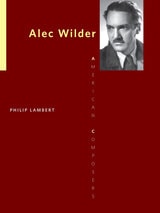
Alec Wilder
Philip Lambert
University of Illinois Press, 2013
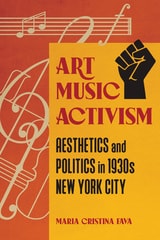
Art Music Activism
Aesthetics and Politics in 1930s New York CityMaria Cristina Fava
University of Illinois Press, 2024
Maria Cristina Fava explores the rich creative milieu shaped by artists dedicated to using music and theater to advance the promotion, circulation, and acceptance of leftist ideas in 1930s New York City. Despite tensions between aesthetic and pragmatic goals, the people and groups produced works at the center of the decade’s sociopolitical and cultural life. Fava looks at the Composers’ Collective of New York and its work on proletarian music and workers’ songs before turning to the blend of experimentation and vernacular idioms that shaped the political use of music within the American Worker’s Theater Movement. Fava then reveals how composers and theater practitioners from these two groups achieved prominence within endeavors promoted by the Works Project Administration.
Fava’s history teases out fascinating details from performances and offstage activity attached to works by composers such as Marc Blitzstein, Charles Seeger, Ruth Crawford Seeger, Elie Siegmeister, and Harold Rome. Endeavors encouraged avant-garde experimentation while nurturing innovations friendly to modernist approaches and an interest in non-western music. Blitzstein’s The Cradle Will Rock offered a memorable example that found popular success, but while the piece achieved its goals, it became so wrapped up in myths surrounding workers’ theater that critics overlooked Blitzstein’s musical ingenuity.
Provocative and original, Art Music Activism considers how innovative classical composers of the 1930s balanced creative aims with experimentation, accessible content, and a sociopolitical message to create socially meaningful works.