110 books match the query 'Education (Higher)' and 8 start with a
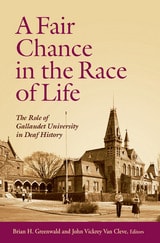
cover of A Fair Chance in the Race of Life: The Role of Gallaudet University in Deaf History

A Fair Chance in the Race of Life

The Role of Gallaudet University in Deaf History

Brian H. Greenwald

Gallaudet University Press, 2008

Despite its prominence as a world cultural center and a locus of research on deaf culture, history, education, and language for more than 150 years, Gallaudet University has only infrequently been the focal point of historical study. Eminent historians Brian H. Greenwald and John Vickrey Van Cleve have remedied this scarcity with A Fair Chance in the Race of Life: The Role of Gallaudet University in Deaf History. In this collection, a remarkable cast of scholars examine the university and its various roles through time, many conducting new research in the Gallaudet University Archives, an unsurpassed repository of primary sources of deaf history.

Pulitzer-Prize-winning historian James M. McPherson sets the stage in his essay “A Fair Chance in the Race of Life,” President Abraham Lincoln’s statement when he chartered the first college for deaf students. The papers that follow scrutinize Gallaudet’s long domination by hearing presidents, its struggle to find a place within higher education, its easy acquiescence to racism, its relationship with the federal government, and its role in creating, shaping, and nurturing the deaf community.

These studies do more than simply illuminate the university, however. They also confront broad issues that deal with the struggles of social conformity versus cultural distinctiveness, minority cohesiveness, and gender discrimination. “Deaf” themes, such as the role of English in deaf education, audism, and the paternalism of hearing educators receive analysis as well.

[more]
cover of A History of Southland College: The Society of Friends and Black Education in Arkansas

A History of Southland College

The Society of Friends and Black Education in Arkansas

Thomas Kennedy

University of Arkansas Press, 2009
In 1864 Alida and Calvin Clark, two abolitionist members of the Religious Society of Friends from Indiana, went on a mission trip to Helena, Arkansas. The Clarks had come to render temporary relief to displaced war orphans but instead found a lifelong calling. During their time in Arkansas, they started the school that became Southland College, which was the first institution of higher education for blacks west of the Mississippi, and they set up the first predominately black monthly meeting of the Religious Society of Friends in North America. Their progressive racial vision was continued by a succession of midwestern Quakers willing to endure the primitive conditions and social isolation of their work and to overcome the persistent challenges of economic adversity, social strife, and natural disaster. Southland’s survival through six difficult and sometimes dangerous decades reflects both the continuing missionary zeal of the Clarks and their successors as well as the dedication of the black Arkansans who sought dignity and hope at a time when these were rare commodities for African Americans in Arkansas.
[more]
cover of Academic Ableism: Disability and Higher Education

Academic Ableism

Disability and Higher Education

Jay Timothy Dolmage

University of Michigan Press, 2017
Academic Ableism brings together disability studies and institutional critique to recognize the ways that disability is composed in and by higher education, and rewrites the spaces, times, and economies of disability in higher education to place disability front and center. For too long, argues Jay Timothy Dolmage, disability has been constructed as the antithesis of higher education, often positioned as a distraction, a drain, a problem to be solved. The ethic of higher education encourages students and teachers alike to accentuate ability, valorize perfection, and stigmatize anything that hints at intellectual, mental, or physical weakness, even as we gesture toward the value of diversity and innovation. Examining everything from campus accommodation processes, to architecture, to popular films about college life, Dolmage argues that disability is central to higher education, and that building more inclusive schools allows better education for all.
[more]
cover of Academic Ableism: Disability and Higher Education

Academic Ableism

Disability and Higher Education

Jay Timothy Dolmage

University of Michigan Press, 2017
Academic Ableism brings together disability studies and institutional critique to recognize the ways that disability is composed in and by higher education, and rewrites the spaces, times, and economies of disability in higher education to place disability front and center. For too long, argues Jay Timothy Dolmage, disability has been constructed as the antithesis of higher education, often positioned as a distraction, a drain, a problem to be solved. The ethic of higher education encourages students and teachers alike to accentuate ability, valorize perfection, and stigmatize anything that hints at intellectual, mental, or physical weakness, even as we gesture toward the value of diversity and innovation. Examining everything from campus accommodation processes, to architecture, to popular films about college life, Dolmage argues that disability is central to higher education, and that building more inclusive schools allows better education for all.
[more]
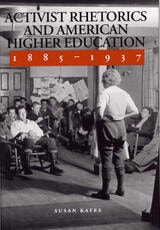
cover of Activist Rhetorics and American Higher Education, 1885-1937

Activist Rhetorics and American Higher Education, 1885-1937

Susan Kates

Southern Illinois University Press, 2000

In this study of the history of rhetoric education, Susan Kates focuses on the writing and speaking instruction developed at three academic institutions founded to serve three groups of students most often excluded from traditional institutions of higher education in late-nineteenth-and early-twentieth-century America: white middle-class women, African Americans, and members of the working class.

Kates provides a detailed look at the work of those students and teachers ostracized from rhetorical study at traditional colleges and universities. She explores the pedagogies of educators Mary Augusta Jordan of Smith College in Northhampton, Massachusetts; Hallie Quinn Brown of Wilberforce University in Wilberforce, Ohio; and Josephine Colby, Helen Norton, and Louise Budenz of Brookwood Labor College in Katonah, New York.

These teachers sought to enact forms of writing and speaking instruction incorporating social and political concerns in the very essence of their pedagogies. They designed rhetoric courses characterized by three important pedagogical features: a profound respect for and awareness of the relationship between language and identity and a desire to integrate this awareness into the curriculum; politicized writing and speaking assignments designed to help students interrogate their marginalized standing within the larger culture in terms of their gender, race, or social class; and an emphasis on service and social responsibility.
[more]
cover of Affirmative Action and the University: A Philosophical Inquiry

Affirmative Action and the University

A Philosophical Inquiry

edited by Steven M. Cahn

Temple University Press, 1995

"This book is recommended for anyone interested in understanding, questioning, articulating, and acting on the basis of their own and others' perspectives on sexism, racism, and affirmative action in American higher education." --Choice While equal opportunity for all candidates is widely recognized as a goal within academia, the implementation of specific procedures to achieve equality has resulted in vehement disputes regarding both the means and ends. To encourage a reexamination of this issue, Cahn asked three prominent American social philosophers--Leslie Pickering Francis, Robert L. Simon, and Lawrence C. Becker--who hold divergent views about affirmative action, to write extended essays presenting their views. Twenty-two other philosophers then respond to these three principal essays. While no consensus is reached, the resulting clash of reasoned judgments will serve to revitalize the issues raised by affirmative action. Contents Introduction - Steven M. Cahn Part I 1. In Defense of Affirmative Action - Leslie Pickering Francis 2. Affirmative Action and the University: Faculty Appointment and Preferential Treatment - Robert L. Simon 3. Affirmative Action and Faculty Appointments - Lawrence C. Becker Part II 4. What Good Am I? - Laurence Thomas 5. Who "Counts" on Campus? - Ann Hartle 6. Reflections on Affirmative Action in Academia - Robert G. Turnbull 7. The Injustice of Strong Affirmative Action - John Kekes 8. Preferential Treatment Versus Purported Meritocratic Rights - Richard J. Arneson 9. Faculties as Civil Societies: A Misleading Model for Affirmative Action - Jeffrie G. Murphy 10. Facing Facts and Responsibilities - The White Man's Burden and the Burden of Proof - Karen Hanson 11. Affirmative Action: Relevant Knowledge and Relevant Ignorance - Joel J. Kupperman 12. Remarks on Affirmative Action - Andrew Oldenquist 13. Affirmative Action and the Multicultural Ideal - Philip L. Quinn 14. "Affirmative Action" in the Cultural Wars - Frederick A. Olafson 15. Quotas by Any Name: Some Problems of Affirmative Action in Faculty Appointments - Tom L. Beauchamp 16. Are Quotas Sometimes Justified? - James Rachels 17. Proportional Representation of Women and Minorities - Celia Wolf-Devine 18. An Ecological Concept of Diversity - La Verne Shelton 19. Careers Open to Talent - Ellen Frankel Paul 20. Some Sceptical Doubts - Alasdair MacIntyre 21. Affirmative Action and Tenure Decisions - Richard T. De George 22. Affirmative Action and the Awarding of Tenure - Peter J. Markie 23. The Case for Preferential Treatment - James P. Sterba 24. Saying What We Think - Fred Sommers 25. Comments on Compromise and Affirmative Action - Alan H. Goldman About the Authors Index About the Author(s) Steven M. Cahn is Professor of Philosophy and former Provost and Vice President for Academic Affairs at the Graduate Center of the City University of New York. He has published numerous other books, including Morality, Responsibility, and the University (Temple). Contributors: Laurence Thomas, Ann Hartle, Robert G. Turnbull, John Kekes, Richard J. Arneson, Jeffrie G. Murphy, Karen Hanson, Joel J. Kupperman, Andrew Oldenquist, Philip L. Quinn, Frederick A. Olafson, Tom L. Beauchamp, James Rachels, Celia Wolf-Devine, La Verne Shelton, Ellen Frankel Paul, Alasdair MacIntyre, Richard T. De George, Peter J. Markie, James P. Sterba, Fred Sommers, Alan H. Goldman, and the editor.
[more]
cover of African Students in East Germany, 1949-1975

African Students in East Germany, 1949-1975

Sara Pugach

University of Michigan Press, 2022

This book explores the largely unexamined history of Africans who lived, studied, and worked in the German Democratic Republic. African students started coming to the East in 1951 as invited guests who were offered scholarships by the East German government to prepare them for primarily technical and scientific careers once they returned home to their own countries. Drawn from previously unexplored archives in Germany, Ghana, Kenya, Zambia, and the United Kingdom, African Students in East Germany, 1949–1975 uncovers individual stories and reconstructs the pathways that African students took in their journeys to the GDR and what happened once they got there. The book places these experiences within the larger context of German history, questioning how ideas of African racial difference that developed from the eighteenth through the early twentieth centuries impacted East German attitudes toward the students.

The book additionally situates African experiences in the overlapping contexts of the Cold War and decolonization. During this time, nations across the Western and Soviet blocs were inviting Africans to attend universities and vocational schools as part of a drive to offer development aid to newly independent countries and encourage them to side with either the United States or Soviet Union in the Cold War. African leaders recognized their significance to both Soviet and American blocs, and played on the desire of each to bring newly independent nations into their folds. Students also recognized their importance to Cold War competition, and used it to make demands of the East German state. The book is thus located at the juncture of many different histories, including those of modern Germany, modern Africa, the Global Cold War, and decolonization.
[more]
cover of An American Phoenix: A History of Storer College from Slavery to Desegregation 1865-1955, Commemorative Edition

An American Phoenix

A History of Storer College from Slavery to Desegregation 1865-1955, Commemorative Edition

Dawne Raines Burke

West Virginia University Press, 2015

In the first book-length study of Storer College, Dawne Raines Burke tells the story of the historically black institution from its Reconstruction origins to its demise in 1955. Established by Northern Baptists in the abolitionist flashpoint of Harpers Ferry, Storer was the first college open to African Americans in West Virginia, and it played a central role in regional and national history. In addition to educating generations of students of all races, genders, and creeds, Storer served as the second meeting place (and the first on U.S. soil) for the Niagara Movement, a precursor to the NAACP.

An American Phoenix provides a comprehensive and extensively illustrated history of this historically black college, bringing to life not just the institution but many of the individuals who taught or were educated there. It fills a significant gap in our knowledge of African American history and the struggle for rights in West Virginia and the wider world.

[more]