108 books match the query 'Effect of human beings on' and 14 start with a
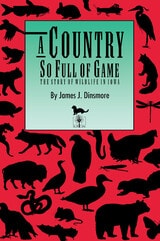
cover of A Country So Full of Game: The Story of Wildlife in Iowa

A Country So Full of Game

The Story of Wildlife in Iowa

James J. Dinsmore

University of Iowa Press, 1994

Indian agent Joseph Street said it well in 1833 when he described his trip across Iowa: “I had never rode through a country so full of game.” In the early 1800s Iowa's deep soil, free-flowing rivers and streams, and favorable climate had combined to produce the welcoming habitats that supported a surprising variety of animals. In his engaging, intelligent book, James Dinsmore has created the first comprehensive history of this abounding wildlife from the arrival of Euro-American explorers to the present day.

Based on a thorough search of hundreds of primary sources ranging from chronicles of military expeditions to field reports by early naturalists, first-person accounts by fur traders and hunters to up-to-date county checklists, A Country So Full of Game examines the dramatic encounters of humans with elk, black bears, passenger pigeons, bobcats, prairie-chickens, otters, and many more. Each chapter discusses the animal's status and distribution when explorers first arrived in Iowa, how it was hunted or trapped, how this exploitation affected its population, and what its current status is both in Iowa and nationally. Enhanced by Mark Müller's distinctive drawings, commissioned for this book, the anecdotes evoke a sense of loss and wonder at the magic abundance of Iowa's wildlife.

Iowa has been changed more than, perhaps, any other state. We can mourn the disappearance of the bison and mountain lion while we marvel at the recent success of the wild turkey and white-tailed deer. Listening to James Dinsmore tell the story of wildlife in Iowa can open a window onto the future as other areas of our planet are increasingly altered by humans. A Country So Full of Game will allow all naturalists, both amateur and professional, hunter and biologist, to appreciate and learn from Iowa's diverse wild heritage.
[more]
cover of A Land Between Waters: Environmental Histories of Modern Mexico

A Land Between Waters

Environmental Histories of Modern Mexico

Edited by Christopher R. Boyer

University of Arizona Press, 2012

Mexico is one of the most ecologically diverse nations on the planet, with landscapes that range from rainforests to deserts and from small villages to the continent’s largest metropolis. Yet historians are only beginning to understand how people’s use of the land, extraction of its resources, and attempts to conserve it have shaped both the landscape and its inhabitants.

A Land Between Waters explores the relationship between the people and the environment in Mexico. It heralds the arrival of environmental history as a major area of study within the field of Mexican history. This volume brings together a dozen original works of environmental history by some of the foremost experts in Mexican environmental history from both the United States and Mexico.

The contributions collected in this seminal volume explore a wide array of topics, from the era of independence to the present day. Together they examine how humans have used, abused, and attended to nature in Mexico over more than two hundred years. Written in clear, accessible prose, A Land Between Waters showcases the breadth of Mexican environmental history in a way that defines the key topics in the field and suggests avenues for subsequent work. Most importantly, it assesses the impacts of environmental changes that Mexico has faced in the past with an eye to informing national debates about the challenges that the nation will face in the future.
[more]
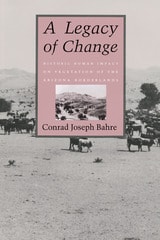
cover of A Legacy of Change: Historic Human Impact on Vegetation in the Arizona Borderlands

A Legacy of Change

Historic Human Impact on Vegetation in the Arizona Borderlands

Conrad Joseph Bahre

University of Arizona Press, 1991

The arrival of Anglo settlers in the 1870s marked the beginning of major vegetation changes in southeastern Arizona, including an increase in woody plants in rangelands, the degradation of riparian wetlands, and the spread of non-native plants. While many of these changes have already been linked to human land-use through comparative photographs and historic descriptions, it has long been presumed that changes in the region's climate have also contributed to vegetation change.

Geographer Conrad Bahre now challenges the view that these vegetation changes are due to climatic change. Correlating his own field research with archival records and photographs, Bahre demonstrates that most of the changes follow some type of human disturbance, such as cattle grazing, fuelwood cutting, wildfire suppression, agriculture, and road construction. Indeed, all available evidence suggests that Anglo settlement brought unprecedented changes to the land.

Vegetation change in the American West has long been an issue of concern. This careful scrutiny of one corner of that region—one of the most ecologically diverse areas of the United States—shows how poorly understood is the relationship between human activities and vegetation. More important, it introduces new techniques for differentiating between natural and anthropogenic factors effecting vegetation change that can be used to help ecologists understand vegetation dynamics worldwide.
[more]
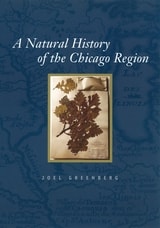
cover of A Natural History of the Chicago Region

A Natural History of the Chicago Region

Joel Greenberg

University of Chicago Press, 2002
In A Natural History of the Chicago Region, Joel Greenberg takes readers on a journey that begins in 1673 with Father Jacques Marquette and Louis Joliet—the first Europeans known to have visited the Chicago region—and that we're still on today. This is a fascinating story, told with humor and passion, of forests battling prairies for dominance; of grasslands plowed, wetlands drained, and species driven to extinction in the settlement of the Midwest; and of caring conservationists fighting to preserve and restore the native plants and animals. Intermingling historical anecdotes and episodes straight from the words of early settlers and naturalists with current scientific information, Greenberg places the natural history of the region in a human context, showing how it affects our everyday existence in even the most urbanized landscape of Chicago.
[more]
cover of A World of Rivers: Environmental Change on Ten of the World's Great Rivers

A World of Rivers

Environmental Change on Ten of the World's Great Rivers

Ellen Wohl

University of Chicago Press, 2010

Far from being the serene, natural streams of yore, modern rivers have been diverted, dammed, dumped in, and dried up, all in efforts to harness their power for human needs. But these rivers have also undergone environmental change. The old adage says you can’t step in the same river twice, and Ellen Wohl would agree—natural and synthetic change are so rapid on the world’s great waterways that rivers are transforming and disappearing right before our eyes.

            A World of Rivers explores the confluence of human and environmental change on ten of the great rivers of the world. Ranging from the Murray-Darling in Australia and the Yellow River in China to Central Europe’s Danube and the United States’ Mississippi, the book journeys down the most important rivers in all corners of the globe. Wohl shows us how pollution, such as in the Ganges and in the Ob of Siberia, has affected biodiversity in the water. But rivers are also resilient, and Wohl stresses the importance of conservation and restoration to help reverse the effects of human carelessness and hubris.

            What all these diverse rivers share is a critical role in shaping surrounding landscapes and biological communities, and Wohl’s book ultimately makes a strong case for the need to steward positive change in the world’s great rivers.
[more]
cover of Acting with the World: Agency in the Anthropocene

Acting with the World

Agency in the Anthropocene

Andrew Pickering

Duke University Press, 2025
In the Anthropocene our actions are coming home to roost. Global warming, species extinctions, and environmental disasters are the dark side of our mastery of nature. In Acting with the World, Andrew Pickering identifies a different pattern of being and doing that can evade this dark side, a pattern that he calls acting-with the world. In contrast to our usual practice of acting on the world, acting-with foregrounds nonhuman or more-than-human agency and aims to attune our practices to the propensities of nature. Pickering explores examples of acting-with from around the globe, including flood control on the Mississippi River, ecosystem restoration on the Colorado River, the Room for the River project and rewilding in the Netherlands, natural farming in Japan, Aboriginal fire techniques in Australia, and Amazonian shamanism. Pickering argues that acting-with intimately and gracefully plugs us into nature, undercuts the Anthropocene from below, and offers a constructive approach to addressing otherwise intractable wicked problems.
[more]
cover of Aerosol Effects on Climate

Aerosol Effects on Climate

S. Gerard Jennings

University of Arizona Press, 1993
There is now a growing awareness that, in addition to the well publicized influence of carbon dioxide and other greenhouse gases on the warming of the earth's atmosphere, aerosol particles may also play an important role in forcing climate change. This volume brings together previously unavailable data and interpretative analyses, derived from studies in both the U.S. and U.S.S.R., which review, update, and assess aerosol-related climatic effects.
[more]
cover of After Eden: The Evolution of Human Domination

After Eden

The Evolution of Human Domination

Kirkpatrick Sale

Duke University Press, 2006

When did the human species turn against the planet that we depend on for survival? Human industry and consumption of resources have altered the climate, polluted the water and soil, destroyed ecosystems, and rendered many species extinct, vastly increasing the likelihood of an ecological catastrophe. How did humankind come to rule nature to such an extent? To regard the planet’s resources and creatures as ours for the taking? To find ourselves on a seemingly relentless path toward ecocide?

In After Eden, Kirkpatrick Sale answers these questions in a radically new way. Integrating research in paleontology, archaeology, and anthropology, he points to the beginning of big-game hunting as the origin of Homo sapiens’ estrangement from the natural world. Sale contends that a new, recognizably modern human culture based on the hunting of large animals developed in Africa some 70,000 years ago in response to a fierce plunge in worldwide temperature triggered by an enormous volcanic explosion in Asia. Tracing the migration of populations and the development of hunting thousands of years forward in time, he shows that hunting became increasingly adversarial in relation to the environment as people fought over scarce prey during Europe’s glacial period between 35,000 and 10,000 years ago. By the end of that era, humans’ idea that they were the superior species on the planet, free to exploit other species toward their own ends, was well established.

After Eden is a sobering tale, but not one without hope. Sale asserts that Homo erectus, the variation of the hominid species that preceded Homo sapiens and survived for nearly two million years, did not attempt to dominate the environment. He contends that vestiges of this more ecologically sound way of life exist today—in some tribal societies, in the central teachings of Hinduism and Buddhism, and in the core principles of the worldwide environmental movement—offering redemptive possibilities for ourselves and for the planet.
[more]
cover of Alaska: Reflections on Land and Spirit

Alaska

Reflections on Land and Spirit

Edited by Robert Hedin and Gary Holthaus

University of Arizona Press, 1989
This aptly named book contains 22 selections by John Muir, John McPhee, Barry Lopez, and others on Alaska and to some extent on the neighboring Yukon, accompanied by a small but evocative collection of photographs of Eskimos. The pieces, most of which are top-notch, vividly describe the harsh climate, the Arctic and sub-Arctic habitats, and the animals of Alaska, and tell the stories of the Native Americans and others who have made their home or worked in the North. This excellent sampler of some of the best writing on Alaska is recommended for academic and, especially, public libraries.
[more]
cover of Allegories of the Anthropocene

Allegories of the Anthropocene

Elizabeth M. DeLoughrey

Duke University Press, 2019
In Allegories of the Anthropocene Elizabeth M. DeLoughrey traces how indigenous and postcolonial peoples in the Caribbean and Pacific Islands grapple with the enormity of colonialism and anthropogenic climate change through art, poetry, and literature. In these works, authors and artists use allegory as a means to understand the multiscalar complexities of the Anthropocene and to critique the violence of capitalism, militarism, and the postcolonial state. DeLoughrey examines the work of a wide range of artists and writers—including poets Kamau Brathwaite and Kathy Jetñil-Kijiner, Dominican installation artist Tony Capellán, and authors Keri Hulme and Erna Brodber—whose work addresses Caribbean plantations, irradiated Pacific atolls, global flows of waste, and allegorical representations of the ocean and the island. In examining how island writers and artists address the experience of finding themselves at the forefront of the existential threat posed by climate change, DeLoughrey demonstrates how the Anthropocene and empire are mutually constitutive and establishes the vital importance of  allegorical art and literature in understanding our global environmental crisis.
[more]
cover of Alterhumanism: Becoming Human on a Conservation Frontier

Alterhumanism

Becoming Human on a Conservation Frontier

Piergiorgio Di Giminiani

University of Arizona Press, 2025
On the conservation frontier of southern Chile, the lives of smallholding settlers, Indigenous Mapuche farmers, environmental activists, entrepreneurs, and conservation scientists all grapple with the enduring impacts of settler-caused environmental depletion, aspirations for a new ethics of care, and the promises of an ecotourism boom. Here, the question of what it means to be human is not simply an existential concern but the reflexive result of experiences of becoming human through and with nonhuman others in an increasingly uncertain world.
[more]
cover of Animate Planet: Making Visceral Sense of Living in a High-Tech Ecologically Damaged World

Animate Planet

Making Visceral Sense of Living in a High-Tech Ecologically Damaged World

Kath Weston

Duke University Press, 2017
In Animate Planet Kath Weston shows how new intimacies between humans, animals, and their surroundings are emerging as people attempt to understand how the high-tech ecologically damaged world they have made is remaking them, one synthetic chemical, radioactive isotope, and megastorm at a time. Visceral sensations, she finds, are vital to this process, which yields a new animism in which humans and "the environment" become thoroughly entangled. In case studies on food, water, energy, and climate from the United States, India, and Japan, Weston approaches the new animism as both a symptom of our times and an analytic with the potential to open paths to new and forgotten ways of living.
[more]
cover of Anthropos and the Material

Anthropos and the Material

Penny Harvey, Christian Krohn-Hansen, and Knut Nustad, editors

Duke University Press, 2019
The destructive effects of modern industrial societies have shaped the planet in such profound ways that many argue for the existence of a new geological epoch called the Anthropocene. This claim brings into relief a set of challenges that have deep implications for how relations between the human, the material, and the political affect contemporary social worlds. The contributors to Anthropos and the Material examine these challenges by questioning and complicating long-held understandings of the divide between humans and things. They present ethnographic case studies from across the globe, addressing myriad topics that range from labor, economics, and colonialism to technology, culture, the environment, agency, and diversity. In foregrounding the importance of connecting natural and social histories, the instability and intangibility of the material, and the ways in which the lively encounters between the human and the nonhuman challenge conceptions of liberal humanism, the contributors point to new understandings of the capacities of people and things to act, transform, and adapt to a changing world.
[more]
cover of Archives of the Anthropocene: Visual Grammars of Deep Time

Archives of the Anthropocene

Visual Grammars of Deep Time

Yuriko Furuhata

Duke University Press, 2026

From geological maps to photographs and films of snow, ice, clouds, and coral reefs, visual inscriptions mediate the construction and codification of extractive modes of seeing Earth’s subterranean depths and aerial heights. Tracing the territorial ambitions of the archipelagic empires of Japan and the United States in the twentieth century, Archives of the Anthropocene explores crucial moments of overlap between the geoscientific history of studying Earth’s deep time and the geopolitical history of territorialization, militarization, and extraction in the Pacific and polar regions. By engaging with contemporary critiques of settler colonialism, liberal humanism, and nonhuman labor from the perspective of environmental media studies, Yuriko Furuhata unsettles the universalist narrative of the Anthropocene, calling us to instead imagine an anticolonial and anti-imperial future for the planet.
[more]