201 books match the query 'English fiction' and 16 start with a

cover of A Common Spring: Crime Novel and Classic

A Common Spring

Crime Novel and Classic

Nadya Aisenberg

University of Wisconsin Press, 1980

Nadya Aisenberg discusses the potentialities of the crime novel, its implications, principles, and scope, and its analogy ot myth and the fairy tale. She proposes that the detective story and the thriller have made an unacknowledged contribution to "serious" literature. Her discussion of Dickens, Conrad, and Green indicate that each borrowed many important ingredients from the formulaic novel.
[more]
cover of A Narrative Compass: Stories that Guide Women's Lives

A Narrative Compass

Stories that Guide Women's Lives

Edited by Betsy Hearne and Roberta Seelinger Trites

University of Illinois Press, 2008

Each of us has a narrative compass, a story that has guided our lifework. In this extraordinary collection, women scholars from a variety of disciplines identify and examine the stories that have inspired them, haunted them, and shaped their research, from Little House on the Prairie to Little Women, from the fairy tales of Hans Christian Andersen and Alice's Adventures in Wonderland to Nancy Drew, Mary Jane, and even the Chinese memoir Jottings from the Transcendant's Abode at Mt. Youtai. Telling the "story of her story" leads each of the essayists to insights about her own approach to studying narratives and to a deeper, often surprising, understanding of the power of imagination.

Contributors are Deyonne Bryant, Minjie Chen, Cindy L. Christiansen, Beverly Lyon Clark, Karen Coats, Wendy Doniger, Bonnie Glass-Coffin, Betsy Hearne, Joanna Hearne, Ann Hendricks, Rania Huntington, Christine Jenkins, Kimberly Lau, Pamela Riney-Kehrberg, Maria Tatar, Ebony Elizabeth Thomas, Roberta Seelinger Trites, Claudia Quintero Ulloa, and Ofelia Zepeda.
 

[more]
cover of A User's Guide to Postcolonial and Latino Borderland Fiction

A User's Guide to Postcolonial and Latino Borderland Fiction

By Frederick Luis Aldama

University of Texas Press, 2009

Why are so many people attracted to narrative fiction? How do authors in this genre reframe experiences, people, and environments anchored to the real world without duplicating "real life"? In which ways does fiction differ from reality? What might fictional narrative and reality have in common—if anything?

By analyzing novels such as Arundhati Roy's The God of Small Things, Amitav Ghosh's The Glass Palace, Zadie Smith's White Teeth, and Hari Kunzru's The Impressionist, along with selected Latino comic books and short fiction, this book explores the peculiarities of the production and reception of postcolonial and Latino borderland fiction. Frederick Luis Aldama uses tools from disciplines such as film studies and cognitive science that allow the reader to establish how a fictional narrative is built, how it functions, and how it defines the boundaries of concepts that appear susceptible to limitless interpretations.

Aldama emphasizes how postcolonial and Latino borderland narrative fiction authors and artists use narrative devices to create their aesthetic blueprints in ways that loosely guide their readers' imagination and emotion. In A User's Guide to Postcolonial and Latino Borderland Fiction, he argues that the study of ethnic-identified narrative fiction must acknowledge its active engagement with world narrative fictional genres, storytelling modes, and techniques, as well as the way such fictions work to move their audiences.

[more]
cover of Abortion, Choice, and Contemporary Fiction: The Armageddon of the Maternal Instinct

Abortion, Choice, and Contemporary Fiction

The Armageddon of the Maternal Instinct

Judith Wilt

University of Chicago Press, 1990

In recent years, public debate has raged over the issue of maternal choice. While personal testimony and political argument have received widespread attention, artistic representations of birth and abortion have been submerged. Judith Wilt offers the first look at how contemporary writers tell and retell the stories that shape our perceptions about abortion. She reveals that the struggle to plot these painful, complex narratives of choice, control, guilt, loss, and liberation has preoccupied an astonishing number of our most distinguished novelists, male and female alike. Readers of twentieth-century novels are more likely to encounter plots centered on maternal choice than those dealing with the more traditional problems of courtship and marriage.

In the opening of the book, Wilt discusses real case histories of several women. After studying the ambiguities of their decisions, she turns to their counterpoints depicted in contemporary fiction. Working from a feminist perspective, Wilt traces the theme of maternal choice in works by Margaret Atwood, Margaret Drabble, Joan Didion, Mary Gordon, Alice Walker, Toni Morrison, Gloria Naylor, Marge Piercy, Thomas Keneally, Graham Swift, Ernest Hemingway, William Faulkner, John Barth, John Irving, and others.

Behind the political, medical, and moral debates on abortion, Wilt argues, is a profound psychocultural shock at the recognition that maternity is passing from the domain of instinct to that of conscious choice. Although never wholly instinctual, maternity's potential capture by consciousness raises complex questions. The novels Wilt discusses portray worlds in which principles are endangered by sexual inequality, male power and hidden male fear of abandonment, impotence, female submission, and covert rage, and, in the case of black maternity, the hideous aftermath of slavery.

Wilt provides a resonant new context for debates—whether political or personal—on the issue of abortion and maternal choice. Ultimately she enables us to rethink how we shape our own identities and lives.
[more]
cover of After Empire: Scott, Naipaul, Rushdie

After Empire

Scott, Naipaul, Rushdie

Michael Gorra

University of Chicago Press, 1997

In After Empire Michael Gorra explores how three novelists of empire—Paul Scott, V. S. Naipaul, and Salman Rushdie—have charted the perpetually drawn and perpetually blurred boundaries of identity left in the wake of British imperialism.

Arguing against a model of cultural identity based on race, Gorra begins with Scott's portrait, in The Raj Quartet, of the character Hari Kumar—a seeming oxymoron, an "English boy with a dark brown skin," whose very existence undercuts the belief in an absolute distinction between England and India. He then turns to the opposed figures of Naipaul and Rushdie, the two great novelists of the Indian diaspora. Whereas Naipaul's long and controversial career maps the "deep disorder" spread by both imperialism and its passing, Rushdie demonstrates that certain consequences of that disorder, such as migrancy and mimicry, have themselves become creative forces.

After Empire provides engaging and enlightening readings of postcolonial fiction, showing how imperialism helped shape British national identity—and how, after the end of empire, that identity must now be reconfigured.

[more]
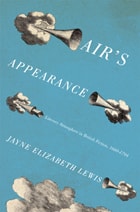
cover of Air's Appearance: Literary Atmosphere in British Fiction, 1660-1794

Air's Appearance

Literary Atmosphere in British Fiction, 1660-1794

Jayne Elizabeth Lewis

University of Chicago Press, 2012
In Air’s Appearance, Jayne Elizabeth Lewis enlists her readers in pursuit of the elusive concept of atmosphere in literary works. She shows how diverse conceptions of air in the eighteenth century converged in British fiction, producing the modern literary sense of atmosphere and moving novelists to explore the threshold between material and immaterial worlds.
 
Air’s Appearance links the emergence of literary atmosphere to changing ideas about air and the earth’s atmosphere in natural philosophy, as well as to the era’s theories of the supernatural and fascination with social manners—or, as they are now known, “airs.” Lewis thus offers a striking new interpretation of several standard features of the Enlightenment—the scientific revolution, the decline of magic, character-based sociability, and the rise of the novel—that considers them in terms of the romance of air that permeates and connects them. As it explores key episodes in the history of natural philosophy and in major literary works like Paradise Lost, “The Rape of the Lock,” Robinson Crusoe, and The Mysteries of Udolpho, this book promises to change the atmosphere of eighteenth-century studies and the history of the novel.
[more]
cover of Alice in Pornoland: Hardcore Encounters with the Victorian Gothic

Alice in Pornoland

Hardcore Encounters with the Victorian Gothic

Laura Helen Marks

University of Illinois Press, 2018

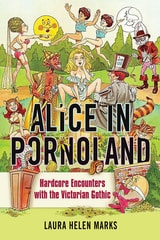
The unquenchable thirst of Dracula. The animal lust of Mr. Hyde. The acquiescence of Lewis Carroll's Alice. Victorian literature--with its overtones of prudishness, respectability, and Old World hypocrisy--belies a subverted eroticism. The Victorian Gothic is monstrous but restrained, repressed but perverse, static but transformative, and preoccupied by gender and sexuality in both regressive and progressive ways.

Laura Helen Marks investigates the contradictions and seesawing gender dynamics in Victorian-inspired adult films and looks at why pornographers persist in drawing substance and meaning from the era's Gothic tales. She focuses on the particular Victorianness that pornography prefers, and the mythologies of the Victorian era that fuel today's pornographic fantasies. In turn, she exposes what porning the Victorians shows us about pornography as a genre.

A bold foray into theory and other forbidden places, Alice in Pornoland reveals how modern-day Victorian Gothic pornography constantly emphasizes, navigates, transgresses, and renegotiates issues of gender, sexuality, and race.
[more]
cover of Allegories of Empire: The Figure of Woman in the Colonial Text

Allegories of Empire

The Figure of Woman in the Colonial Text

Jenny Sharpe

University of Minnesota Press, 1993

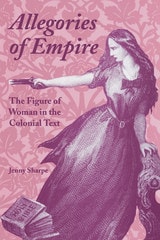
Allegories of Empire was first published in 1993.“Allegories of Empire re-constellates a metropolitan masterpiece, Forster’s A Passage to India, within colonial discourse studies. Sharpe, a materialist feminist, is scrupulous in her use of theory to articulate nationalism, historical race-gendering, and contemporary feminist critique.” -Gayatri Chakravorty Spivak, Columbia University“Jenny Sharpe has done a great service in opening up the virtually taboo subject of the rape of the white woman by the colored man, and, furthermore, in teaching us theory - making by locating this frenzy of fantasy and reality within a specific crisis of European colonialism in India. ... In showing how a ‘wild anthropology’ must continuously rework feminism in the face of racism, and vice versa, she shows how the margins of empire were and still are at its center.” -Michael Taussig, New York UniversityAllegories of Empire introduces race and colonialism to feminist theories of rape and sexual difference, deploying women’s writing to undo the appropriation of English (universal) womanhood for the perpetuation of Empire.Sharpe brings the historical memory of the 1857 Indian Mutiny to bear upon the theme of rape in British adn Anglo-Indian fiction. She argues that the idea of Indian men raping white women was not part of the colonial landscape prior to the revolt that was remembered as the savage attack of mutinous Indian soldiers on defenseless English women.By showing how contemporary theories of female agency are implicated in an imperial past, Sharpe argues that such models are inappropriate, not only for discussion of colonized women, but for European women as well. Ultimately, she insists that feminist theory must begin from difference and dislocation rather than from identity and correspondence if it is to get beyond the race-gender-class impasse.Jenny Sharpe received her Ph.D. in comparative literature at the University of Texas at Austin and is currently a professor of English at the University of California at Los Angeles. She has contributed articles to Modern Fiction Studies, Genders, and boundary 2.
[more]
cover of And Then There Were Nine. . .: More Women of Mystery

And Then There Were Nine. . .

More Women of Mystery

University of Wisconsin Press, 1985

Within the formulas of crime fiction, this collection ranges from writers Daphne du Maurier and Margery Allingham, whose names are synonymous with conventional subgenres of crime fiction, through Patricia Highsmith, and Shirley Jackson, who deliberately set conventions aside or who moved those conventions into other realms. Most important, perhaps, Jackson, Highsmith and E. X. Ferrars depict civilizations that are not essentially orderly, that are not founded upon a commonly understood concept of justice--where one must make her own order.
[more]
cover of Angelic Airs, Subversive Songs: Music as Social Discourse in the Victorian Novel

Angelic Airs, Subversive Songs

Music as Social Discourse in the Victorian Novel

Alisa Clapp-Itnyre

Ohio University Press, 2027

Music was at once one of the most idealized and one of the most contested art forms of the Victorian period. Yet this vitally important nineteenth-century cultural form has been studied by literary critics mainly as a system of thematic motifs. Angelic Airs, Subversive Songs positions music as a charged site of cultural struggle, promoted concurrently as a transcendent corrective to social ills and as a subversive cause of those ills. Alisa Clapp-Itnyre examines Victorian constructions of music to advance patriotism, Christianity, culture, and domestic harmony, and suggests that often these goals were undermined by political tensions in song texts or “immoral sensuality” in the “spectacle” of live music-making. Clapp-Itnyre turns her focus to the novels of Elizabeth Gaskell, George Eliot, and Thomas Hardy, who present complex engagements with those musical genres most privileged by Victorian society: folk songs, religious hymns, and concert music. Angelic Airs, Subversive Songs recovers the pervasive ambiguities of the Victorian musical period, ambiguities typically overlooked by both literary scholars and musicologists. To the literary critic and cultural historian, Clapp-Itnyre demonstrates the necessity of further exploring the complete aesthetic climate behind some of the Victorian period’s most powerful literary works. And to the feminist scholar and the musicologist, Clapp-Itnyre reveals the complexities of music as both an oppressive cultural force and an expressive, creative outlet for women.
[more]
cover of Animal Stories: Narrating across Species Lines

Animal Stories

Narrating across Species Lines

Susan McHugh

University of Minnesota Press, 2010

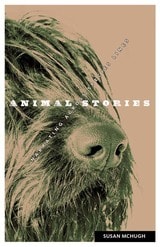
Beginning with a historical account of why animal stories pose endemic critical challenges to literary and cultural theory, Animal Stories argues that key creative developments in narrative form became inseparable from shifts in animal politics and science in the past century. Susan McHugh traces representational patterns specific to modern and contemporary fictions of cross-species companionship through a variety of media—including novels, films, fine art, television shows, and digital games—to show how nothing less than the futures of all species life is at stake in narrative forms.

McHugh’s investigations into fictions of people relying on animals in civic and professional life—most obviously those of service animal users and female professional horse riders—showcase distinctly modern and human–animal forms of intersubjectivity. But increasingly graphic violence directed at these figures indicates their ambivalent significance to changing configurations of species.

Reading these developments with narrative adaptations of traditional companion species relations during this period— queer pet memoirs and farm animal fictions—McHugh clarifies the intercorporeal intimacies—the perforations of species boundaries now proliferating in genetic and genomic science—and embeds the representation of animals within biopolitical frameworks.
[more]
cover of Anti-Nazi Modernism: The Challenges of Resistance in 1930s Fiction

Anti-Nazi Modernism

The Challenges of Resistance in 1930s Fiction

Mia Spiro

Northwestern University Press, 2013

Mia Spiro's Anti-Nazi Modernism marks a major step forward in the critical debates over the relationship between modernist art and politics. Spiro analyzes the antifascist, and particularly anti-Nazi, narrative methods used by key British and American fiction writers in the 1930s. Focusing on works by Djuna Barnes, Christopher Isherwood, and Virginia Woolf, Spiro illustrates how these writers use an "anti-Nazi aesthetic" to target and expose Nazism’s murderous discourse of exclusion. The three writers challenge the illusion of harmony and unity promoted by the Nazi spectacle in parades, film, rallies, and propaganda. Spiro illustrates how their writings, seldom read in this way, resonate with the psychological and social theories of the period and warn against Nazism’s suppression of individuality.  Her approach also demonstrates how historical and cultural contexts complicate the works, often reinforcing the oppressive discourses they aim to attack. This book explores the textual ambivalences toward the "Others" in society—most prominently the Modern Woman, the homosexual, and the Jew. By doing so, Spirouncovers important clues to the sexual and racial politics that were widespread in Europe and the United States in the years leading up to World War II.


[more]
cover of Are Girls Necessary?: Lesbian Writing and Modern Histories

Are Girls Necessary?

Lesbian Writing and Modern Histories

Julie Abraham

University of Minnesota Press, 2008
[more]
cover of Are We There Yet?: Virtual Travel and Victorian Realism

Are We There Yet?

Virtual Travel and Victorian Realism

Alison Byerly

University of Michigan Press, 2012

Are We There Yet? Virtual Travel and Victorian Realismconnects the Victorian fascination with "virtual travel" with the rise of realism in nineteenth-century fiction and twenty-first-century experiments in virtual reality. Even as the expansion of river and railway networks in the nineteenth century made travel easier than ever before, staying at home and fantasizing about travel turned into a favorite pastime. New ways of representing place—360-degree panoramas, foldout river maps, exhaustive railway guides—offered themselves as substitutes for actual travel. Thinking of these representations as a form of "virtual travel" reveals a surprising continuity between the Victorian fascination with imaginative dislocation and twenty-first -century efforts to use digital technology to expand the physical boundaries of the self.
[more]
cover of Ashes Taken for Fire: Aesthetic Modernism and the Critique of Identity

Ashes Taken for Fire

Aesthetic Modernism and the Critique of Identity

Kevin M. Bell

University of Minnesota Press, 2007
For years critics have held that literary modernism was both apolitical and solipsistic. While the former charge began to give way with the recession of New Criticism, the latter has grown in strength as a lead-in to the claim that postmodernism is apolitical and solipsistic. Against this backdrop, Kevin Bell surveys fiction by Conrad, Woolf, Faulkner, West, Ellison, and Himes to show that modernism is a sharply philosophical archive. In Ashes Taken for Fire, he argues that modernism exposes cultural identities such as blackness as mere strategies of conforming the self into belonging. Bell’s examination pursues the question of nonidentity through sound, silence, and gesture, treating these as technologies of reading the contradictions, breakdowns, and erasures that constitute subjectivity. His analysis of these texts reveals that the aesthetic investigations they perform undo the logic of cultural identity, devastating such reductive rubrics as “race” or “gender.”Ashes Taken for Fire explores the experience of blackness in both its chromatic/ocular and “racial” registers. For while blackness operates as a standard figural expression for disorientation, its presumably “voided” character is reprojected in this work as an immanent force of possibility and experimentation.Kevin Bell is assistant professor of English and comparative literary studies at Northwestern University.
[more]
cover of Autistic Disturbances: Theorizing Autism Poetics from the DSM to Robinson Crusoe

Autistic Disturbances

Theorizing Autism Poetics from the DSM to Robinson Crusoe

Julia Miele Rodas

University of Michigan Press, 2018

While research on autism has sometimes focused on special talents or abilities, autism is typically characterized as impoverished or defective when it comes to language. Autistic Disturbances reveals the ways interpreters have failed to register the real creative valence of autistic language and offers a theoretical framework for understanding the distinctive aesthetics of autistic rhetoric and semiotics. Reinterpreting characteristic autistic verbal practices such as repetition in the context of a more widely respected literary canon, Julia Miele Rodas argues that autistic language is actually an essential part of mainstream literary aesthetics, visible in poetry by Walt Whitman and Gertrude Stein, in novels by Charlotte Brontë and Daniel Defoe, in life writing by Andy Warhol, and even in writing by figures from popular culture. Autistic Disturbances pursues these resonances and explores the tensions of language and culture that lead to the classification of some verbal expression as disordered while other, similar expression enjoys prized status as literature. It identifies the most characteristic patterns of autistic expression-repetition, monologue, ejaculation, verbal ordering or list-making, and neologism-and adopts new language to describe and reimagine these categories in aesthetically productive terms. In so doing, the book seeks to redress the place of verbal autistic language, to argue for the value and complexity of autistic ways of speaking, and to invite recognition of an obscured tradition of literary autism at the very center of Anglo-American text culture.
[more]