Results by title
101 books match the query 'Environmentalism' and 9 start with a
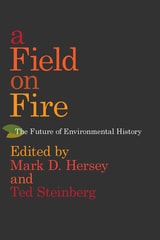
A Field on Fire
The Future of Environmental HistoryEdited by Mark D. Hersey and Ted Steinberg
University of Alabama Press, 2019
Inspired by the pioneering work of preeminent environmental historian Donald Worster, the contributors to A Field on Fire: The Future of Environmental History reflect on the past and future of this discipline. Featuring wide-ranging essays by leading environmental historians from the United States, Europe, and China, the collection challenges scholars to rethink some of their orthodoxies, inviting them to approach familiar stories from new angles, to integrate new methodologies, and to think creatively about the questions this field is well positioned to answer.
Worster’s groundbreaking research serves as the organizational framework for the collection. Editors Mark D. Hersey and Ted Steinberg have arranged the book into three sections corresponding to the primary concerns of Worster’s influential scholarship: the problem of natural limits, the transnational nature of environmental issues, and the question of method. Under the heading “Facing Limits,” five essays explore the inherent tensions between democracy, technology, capitalism, and the environment. The “Crossing Borders” section underscores the ways in which environmental history moves easily across national and disciplinary boundaries. Finally, “Doing Environmental History” invokes Worster’s work as an essayist by offering self-conscious reflections about the practice and purpose of environmental history.
The essays aim to provoke a discussion on the future of the field, pointing to untapped and underdeveloped avenues ripe for further exploration. A forward thinker like Worster presents bold challenges to a new generation of environmental historians on everything from capitalism and the Anthropocene to war and wilderness. This engaging volume includes a very special afterword by one of Worster’s oldest friends, the eminent intellectual historian Daniel Rodgers, who has known Worster for close to fifty years.
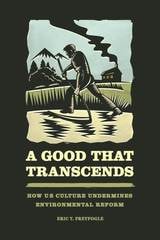
A Good That Transcends
How US Culture Undermines Environmental ReformEric T. Freyfogle
University of Chicago Press, 2017
A lawyer by training, with expertise in property rights, Freyfogle uses his legal knowledge to demonstrate that bad land use practices are rooted in the way in which we see the natural world, value it, and understand our place within it. While social and economic factors are important components of our current predicament, it is our culture, he shows, that is driving the reform crisis—and in the face of accelerating environmental change, a change in culture is vital. Drawing upon a diverse array of disciplines from history and philosophy to the life sciences, economics, and literature, Freyfogle seeks better ways for humans to live in nature, helping us to rethink our relationship with the land and craft a new conservation ethic. By confronting our ongoing resistance to reform as well as pointing the way toward a common good, A Good That Transcends enables us to see how we might rise above institutional and cultural challenges, look at environmental problems, appreciate their severity, and both support and participate in reform.
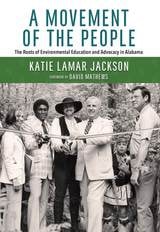
A Movement of the People
The Roots of Environmental Education and Advocacy in AlabamaKatie Lamar Jackson, Foreword by David Mathews
University of Alabama Press, 2017
A Movement of the People: The Roots of Environmental Education and Advocacy in Alabama is a detailed history of the Alabama Environmental Quality Association (AEQA). The AEQA helped to establish groundbreaking environmental protection and natural resource preservation policies for the state and the region and grew into one of the nation’s most progressive environmental education efforts.
The AEQA began in 1966 with the relatively simple political action agenda of cleaning up unsightly and unsanitary roadside trash. These inspired citizens collaborated with civic leaders to identify and remove illegal rural dumps and create more regulated landfills statewide. Eventually they became involved in the “Keep America Beautiful” campaign and with the US Public Health Service in its attempt to rid the state of the yellow-fever mosquito vector, Aedes aegypti, which breeds in standing, fetid water. The acme of these early efforts was the passage of Alabama’s Solid Waste Disposal Law of 1969, one of the nation’s first such bills.
The AEQA’s dedicated staff and supporters spearheaded other environmental projects, many of which remain active today, such as recycling programs with industry giants throughout the Southeast and the founding of the Bartram Trail Conference, a multistate initiative to identify and preserve the path that Quaker botanist William Bartram took through the territory before its formation into states.
Using recorded interviews with Martha McInnis, executive vice president of the AEQA, and full access to a meticulously preserved archive of the organization’s papers and artifacts, Katie Lamar Jackson relates this previously untold story of remarkable “citizen activism.” A Movementof the People is a valuable account of the organization’s growth and advancement, both economically and societally, which serves as a blueprint for successful civic activism and grassroots organizing.
A People’s Green New Deal
Max Ajl
Pluto Press, 2021
'Hands-down the best book yet on the Green New Deal' - Jason Hickel
The idea of a Green New Deal was launched into popular consciousness by US Congressperson Alexandria Ocasio-Cortez in 2018. It has become a watchword in the current era of global climate crisis. But what - and for whom - is the Green New Deal?
In this concise and urgent book, Max Ajl provides an overview of the various mainstream Green New Deals. Critically engaging with their proponents, ideological underpinnings and limitations, he goes on to sketch out a radical alternative: a 'People's Green New Deal' committed to decommodification, working-class power, anti-imperialism and agro-ecology.
Ajl diagnoses the roots of the current socio-ecological crisis as emerging from a world-system dominated by the logics of capitalism and imperialism. Resolving this crisis, he argues, requires nothing less than an infrastructural and agricultural transformation in the Global North, and the industrial convergence between North and South. As the climate crisis deepens and the literature on the subject grows, A People's Green New Deal contributes a distinctive perspective to the debate.

A World of Many Worlds
Marisol de la Cadena and Mario Blaser, editors
Duke University Press, 2018
Contributors. Mario Blaser, Alberto Corsín Jiménez, Déborah Danowski, Marisol de la Cadena, John Law, Marianne Lien, Isabelle Stengers, Marilyn Strathern, Helen Verran, Eduardo Viveiros de Castro
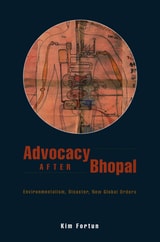
Advocacy after Bhopal
Environmentalism, Disaster, New Global OrdersKim Fortun
University of Chicago Press, 2001
Kim Fortun explores these claims by focusing on the dynamics and paradoxes of advocacy in competing power domains. She moves from hospitals in India to meetings with lawyers, corporate executives, and environmental justice activists in the United States to show how the disaster and its effects remain with us. Spiraling outward from the victims' stories, the innovative narrative sheds light on the way advocacy works within a complex global system, calling into question conventional notions of responsibility and ethical conduct. Revealing the hopes and frustrations of advocacy, this moving work also counters the tendency to think of Bhopal as an isolated incident that "can't happen here."
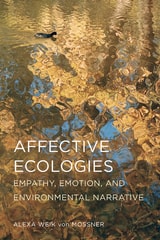
Affective Ecologies
Empathy, Emotion, and Environmental NarrativeAlexa Weik von Mossner
The Ohio State University Press, 2017
How do we experience the virtual environments we encounter in literature and film on the sensory and emotional level? How do environmental narratives invite us to care for human and nonhuman others who are put at risk? And how do we feel about the speculative futures presented to us in ecotopian and ecodystopian texts? Weik von Mossner explores these central questions that are important to anyone with an interest in the emotional appeal and persuasive power of environmental narratives.
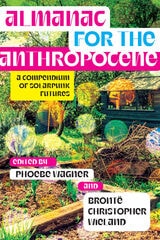
Almanac for the Anthropocene
A Compendium of Solarpunk FuturesPhoebe Wagner
West Virginia University Press, 2022
Original voices from across the solarpunk movement, which positions ingenuity, generativity, and community as ways to resist hopelessness in response to the climate crisis.
Almanac for the Anthropocene collects original voices from across the solarpunk movement, which positions ingenuity, generativity, and community as beacons of resistance to the hopelessness often inspired by the climate crisis. To point toward practical implementation of the movement’s ideas, it gathers usable blueprints that bring together theory and practice. The result is a collection of interviews, recipes, exercises, DIY instructions, and more—all of it amounting to a call to create hope through action.
Inspired by a commitment to the idea that there can be no environmental justice without decolonial and racial justice, Almanac for the Anthropocene unites in a single volume both academic and practical responses to environmental crisis.
Anthropos and the Material
Penny Harvey, Christian Krohn-Hansen, and Knut Nustad, editors
Duke University Press, 2019