Results by title
438 books match the query 'Hispanic & Latino' and 33 start with a
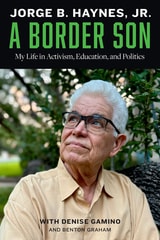
A Border Son
My Life in Activism, Education, and PoliticsJorge B. Haynes, Jr.with Denise Gamino and Benton Graham
University of Texas Press, 2026
Behind the success of every great politician, inspiring activist, or business titan, there is a staffer; Jorge B. Haynes was that staffer for some of the most influential leaders in Texas, Florida, and California.
Jorge B. Haynes had a knack for finding his way into the rooms where history was being made. From his work boycotting farmworker conditions alongside Cesar Chavez and Dolores Huerta as a young man in California to his role in President Bill Clinton’s NAFTA war room in the 1990s, he was the man advising some of the country’s most influential leaders and he left an imprint on the monumental moments that defined their time. His career spanned almost five decades, beginning with his decision to leave home in Laredo to serve in the US Air Force. But his service to the country took many different forms. Haynes worked for the Bureau of the Census the first year Latinos were allowed to declare their Hispanic heritage. He wrote speeches and orchestrated pivotal meetings for top political leadership in Texas and later Florida. In the final years of his career, he fought to make college a more accessible path for under-represented students in California.
As his paternal grandmother used to say, “Cuando vas a un lugar donde nunca has estado, finge que has estado allí,” which means, “When you go somewhere that you've never been, pretend like you've been there before.” By the end of his career, there weren’t many places that Haynes hadn’t been.
A Face Out of Clay
Brent Ameneyro
University Press of Colorado, 2024
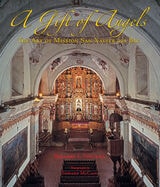
A Gift of Angels
The Art of Mission San Xavier del BacBernard L. Fontana; photographs by Edward McCain
University of Arizona Press, 2010
Mission San Xavier del Bac is a two-century-old Spanish church in southern Arizona located just a few miles from downtown Tucson, a metropolis of more than half a million people in the American Southwest. A National Historic Landmark since 1963, the mission’s graceful baroque art and architecture have drawn visitors from all over the world.
Now Bernard Fontana—the leading expert on San Xavier—and award-winning photographer Edward McCain team up to bring us a comprehensive view of the mission as we’ve never seen it before. With 200 stunning full-color photographs and incisive text illuminating the religious, historical, and motivational context of these images, A Gift of Angels is a must-have for tourists, scholars, and other visitors to San Xavier.
From its glorious architecture all the way down to the finest details of its art, Mission San Xavier del Bac is indeed a gift of angels.
A Good Map of All Things
A Picaresque NovelAlberto Álvaro Ríos
University of Arizona Press, 2020
In Alberto Álvaro Ríos’s new picaresque novel, momentous adventure and quiet connection brings twenty people to life in a small town in northern Mexico. A Good Map of All Things is home to characters whose lives are interwoven but whose stories are their own, adding warmth and humor to this continually surprising communal narrative. The stories take place in the mid-twentieth century, in the high desert near the border—a stretch of land generally referred to as the Pimería Alta—an ancient passage through the desert that connected the territory of Tucson in the north and Guaymas and Hermosillo in the south. The United States is off in the distance, a little difficult to see, and, in the middle of the century, not the only thing to think about. Mexico City is somewhere to the south, but nobody can say where and nobody has ever seen it.
Ríos has created a whimsical yet familiar town, where brightly unique characters love fiercely and nurture those around them. The people in A Good Map of All Things have secrets and fears, successes and happiness, winters and summers. They are people who do not make the news, but who are living their lives for the long haul, without lotteries or easy answers or particular luck. Theirs is the everyday, with its small but meaningful joy. Whether your heart belongs to a small town in Mexico or a bustling metropolis, Alberto Álvaro Ríos has crafted a book that is overflowing with comfort, warmth, and the familiar embrace of a tightly woven community.
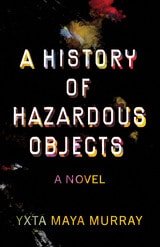
A History of Hazardous Objects
A NovelYxta Maya Murray
University of Nevada Press, 2024
Simultaneously, Laura is trying to write the history section of a Congressional report titled the National Near-Earth Object Preparedness Strategy and Action Plan. This report will advise Congress that it must develop a system to detect and deflect PHOs, and the section Laura is working on cites several historical meteorite impacts as proof that the Earth is now undefended against a significant impact event.
A story about family, love, risk, and science, A History of Hazardous Objects contemplates how experiencing trauma and pain may help us secure a safer and more just world.
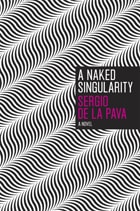
A Naked Singularity
A NovelSergio De La Pava
University of Chicago Press, 2012
The mind-bending, brilliant, often hilarious PEN Award-winning classic novel of justice, the law, and the brutal gap between the two.
A Naked Singularity tells the story of Casi, a child of Colombian immigrants who lives in Brooklyn and works in Manhattan as a public defender--one who, tellingly has never lost a trial. Never. In the book, we watch what happens when his sense of justice and even his sense of self begin to crack--and how his world then slowly devolves. It’s a huge, ambitious novel clearly in the vein of DeLillo, Foster Wallace, Pynchon, and even Melville, and it's told in a distinct, frequently hilarious voice, with a striking human empathy at its center. Its panoramic reach takes readers through crime and courts, immigrant families and urban blight, media savagery and media satire, scatology and boxing, and even a breathless heist worthy of any crime novel. If InfiniteJest stuck a pin in the map of mid-90s culture and drew our trajectory from there, A Naked Singularity does the same for the feeling of surfeit, brokenness, and exhaustion that permeates our civic and cultural life today. In the opening sentence of William Gaddis’s A Frolic of His Own, a character sneers, "Justice? You get justice in the next world. In this world, you get the law." A Naked Singularity reveals the extent of that gap, and lands firmly on the side of those who are forever getting the law.
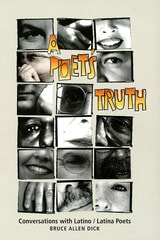
A Poet's Truth
Conversations with Latino/Latina PoetsBruce Allen Dick
University of Arizona Press, 2003
As Bruce Dick's insightful questions reveal, the key threads linking these writers are their connections to their families and communities and their concern for civil rights—believing like Chicana writer Pat Mora that "the work of the poet is for the people." The interviews also reveal diversity among and within the three communities, from Victor Hernández Cruz, who traces Latino collective identity to Africa and claims that all Latinos are "swimming in olive oil," to Cuban writer Gustavo Perez Firmat, who considers nationality more important than ethnicity and says that "the term Latino erases [his] nationality."
The dialogues also offer new insights on the place of Chicano/a writings in the U.S.-Mexico borderlands, on the Puerto Rican/Nuyorican establishment, and on the anti-Castro stand of Cuban-born poets. As these writers answer questions about their work, background, ethnic identity, and political ideology, they provide a wealth of biographical, intellectual, and literary material collected here for the first time. A Poet's Truth is a provocative and revealing book that not only conveys the fire of these writers' passions but also sheds important light on a whole literary movement.Interviews with:
Miguel Algarín
Martín Espada
Sandra María Esteves
Victor Hernández Cruz
Carolina Hospital and Carlos Medina
Demetria Martínez
Pat Mora
Judith Ortiz Cofer
Ricardo Pau-Llosa
Gustavo Pérez Firmat
Leroy Quintana
Aleida Rodríguez
Luis Rodríguez
Benjamin Alire Sáenz
Virgil Suárez
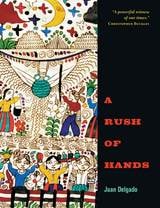
A Rush of Hands
Juan Delgado
University of Arizona Press, 2003
These poems deal honestly with the realities of urban life, whether dramatizing the effects of drive-by shootings, unfolding a labor protest that "spreads across the city like a prayer," or summoning a ghostlike immigrant damned to retrace his journey across the border. Daily and historical struggles are elevated to the level of myth. Yet, amid these poems there are images of life and love: a girl leaving hickeys rich as chocolate, a boy pledging to rescue his mother from poverty, a man studying the desert ground for tracks signaling immigrants in distress.
Delgado is unflinching in showing us the harshness surrounding the lives he cherishes, and with resonant details and lyrical language he urges us to examine those lives-and ultimately our own. A Rush of Hands is a spellbinding book that will captivate both the ear and the heart.
A User's Guide to Postcolonial and Latino Borderland Fiction
By Frederick Luis Aldama
University of Texas Press, 2009
Why are so many people attracted to narrative fiction? How do authors in this genre reframe experiences, people, and environments anchored to the real world without duplicating "real life"? In which ways does fiction differ from reality? What might fictional narrative and reality have in common—if anything?
By analyzing novels such as Arundhati Roy's The God of Small Things, Amitav Ghosh's The Glass Palace, Zadie Smith's White Teeth, and Hari Kunzru's The Impressionist, along with selected Latino comic books and short fiction, this book explores the peculiarities of the production and reception of postcolonial and Latino borderland fiction. Frederick Luis Aldama uses tools from disciplines such as film studies and cognitive science that allow the reader to establish how a fictional narrative is built, how it functions, and how it defines the boundaries of concepts that appear susceptible to limitless interpretations.
Aldama emphasizes how postcolonial and Latino borderland narrative fiction authors and artists use narrative devices to create their aesthetic blueprints in ways that loosely guide their readers' imagination and emotion. In A User's Guide to Postcolonial and Latino Borderland Fiction, he argues that the study of ethnic-identified narrative fiction must acknowledge its active engagement with world narrative fictional genres, storytelling modes, and techniques, as well as the way such fictions work to move their audiences.
Abuela in Shadow, Abuela in Light
Rigoberto González
University of Wisconsin Press, 2022
González travels to his abuela’s birthplace, Michoacán, Mexico, and along the way recovers his memories of a past he had tried to leave behind. A complex woman who was forced to take on maternal roles and suffered years of abuse, his grandmother simultaneously resisted traditional gender roles; she was kind yet unaffectionate, and she kept many secrets in a crowded household with little personal space. Sifting through family histories and anecdotes, González pieces together the puzzling life story of a woman who was present in her grandson’s life yet absent during his emotional journey as a young man discovering his sexuality and planning his escape from a toxic and abusive environment.
From fragments of memory and story, González ultimately creates a portrait of an unconventional yet memorable grandmother, a hard-working Indigenous Mexican woman who remained an enigma while she was alive. A grandmother, he shows, is more than what her descendants remember; she is also all that has been forgotten or never known. Through this candid exploration of his own family, González explores how we learn to remember and honor those we’ve lost.
Accessible Citizenships
Disability, Nation, and the Cultural Politics of Greater MexicoJulie Avril Minich
Temple University Press, 2013
A volume in the American Literatures Initiative
Acoustic Properties
Radio, Narrative, and the New Neighborhood of the AmericasTom McEnaney
Northwestern University Press, 2017
Based on original archival research in Buenos Aires, Havana, Paris, and the United States, the book develops a literary media theory that understands sound as a transmedial phenomenon and radio as a transnational medium. Analyzing the construction of new social and political relations in the wake of the United States’ 1930s Good Neighbor Policy, Acoustic Properties challenges standard narratives of hemispheric influence through new readings of Richard Wright’s cinematic work in Argentina, Severo Sarduy’s radio plays in France, and novels by John Dos Passos, Manuel Puig, Raymond Chandler, and Carson McCullers. Alongside these writers, the book also explores Che Guevara and Fidel Castro’s Radio Rebelde, FDR’s fireside chats, Félix Caignet’s invention of the radionovela in Cuba, Evita Perón’s populist melodramas in Argentina, Orson Welles’s experimental New Deal radio, Cuban and U.S. “radio wars,” and the 1960s African American activist Robert F. Williams’s proto–black power Radio Free Dixie.
From the doldrums of the Great Depression to the tumult of the Cuban Revolution, Acoustic Properties illuminates how novelists in the radio age converted writing into a practice of listening, transforming realism as they struggled to channel and shape popular power.
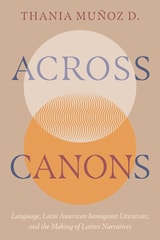
Across Canons
Language, Latin American Immigrant Literature, and the Making of Latinx NarrativesThania Muñoz D.
University of Arizona Press, 2026
Author Thania Muñoz D. looks at immigrant experiences impacted by a prism of social and political factors, including free trade agreements, drug trafficking, political violence, massive foreign debt, and economic dependency. The author examines why these writers refuse to identify as immigrants and reject stereotypical portrayals. Throughout, Muñoz D. makes the case for a new field within Latinx literature: Latin American immigrant writing in Spanish. She explains why this type of literary work is critical across Latin American, Latinx, and U.S. literature.
This book highlights the benefits of comparative, interdisciplinary interpretations that allow readers and scholars to grapple with the realities of a multilingual Latin American–origin literary present and future of the United States.
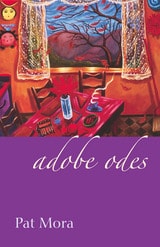
Adobe Odes
Pat Mora
University of Arizona Press, 2006
From family gossip and beauty secrets, to women darning hand-me-downs, to reluctant hands carrying bodies across borders, Mora traverses the tangled threads of culture, community, family, gender, and injustice. Her vivid observations together with her deft handling of symmetry and meter make her poetry uniquely insightful, subtle, and elegant. Sprinkled with Spanish and plenty of spice, each ode is a sensory flurry of mind and body. Together they make a cauldron of flavorful, simmering language. They are meant to be savored as they slowly stir the soul.
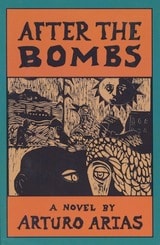
After the Bombs
Arturo Arias
Northwestern University Press, 1995
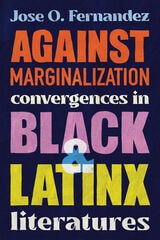
Against Marginalization
Convergences in Black and Latinx LiteraturesJose O. Fernandez
The Ohio State University Press, 2022
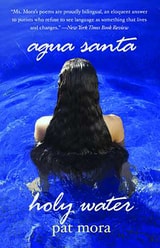
Agua Santa / Holy Water
Pat Mora
University of Arizona Press, 2007
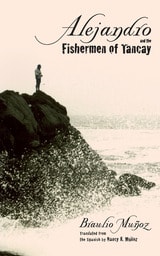
Alejandro and the Fishermen of Tancay
Braulio Muñoz
University of Arizona Press, 2008
Don Morales is a wise man. But he is also a sad man, mourning the loss of the past, of better times, of brotherhood. With his short, evocative stories—told with simplicity and beauty—he pulls his readers closer to him, as if he were speaking directly to us. For the good fishermen of Tancay, life was better yesterday than it is today. It was better to live in harmony with the sea. When they lived in harmony with the natural world, there was harmony in the human world, too.
With a nostalgic feel, yet reflecting Peru’s current political instability, this is a delightful book with an important message. When the natural order is disrupted, it is not only fish that die. When nature dies, so might we all.
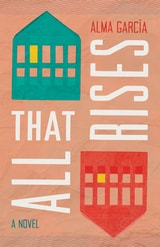
All That Rises
A NovelAlma García
University of Arizona Press, 2023
What follows is a story in which mysteries are unraveled, odd alliances are forged, and the boundaries between lives blur in destiny-changing ways—all in a place where the physical border between two countries is as palpable as it is porous, and the legacies of history are never far away. There are no easy solutions to the issues the characters face in this story, and their various realities—as undocumented workers, Border Patrol agents, the American supervisor of a Mexican factory employing an impoverished workforce—never play out against a black-and-white moral canvas. Instead, they are complex human beings with sometimes messy lives who struggle to create a place for themselves in a part of the world like no other, even as they are forced to confront the lives they have made.
All That Rises is about secrets, lies, border politics, and discovering where you belong—within a family, as well as in the world beyond. It is a novel for the times we live in, set in a place many people know only from the news.
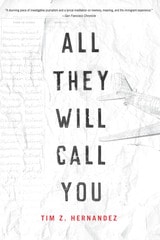
All They Will Call You
Tim Z. Hernandez
University of Arizona Press, 2017
All They Will Call You is the harrowing account of “the worst airplane disaster in California’s history,” which claimed the lives of thirty-two passengers, including twenty-eight Mexican citizens—farmworkers who were being deported by the U.S. government. Outraged that media reports omitted only the names of the Mexican passengers, American folk icon Woody Guthrie penned a poem that went on to become one of the most important protest songs of the twentieth century, “Plane Wreck at Los Gatos (Deportee).” It was an attempt to restore the dignity of the anonymous lives whose unidentified remains were buried in an unmarked mass grave in California’s Central Valley. For nearly seven decades, the song’s message would be carried on by the greatest artists of our time, including Pete Seeger, Dolly Parton, Bruce Springsteen, Bob Dylan, and Joan Baez, yet the question posed in Guthrie’s lyrics, “Who are these friends all scattered like dry leaves?” would remain unanswered—until now.
Combining years of painstaking investigative research and masterful storytelling, award-winning author Tim Z. Hernandez weaves a captivating narrative from testimony, historical records, and eyewitness accounts, reconstructing the incident and the lives behind the legendary song. This singularly original account pushes narrative boundaries, while challenging perceptions of what it means to be an immigrant in America, but more importantly, it renders intimate portraits of the individual souls who, despite social status, race, or nationality, shared a common fate one frigid morning in January 1948.
Along These Highways
Rene S. Perez II
University of Arizona Press, 2012
Amarisa's Cooking Pot
Tales of Life in All Its WondersDésirée Zamorano
University of Nevada Press, 2026
Each story is dedicated to capturing something ineffable, an emotional truth, a moment of beauty or realization, a moment of calm, or a spark of fury. What does it mean to be alive in a capricious world? Désirée Zamorano allows readers to explore this question beautifully, and memorably, long after the last page is turned.
Ameriscopia
Edwin Torres
University of Arizona Press, 2014
Ameriscopia reimagines New York City and its expansive inspirations, which for Torres capture the contradictions of America. Allusions to the Twin Towers, Coney Island hot dogs, and the Nuyorican Poet’s Cafe continuously recolor the pages. But even as he makes these iconic references, Torres allows his poems to invert and refract the identities they evoke—New-Yorker-American-Latino-Dad-Performer-Boy-Writer—to invigorate poetry out of its slumber into a deep cultural urgency. Torres’s kaleidoscopic vision is borne of decades of poetic experimentation. Audiences have delighted in his spontaneous mashups of disparate topic matters; writers have studied his skilled technique at synthesizing—for example, from a mundane curbside view to an imagined conversation with artists Marcel Duchamp and Yves Tanguy.
Torres writes, “I discovered that, this world uncovered / is like the soul / of The Puerto Rican man — occupied / by the weight of his balance.” Ameriscopia is Torres’s statement on growing up and the inspirational facets that accompany his journey into fatherhood. From conversations in cars to fast-beat lullabies, Torres’s poetry taps into rhythms both distinctive and dynamic. In Ameriscopia Torres is at full force, a poet in control, a writer emboldened by the page—in flight.
Amherst Suite
Emily Dickinson, Spanish Translation & Poetic TranscreationBy Alberto Blanco, Translated and Edited by Jennifer Rathbun, with an Introduction by Ilan Stavans
Amherst College Press, 2026
Opening with a creative essay by renowned author Ilan Stavans, the volume also includes a conversation between Blanco and scholar Ronald J. Friis; Blanco’s own essay on Dickinson, translated into English by Jennifer Rathbun; as well as an introduction by Rathbun that helpfully situates this interlinguistic, intercultural, and inter-generational network. Amherst Suite is a fascinating and unique look into the work and worlds of poets and their translators and will be an invaluable text for students, scholars, and all readers of Emily Dickinson.
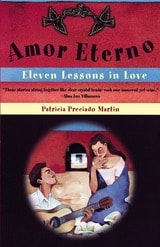
Amor Eterno
Eleven Lessons in LovePatricia Preciado Martin
University of Arizona Press, 2000
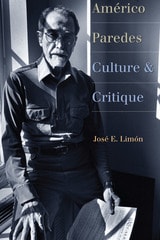
Américo Paredes
Culture and CritiqueBy José E. Limón
University of Texas Press, 2012
Several biographies of Américo Paredes have been published over the last decade, yet they generally overlook the paradoxical nature of his life’s work. Embarking on an in-depth, critical exploration of the significant body of work produced by Paredes, José E. Limón (one of Paredes’s students and now himself one of the world’s leading scholars in Mexican American studies) puts the spotlight on Paredes as a scholar/citizen who bridged multiple arenas of Mexican American cultural life during a time of intense social change and cultural renaissance.
Serving as a counterpoint to hagiographic commentaries, Américo Paredes challenges and corrects prevailing readings by contemporary critics of Paredes’s Asian period and of such works as the novel George Washington Gómez, illuminating new facets in Paredes’s role as a folklorist and public intellectual. Limón also explores how the field of cultural studies has drifted away from folklore, or “the poetics of everyday life,” while he examines the traits of Mexican American expressive culture. He also investigates the scholarly paradigm of ethnography itself, a stimulating inquiry that enhances readings of Paredes’s best-known study, “With His Pistol in His Hand,” and other works. Underscoring Paredes’s place in folklore and Mexican American literary production, the book questions the shifting reception of Paredes throughout his academic career, ultimately providing a deep hermeneutics of widely varied work. Offering new conceptions, interpretations, and perspectives, Américo Paredes gives this pivotal literary figure and his legacy the critical analysis they deserve.

An Eye for an I
Growing up with Blindness, Bigotry, and Family Mental IllnessJames Francisco Bonilla
University of Minnesota Press, 2025
The personal story of a blind Puerto Rican boy in New York who transcends a harrowing childhood to become a lifelong advocate for social justice
“Jovencito, it’s going to be lonely being different and yet strong in this world,” James Francisco Bonilla’s grandmother told him when he was ten. He had come home after defending himself against a bully who had threatened him with violence, making it clear that he didn’t care that James was blind. But despite the isolation James felt in childhood, he would come to commit his life to leveraging his differences and strengths toward a collective fight for justice. James’s memoir, An Eye for an I, is an inspiring account of how he found a path through his own suffering to make a difference for others.
Born with congenital cataracts, James had limited vision in his right eye and none in his left. At age nine, after a classmate hurled a horseshoe at his face in a racially motivated assault, James’s right eye was injured and he became legally blind. At home, too, he feared physical violence, experiencing the unpredictable outbursts of a single mother suffering from severe mental illness. Throughout his youth as a Puerto Rican New Yorker, James was continually failed by educational systems that exposed him to one abuse after another. Searching for relief and inspiration, he discovered an unexpected solace in the natural world, spiritual encounters with Mother Earth that led him toward both personal healing and advocacy.
At nineteen, a breakthrough in medical technology restored the sight in his right eye, and James recognized his unique perspective on the struggles of the disabled and marginalized in American life—and his intense will to make a difference. He seeks to understand generational trauma, and in documenting his growth—physically, mentally, and spiritually—his memoir exemplifies the introspection necessary to participate in truly equitable and effective movement building. An Eye for an I presents both James and his aggressors with refreshing nuance and humility, inviting readers to empathize, be inspired, and consider their own potential to be of service in a broken, yet beautiful, world.
Retail e-book files for this title are screen-reader friendly with images accompanied by short alt text and/or extended descriptions.
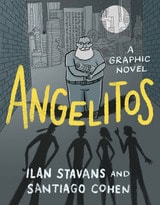
Angelitos
A Graphic NovelIlan Stavans and Santiago Cohen
The Ohio State University Press, 2018
Though Angelitos: A Graphic Novel is a fictional retelling of a desperate time, it draws on autobiographical elements to tell the real-life story of Alejandro García Durán de Lara, popularly known as Padre Chinchachoma, a complicated figure revered by some and reviled by others.
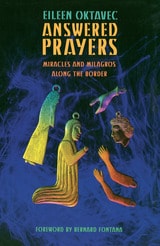
Answered Prayers
Miracles and Milagros along the BorderEileen Oktavec
University of Arizona Press, 1995
In Answered Prayers, the Mexicans, Mexican Americans, Tohono O'odham, and Yaquis who practice this tradition share their stories of unwavering faith and divine intervention. Anthropologist and photographer Eileen Oktavec has spent more than two decades documenting this fascinating tradition in the Arizona-Mexico borderlands. Quoting extensive interviews, she explains the beliefs of the people who perform this ancient folk ritual and the many rules guiding this practice. She also describes the many places where milagros are offered—from the elaborate Mexican baroque Mission San Xavier near Tucson, Arizona, to tiny household shrines and hospitals on both sides of the border. Oktavec also explains how milagros are made, where they are bought, and how they are used in jewelry, sculpture, and art.
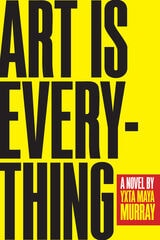
Art Is Everything
A NovelYxta Maya Murray
Northwestern University Press, 2021
In her funny, idiosyncratic, and propulsive new novel, Art Is Everything, Yxta Maya Murray offers us a portrait of a Chicana artist as a woman on the margins. L.A. native Amanda Ruiz is a successful performance artist who is madly in love with her girlfriend, a wealthy and pragmatic actuary named Xōchitl. Everything seems under control: Amanda’s grumpy father is living peacefully in Koreatown; Amanda is about to enjoy a residency at the Guggenheim Museum in New York and, once she gets her NEA, she’s going to film a groundbreaking autocritical documentary in Mexico.
But then everything starts to fall apart when Xōchitl’s biological clock begins beeping, Amanda’s father dies, and she endures a sexual assault. What happens to an artist when her emotional support vanishes along with her feelings of safety and her finances? Written as a series of web posts, Instagram essays, Snapchat freakouts, rejected Yelp reviews, Facebook screeds, and SmugMug streams-of-consciousness that merge volcanic confession with eagle-eyed art criticism, Art Is Everything shows us the painful but joyous development of a mid-career artist whose world implodes just as she has a breakthrough.
Ashes of Izalco
Claribel Alegría and Darwin J. Flakoll
Northwestern University Press, 1995
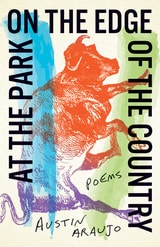
At the Park on the Edge of the Country
PoemsAustin Araujo
The Ohio State University Press, 2025
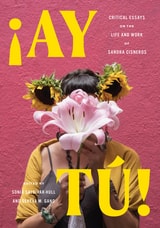
Ay Tú!
Critical Essays on the Life and Work of Sandra CisnerosSonia Saldívar-Hull and Geneva M. Gano
University of Texas Press, 2024
A comprehensive volume on the life and work of renowned Chicana author Sandra Cisneros.
Sandra Cisneros (b. 1954), author of the acclaimed novel The House on Mango Street and a recipient of the National Medal of the Arts, a MacArthur “Genius Grant” and the PEN/Nabokov Award for International Literature, was the first Chicana to be published by a major publishing house. ¡Ay Tú! is the first book to offer a comprehensive, critical examination of her life and work as a whole. Edited by scholars Sonia Saldívar-Hull and Geneva M. Gano, this volume addresses themes that pervade Cisneros’s oeuvre, like romantic and erotic love, female friendship, sexual abuse and harassment, the exoticization of the racial and ethnic “other,” and the role of visual arts in the lives of everyday people. Essays draw extensively on the newly opened Cisneros Papers, housed in the Wittliff Collections at Texas State University, and the volume concludes with a new long-form interview with Cisneros by the award-winning journalist Macarena Hernández.
As these essays reveal, Cisneros’s success in the literary field was integrally connected to the emergent Chicana feminist movement and the rapidly expanding Chicanx literary field of the late twentieth century. This collection shows that Cisneros didn’t achieve her groundbreaking successes in isolation and situates her as a vital Chicana feminist writer and artist.