Results by title
54 books match the query 'Indians in literature' and 6 start with a

A Pillar of Fire to Follow
American Indian Dramas, 1808–1859Priscilla Sears
University of Wisconsin Press, 1982
A Reader's Guide to the Novels of Louise Erdrich
Peter G. Beidler & Gay Barton
University of Missouri Press, 2006
American Indian Literature and the Southwest
Contexts and DispositionsBy Eric Gary Anderson
University of Texas Press, 1999
Culture-to-culture encounters between "natives" and "aliens" have gone on for centuries in the American Southwest—among American Indian tribes, between American Indians and Euro-Americans, and even, according to some, between humans and extraterrestrials at Roswell, New Mexico. Drawing on a wide range of cultural productions including novels, films, paintings, comic strips, and historical studies, this groundbreaking book explores the Southwest as both a real and a culturally constructed site of migration and encounter, in which the very identities of "alien" and "native" shift with each act of travel.
Eric Anderson pursues his inquiry through an unprecedented range of cultural texts. These include the Roswell spacecraft myths, Leslie Marmon Silko's Almanac of the Dead, Wendy Rose's poetry, the outlaw narratives of Billy the Kid, Apache autobiographies by Geronimo and Jason Betzinez, paintings by Georgia O'Keeffe, New West history by Patricia Nelson Limerick, Frank Norris' McTeague, Mary Austin's The Land of Little Rain, Sarah Winnemucca's Life Among the Piutes, Willa Cather's The Professor's House, George Herriman's modernist comic strip Krazy Kat, and A. A. Carr's Navajo-vampire novel Eye Killers.
American Indian Literature, Environmental Justice, and Ecocriticism
The Middle PlaceJoni Adamson
University of Arizona Press, 2001
This powerful book is one of the first to examine the intersections between literature and the environment from the perspective of the oppressions of race, class, gender, and nature, and the first to review American Indian literature from the standpoint of environmental justice and ecocriticism. By examining such texts as Sherman Alexie's short stories and Leslie Marmon Silko's novel Almanac of the Dead, Adamson contends that these works, in addition to being literary, are examples of ecological criticism that expand Euro-American concepts of nature and place.
Adamson shows that when we begin exploring the differences that shape diverse cultural and literary representations of nature, we discover the challenge they present to mainstream American culture, environmentalism, and literature. By comparing the work of Native authors such as Simon Ortiz with that of environmental writers such as Edward Abbey, she reveals opportunities for more multicultural conceptions of nature and the environment.
More than a work of literary criticism, this is a book about the search to find ways to understand our cultural and historical differences and similarities in order to arrive at a better agreement of what the human role in nature is and should be. It exposes the blind spots in early ecocriticism and shows the possibilities for building common ground— a middle place— where writers, scholars, teachers, and environmentalists might come together to work for social and environmental change.
Anti-Indianism in Modern America
A Voice from Tatekeya's EarthElizabeth Cook-Lynn
University of Illinois Press, 2000
Addressing Native American studies past, present, and future, the essays in New Indians, Old Wars tackle the discipline head-on, presenting a radical revision of the popular view of the American West in the process. Instead of luxuriating in the West's past glories or accepting the widespread historians' view of it as a shared place, Elizabeth Cook-Lynn argues that the American West should be fundamentally understood as stolen.
Cook-Lynn says that the Indian Wars of Resistance to the nineteenth- and twentieth-century colonial effort to seize native lands and resources must be given standing in the face of the ever-growing imperial narrative of America--because the terror the world is now witnessing may be the direct consequence of events which began in America's earliest dealings with the natives of this continent. Cook-Lynn's story examines the ongoing and perennial relationship of conflict between colonizers and indigenous people, and it is a story that every American must read.
Cook-Lynn understands that the story of the American West teaches the political language of land theft and tyranny. She argues that to remedy this situation, Native American studies must be considered and pursued as its own discipline, rather than as a subset of history or anthropology. She makes an impassioned claim that such a shift, not merely an institutional or theoretical change, could allow Native American studies to play an important role in defending the sovereignty of indigenous nations today.
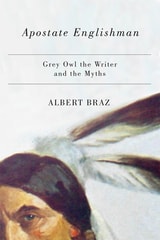
Apostate Englishman
Grey Owl the Writer and the MythsAlbert Braz
University of Manitoba Press, 2015