Results by title
155 books match the query 'Indians of South America' and 15 start with a
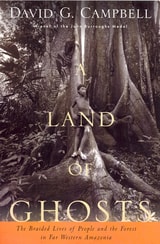
A Land of Ghosts
The Braided Lives of People and the Forest in Far Western AmazoniaCampbell, David G
Rutgers University Press, 2007
For thirty years David G. Campbell has explored the Amazon, an enchanting terrain of forest and river that is home to the greatest diversity of plants and animals to have ever existed, anywhere at any time, during the four-billion-year history of life on Earth.
With great artistic flair, Campbell describes a journey up the Rio Moa, a remote tributary of the Amazon River, 2,800 miles from its mouth. Here he joins three old friends: Arito, a caiman hunter turned paleontologist; Tarzan, a street urchin brought up in a bordello; and Pimentel, a master canoe pilot. They travel together deep into the rainforest and set up camp in order to survey every woody plant on a two-hectare plot of land with about as many tree species as in all of North America.
Campbell introduces us to two remarkable women, Dona Cabocla, a widow who raised six children on that lonely frontier, and Dona Ausira, a Nokini Native American who is the last speaker of her tribe's ages-old language. These pioneers live in a land whose original inhabitants were wiped out by centuries of disease, slavery, and genocide, taking their traditions and languages with them. He explores the intimate relationship between the extinction of native language and the extirpation of biological diversity. "It's hard for a people to love a place that is not defined in words and thus cannot be understood. And it's easy to give away something for which there are no words, something you never knew existed."
In elegant prose that enchants and entrances, Campbell has written an elegy for the Amazon forest and its peoples-for what has become a land of ghosts.
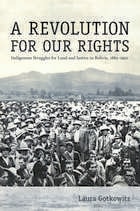
A Revolution for Our Rights
Indigenous Struggles for Land and Justice in Bolivia, 1880-1952Laura Gotkowitz
Duke University Press, 2008
Gotkowitz combines an emphasis on national political debates and congresses with a sharply focused analysis of Indian communities and large estates in the department of Cochabamba. The fragmented nature of Cochabamba’s Indian communities and the pioneering significance of its peasant unions make it a propitious vantage point for exploring contests over competing visions of the nation, justice, and rights. Scrutinizing state authorities’ efforts to impose the law in what was considered a lawless countryside, Gotkowitz shows how, time and again, indigenous activists shrewdly exploited the ambiguous status of the state’s pro-Indian laws to press their demands for land and justice. Bolivian indigenous and social movements have captured worldwide attention during the past several years. By describing indigenous mobilization in the decades preceding the revolution of 1952, A Revolution for Our Rights illuminates a crucial chapter in the long history behind present-day struggles in Bolivia and contributes to an understanding of indigenous politics in modern Latin America more broadly.
Advances in Titicaca Basin Archaeology–III
Edited by Alexei Vranich, Elizabeth A. Klarich and Charles Stanish
University of Michigan Press, 2012
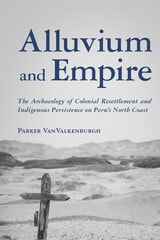
Alluvium and Empire
The Archaeology of Colonial Resettlement and Indigenous Persistence on Peru’s North CoastParker VanValkenburgh
University of Arizona Press, 2021
The volume draws on nearly ten years of field and archival research to craft a nuanced account of the Reducción General and its aftermath. Written at the intersections of history and archaeology, Alluvium and Empire at once bears witness to the violence of Spanish colonization and highlights Indigenous resilience in the aftermath of resettlement. In the process, VanValkenburgh critiques previous approaches to the study of empire and models a genealogical approach that attends to the open-ended—and often unpredictable—ways in which empires take shape.
Amazonian Indians from Prehistory to the Present
Anthropological PerspectivesAnna Roosevelt
University of Arizona Press, 1994
CONTENTS
Amazonian Anthropology: Strategy for a New Synthesis, Anna C. Roosevelt
The Ancient Amerindian Polities of the Amazon, Orinoco and Atlantic Coast: A Preliminary Analysis of Their Passage from Antiquity to Extinction, Neil Lancelot Whitehead
The Impact of Conquest on Contemporary Indigenous Peoples of the Guiana Shield: The System of Orinoco Regional Interdependence, Nelly Arvelo-Jiménez and Horacio Biord
Social Organization and Political Power in the Amazon Floodplain: The Ethnohistorical Sources, Antonio Porro
The Evidence for the Nature of the Process of Indigenous Deculturation and Destabilization in the Amazon Region in the Last 300 Years: Preliminary Data, Adélia Engrácia de Oliveira
Health and Demography of Native Amazonians: Historical Perspective and Current Status, Warren M. Hern
Diet and Nutritional Status of Amazonian Peoples, Darna L. Dufour
Hunting and Fishing in Amazonia: Hold the Answers, What are the Questions?, Stephen Beckerman
Homeostasis as a Cultural System: The Jivaro Case, Philippe Descola
Farming, Feuding, and Female Status: The Achuara Case, Pita Kelekna
Subsistence Strategy, Social Organization, and Warfare in Central Brazil in the Context of European Penetration, Nancy M. Flowers
Environmental and Social Implications of Pre- and Post-Contact Situations on Brazilian Indians: The Kayapo and a New Amazonian Synthesis, Darrell Addison Posey
Beyond Resistance: A Comparative Study of Utopian Renewal in Amazonia, Michael F. Brown
The Eastern Bororo Seen from an Archaeological Perspective, Irmhilde Wüst
Genetic Relatedness and Language Distributions in Amazonia, Harriet E. Manelis Klein
Language, Culture, and Environment: Tup¡-Guaran¡ Plant Names Over Time, William Balée and Denny Moore
Becoming Indian: The Politics of Tukanoan Ethnicity, Jean E. Jackson
Amazonian Linguistics
Studies in Lowland South American LanguagesEdited by Doris L. Payne
University of Texas Press, 1990
Lowland South American languages have been among the least studied ln the world. Consequently, their previous contribution to linguistic theory and language universals has been small. However, as this volume demonstrates, tremendous diversity and significance are found in the languages of this region.
These nineteen essays, originally presented at a conference on Amazonian languages held at the University of Oregon, offer new information on the Tupian, Cariban, Jivaroan, Nambiquaran, Arawakan, Tucanoan, and Makuan languages and new analyses of previously recalcitrant Tupí-Guaraní verb agreement systems.
The studies are descriptive, but typological and theoretical implications are consistently considered. Authors invariably indicate where previous claims must be adjusted based on the new information presented. This is true in the areas of nonlinear phonological theory, verb agreement systems and ergativity, grammatical relations and incorporation, and the uniqueness of Amazonian noun classification systems. The studies also contribute to the now extensive interest in grammatical change.
Ancient Andean Political Economy
By Charles Stanish
University of Texas Press, 1992
For more than two millennia prior to the Spanish conquest, the southern region of the central Andes was home to dozens of societies, ranging from modest chiefdoms to imperial states. Attempts to understand the political and economic dynamics of this complex region have included at least two major theories in Andean anthropology. In this pathfinding study, Charles Stanish shows that they are not exclusive and competing models, but rather can be understood as variations within a larger theoretical framework.
Stanish builds his arguments around a case study from the Moquequa region of Peru, augmented with data from Puno. He uses the "archaeological household" as his basic unit of analysis. This approach allows him to reconcile the now-classic model of zonal complementarity proposed by John Murra with the model of craft specialization and exchange offered by Maria Rostworowski de Diez Canseco. These models of political economy are analyzed with the concepts of economic anthropology in the tradition of Karl Polanyi.
For students of archaeology, Andean studies, anthropology, and economic history, Ancient Andean Political Economy will be important reading.
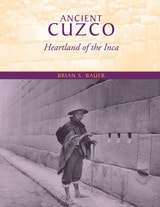
Ancient Cuzco
Heartland of the IncaBy Brian S. Bauer
University of Texas Press, 2004
The Cuzco Valley of Peru was both the sacred and the political center of the largest state in the prehistoric Americas—the Inca Empire. From the city of Cuzco, the Incas ruled at least eight million people in a realm that stretched from modern-day Colombia to Chile. Yet, despite its great importance in the cultural development of the Americas, the Cuzco Valley has only recently received the same kind of systematic archaeological survey long since conducted at other New World centers of civilization.
Drawing on the results of the Cuzco Valley Archaeological Project that Brian Bauer directed from 1994 to 2000, this landmark book undertakes the first general overview of the prehistory of the Cuzco region from the arrival of the first hunter-gatherers (ca. 7000 B.C.) to the fall of the Inca Empire in A.D. 1532. Combining archaeological survey and excavation data with historical records, the book addresses both the specific patterns of settlement in the Cuzco Valley and the larger processes of cultural development. With its wealth of new information, this book will become the baseline for research on the Inca and the Cuzco Valley for years to come.
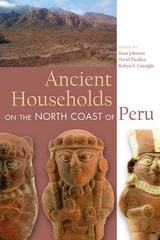
Ancient Households on the North Coast of Peru
Ilana Johnson
University Press of Colorado, 2020
Many volumes on this region are limited to one time period or civilization, often the Moche. While Ancient Households on the North Coast of Peru does examine the Moche, it offers a wider thematic approach to a broader swath of prehistory. Chapters on various time periods use a comparable scale of analysis to examine long-term continuity and change and draw on a large corpus of prior research on states, rulership, and cosmology to offer new insight into the intersection of household, community, and state. Contributors address social reproduction, construction and reinforcement of gender identities and social hierarchy, household permanence and resilience, and expression of identity through cuisine.
This volume challenges common concepts of the “household” in archaeology by demonstrating the complexity and heterogeneity of household-level dynamics as they intersect with institutions at broader social scales and takes a comparative perspective on daily life within one region of the Andes. It will be of interest to both students and scholars of South American archaeology and household archaeology.
Contributors: Brian R. Billman, David Chicoine, Guy S. Duke, Hugo Ikehara, Giles Spence-Morrow, Jessica Ortiz, Edward Swenson, Kari A. Zobler
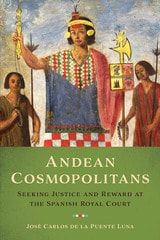
Andean Cosmopolitans
Seeking Justice and Reward at the Spanish Royal CourtBy José Carlos de la Puente Luna
University of Texas Press, 2018
Winner, Premio Flora Tristán Al Mejor Libro, Peru Section, Latin American Studies Association, 2019
After the Spanish victories over the Inca claimed Tawantinsuyu for Charles V in the 1530s, native Andeans undertook a series of perilous trips from Peru to the royal court in Spain. Ranging from an indigenous commoner entrusted with delivering birds of prey for courtly entertainment to an Inca prince who spent his days amid titles, pensions, and other royal favors, these sojourners were both exceptional and paradigmatic. Together, they shared a conviction that the sovereign’s absolute authority would guarantee that justice would be done and service would receive its due reward. As they negotiated their claims with imperial officials, Amerindian peoples helped forge the connections that sustained the expanding Habsburg realm’s imaginary and gave the modern global age its defining character.
Andean Cosmopolitans recovers these travelers’ dramatic experiences, while simultaneously highlighting their profound influences on the making and remaking of the colonial world. While Spain’s American possessions became Spanish in many ways, the Andean travelers (in their cosmopolitan lives and journeys) also helped to shape Spain in the image and likeness of Peru. De la Puente brings remarkable insights to a narrative showing how previously unknown peoples and ideas created new power structures and institutions, as well as novel ways of being urban, Indian, elite, and subject. As indigenous people articulated and defended their own views regarding the legal and political character of the “Republic of the Indians,” they became state-builders of a special kind, cocreating the colonial order.
Animal Myths and Metaphors in South America
URTON
University of Utah Press, 1985
The contributors to this anthology have not limited themselves to the notion that clans and moieties are the only sources and objects of metaphorical comparisons between humans and animals. They suggest a shift in perspective that has metaphorical comparisons generated by conceived similarities and differences between animals and particular types of human beings. Some examples of this include macaw fledglings as adolescents; pumas as fully initiated men, and foxes as young married men. With this shift of emphasis, a significantly different analytic focus in the study of human-animal relations is produced.
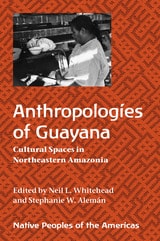
Anthropologies of Guayana
Cultural Spaces in Northeastern AmazoniaEdited by Neil L. Whitehead and Stephanie Alemán
University of Arizona Press, 2009
This is an important collection that brings together the work of scholars from North America, South America, and Europe to reveal the anthropological significance of Guayana, the ancient realm of El Dorado and still the scene of gold and diamond mining. Beginning with the earliest civilizations of the region, the chapters focus on the historical ecology of the rain forest and the archaeological record up to the sixteenth century, as well as ethnography, ethnology, and perceptions of space. The book features extensive discussions of the history of a range of indigenous groups, such as the Waiwai, Trio, Wajãpi, and Palikur. Contributions analyze the emergence of a postcolonial national society, the contrasts between the coastlands and upland regions, and the significance of race and violence in contemporary politics.
A noteworthy study of the prehistory and history of the region, the book also provides a useful survey of the current issues facing northeastern Amazonia. The chapters extend the anthropological agenda beyond the conventional focus on the “indigenous” even as contributors describe how Guayanese languages, mythologies, and social structures have remained resilient in the face of intense outside pressures.
Anxious Pleasures
The Sexual Lives of an Amazonian PeopleThomas Gregor
University of Chicago Press, 1987
Archaeology of Wak'as
Explorations of the Sacred in the Pre-Columbian AndesTamara L. Bray
University Press of Colorado, 2014
Wak'as were understood as agentive, nonhuman persons within many Andean communities and were fundamental to conceptions of place, alimentation, fertility, identity, and memory and the political construction of ecology and life cycles. The ethnohistoric record indicates that wak'as were thought to speak, hear, and communicate, both among themselves and with humans. In their capacity as nonhuman persons, they shared familial relations with members of the community, for instance, young women were wed to local wak'as made of stone and wak'as had sons and daughters who were identified as the mummified remains of the community's revered ancestors.
Integrating linguistic, ethnohistoric, ethnographic, and archaeological data, The Archaeology of Wak'as advances our understanding of the nature and culture of wak'as and contributes to the larger theoretical discussions on the meaning and role of–"the sacred” in ancient contexts.
Art, Nature, and Religion in the Central Andes
Themes and Variations from Prehistory to the PresentBy Mary Strong
University of Texas Press, 2012
From prehistory to the present, the Indigenous peoples of the Andes have used a visual symbol system—that is, art—to express their sense of the sacred and its immanence in the natural world. Many visual motifs that originated prior to the Incas still appear in Andean art today, despite the onslaught of cultural disruption that native Andeans have endured over several centuries. Indeed, art has always been a unifying power through which Andeans maintain their spirituality, pride, and culture while resisting the oppression of the dominant society.
In this book, Mary Strong takes a significantly new approach to Andean art that links prehistoric to contemporary forms through an ethnographic understanding of Indigenous Andean culture. In the first part of the book, she provides a broad historical survey of Andean art that explores how Andean religious concepts have been expressed in art and how artists have responded to cultural encounters and impositions, ranging from invasion and conquest to international labor migration and the internet. In the second part, Strong looks at eight contemporary art types—the scissors dance (danza de tijeras), home altars (retablos), carved gourds (mates), ceramics (ceramica), painted boards (tablas), weavings (textiles), tinware (hojalateria), and Huamanga stone carvings (piedra de Huamanga). She includes prehistoric and historic information about each art form, its religious meaning, the natural environment and sociopolitical processes that help to shape its expression, and how it is constructed or performed by today’s artists, many of whom are quoted in the book.