Results by title
63 books match the query 'Indigenous Languages in the Americas' and 6 start with a

A Grammar Of Misantla Totonac
Carolyn Mackay
University of Utah Press, 1999
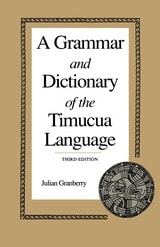
A Grammar and Dictionary of the Timucua Language
Julian Granberry
University of Alabama Press, 1993
Preserving the voice of a vanished people through language, history, and scholarship.
Taken from the surviving contemporary documentary sources, Julian Granberry's volume describes the grammar and lexicon for the extinct 17th-century Timucua language of Central and North Florida and traces the origins of the 17th-century Timucua speakers and their language. Originally privately published in 1987, with limited circulation, this is the only available publication on the Timucuan language. It provides full grammatical analysis and complete lexical data, and it synthesizes both linguistic and archaeological data in order to provide a coherent picture of the Timucua peoples. Granberry traces the probable historical origins of Timucua speakers to a central Amazonian homeland at approximately 2,500 B.C. and proposes that Timucua speakers were responsible for introducing ceramic wares into North America.

A Tohono O'odham Grammar
Ofelia Zepeda
University of Arizona Press, 1983
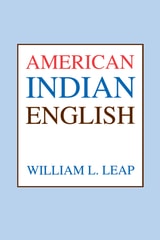
American Indian English
William L Leap
University of Utah Press, 1993
A distillation of over twenty years’ experience, William Leap’s pioneering work on the varieties of American Indian English explores the linguistic and sociolinguistic characteristics of language use among Navajo, Hopi, Mojave, Ute, Tsimshian, Kotzebue, Ponca, Chilcotin, Seminole, Cherokee, and other American Indian tribes.
Unlike contemporary studies on schooling, ethnicity, empowerment, and educational failure, American Indian English avoids postmodernist jargon and discourse strategies in favor of direct description and commentary. Data are derived from real-life conditions faced by speakers of Indian English in various English-speaking settings. This practical focus enhances the book’s accessibility to Indian educators and community-based teachers, as well as non-Indian academics.
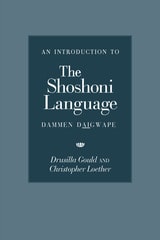
An Introduction to the Shoshoni Language
Dammen DaigwapeDrusilla Gould
University of Utah Press, 2003
Listen to the open source audio companion to this book:
An Introduction to the Shoshoni Language Chapter 1
An Introduction to the Shoshoni Language Chapter 2
An Introduction to the Shoshoni Language Chapter 3
An Introduction to the Shoshoni Language Chapter 4
An Introduction to the Shoshoni Language Chapter 5
An Introduction to the Shoshoni Language Chapter 6
An Introduction to the Shoshoni Language Chapter 7
An Introduction to the Shoshoni Language Chapter 8
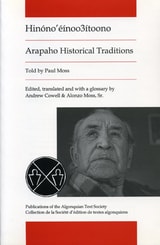
Arapaho Historical Traditions
Hinono'einoo3itoonoAlonzo Moss, Sr.
University of Manitoba Press, 2005