Results by title
84 books match the query 'Instruction & Study' and 8 start with a

A Gift of Madrigals and Motets
Edited by H. Colin Slim
University of Chicago Press, 1972
At first encounter, these partbooks yield no clues concerning their provenance, their composers' names, or the reasons for their dispatch to England. In his search for this information, Professor Slim used the musicologists' customary tools, namely, biobibliography, concordances, and textual and musical analysis. But he also used bibliographers' tools not always employed by musicologists: watermarks, bindings, script, orthography, and illuminations.
As a result of his efforts, the author was able to identify nearly all the works' composers and the manuscripts' expert illuminator. He also presents a detailed description of the binding process and the probably background of the scribe, places the political and social references in the works, and determines the route the volumes may have taken after they left Henry's library.
By placing the date of the partbooks' arrival in England around 1528, Professor Slim suggests that the musical culture of the early Tudor court was less French than has hitherto been thought. Indeed, the presence of the partbooks in Henry's library makes them the earliest evidence of the Italian madrigal in England. The author also provides new and significant data on the artistic and historical position of Philippe Verdelot, the partbooks' most extensively represented composer.
Volume I of this set contains two parts. The first, dealing with the manuscript itself, contains the history of the partbooks, information on their origin, composers, texts, and their importance as a gift to Henry VIII. Part II, dealing with the music, discusses general musical traits, the motets, the madrigals, the results of collation, and the appearance of some of the Newberry motets and madrigals in other sources.
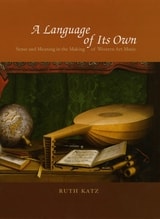
A Language of Its Own
Sense and Meaning in the Making of Western Art MusicRuth Katz
University of Chicago Press, 2009
The Western musical tradition has produced not only music, but also countless writings about music that remain in continuous—and enormously influential—dialogue with their subject. With sweeping scope and philosophical depth, A Language of Its Own traces the past millennium of this ongoing exchange.
Ruth Katz argues that the indispensible relationship between intellectual production and musical creation gave rise to the Western conception of music. This evolving and sometimes conflicted process, in turn, shaped the art form itself. As ideas entered music from the contexts in which it existed, its internal language developed in tandem with shifts in intellectual and social history. Katz explores how this infrastructure allowed music to explain itself from within, creating a self-referential and rational foundation that has begun to erode in recent years.
A magisterial exploration of a frequently overlooked intersection of Western art and philosophy, A Language of Its Own restores music to its rightful place in the history of ideas.
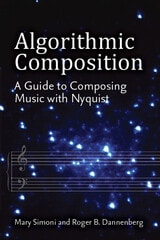
Algorithmic Composition
A Guide to Composing Music with NyquistMary Simoni and Roger B. Dannenberg
University of Michigan Press, 2013
Composers have used formalized procedures to create music throughout history. With the advent of the computer, algorithmic composition allows composers not only to create and experiment with different formalisms, but to hear and evaluate results quickly. Often in algorithmic composition, the composer has only a vague idea how the output will sound, but because the input is highly automated, the composer can make adjustments to take advantage of happy accidents, program bugs, and other creative sources of sound.
Algorithmic Composition: A Guide to Composing Music with Nyquistprovides an overview of procedural approaches to music generation. It introduces programming concepts through many examples written using the Nyquist system for music composition and sound synthesis. Nyquist is freely available software, and over 100 program examples from this book are available in electronic form. Readers will be well equipped to develop their own algorithms for composition.
Music students who are learning about computer music and electronic music will all be interested in this innovative book, as generative music becomes an important part of the future of the discipline. Students and scholars in computer science will also find much to interest them, in a straightforward and fun way.

Analyzing NES Music
Harmony, Form, and the Art of Technological ConstraintAndrew Schartmann
Intellect Books, 2025
Faced with severe technological constraints on system memory, composers of the Nintendo Entertainment System (NES) sought ways to disguise repetition in music that repeats extensively. Their efforts gave rise to a set of compositional techniques for creating the illusion of variety.
This book distills these techniques into a theory of harmony and form for the analysis of NES music. It then uses this theory to analyze five landmark scores of the NES era: Super Mario Bros., Dragon Warrior, Metroid, Mega Man 2, and Silver Surfer. The book also includes a detailed description of the NES hardware and its attendant constraints, highlighting the ever-evolving dialogue between technology, commercial demand, and artistic sensibility that characterizes video game music of the 1980s and 1990s.
Applications of Research in Music Behavior
Clifford K. Madsen
University of Alabama Press, 1991
Applications of Research in Music Behavior stresses the practical applications and implications of investigating music behavior in a systematic, objective manner. Specifically, the book focuses on factors influencing the teaching of children; efficient methods for instructing future teachers; elements affecting musical perception, likes, and dislikes; and innovative efforts to investigate new areas of study. Recent studies by twenty-six nationally known educators that use objective strategies associated with experimental and behavioral research are presented to illustrate how people learn about music and how people are taught to make music.
The research studies are introduced by an article emphasizing the usefulness of research literature in devising a teaching strategy and are grouped into four sections: Teaching Music to Children, Teaching Future Teachers, Preference and Perception, and New Horizons. The concluding article is an allegorical proposal for balance and perspective in the consideration of music education.
Art and Freedom
E. E. Sleinis
University of Illinois Press, 2002
What does a life with art offer that a life without art does not? Art and Freedom asserts that the fundamental point of the enterprise of art is the creation and delivery of values that are not singularly available in the nonart world.
E. E. Sleinis discusses visual art, literature, music, theater, and other art forms, arguing that as art both liberates and provides new points of focus and awareness, the art enterprise depends on a positive freeing from the nonart world, rather than on mere addition to it.
Art and Freedom introduces a novel classificatory system for representation, expression, and formalist theories of art. Sleinis argues that a characteristic defect of contemporary theories of art is their neglect of the issue of value. Challenging these reductive, formalist notions of art, he emphasizes the potential, and the need, for art to evolve and make progress in ways comparable to the sciences, albeit on a very different model.
A smart blend of incisive commentary and illuminating philosophy, Art and Freedom provides a useful context for transforming a sometimes baffling medium into a means of fostering personal growth and creating and sharing values.
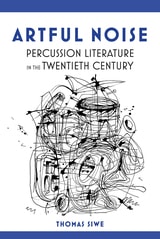
Artful Noise
Percussion Literature in the Twentieth CenturyThomas Siwe
University of Illinois Press, 2020
Percussionist Thomas Siwe organizes and analyzes the groundbreaking musical literature that arose during the twentieth century. Focusing on innovations in style and the evolution of the percussion ensemble, Siwe offers a historical overview that connects the music to scoring techniques, new instrumentation and evolving technologies as well as world events. Discussions of representative pieces by seminal composers examines the resources a work requires, its construction, and how it relates to other styles that developed during the same period. In addition, Siwe details the form and purpose of many of the compositions while providing background information on noteworthy artists. Each chapter is supported with musical examples and concludes with a short list of related works specifically designed to steer musicians and instructors alike toward profitable explorations of composers, styles, and eras.
Aspects of Orality and Formularity in Gregorian Chant
Theodore Karp
Northwestern University Press, 1998
The essays are loosely connected through their bearing on one or more of three themes: the role of orality in the transmission of chant circa 700-1400; varying degrees of stability or instability in the transmission of chant; and the role of the formula in the construction of chant. Throughout, Karp uses 202 musical examples.
The first essay evaluates forms of evidence that may shed light on the nature of orality that led to the surviving notational records of Gregorian chant and assembles evidence that supports the conclusion that fidelity of transmission represented an important goal of the Franks. The second essay treats formulas that cross the boundaries of individual liturgical genres and modes. The third essay defines the varying kinds of musical formulas in chant and proposes a chronological ordering of the genre of second-mode tracts.
The fourth essay treats the transmission of a stable melody and explores the ways in which one basic melody may be adapted to texts of widely differing structures and lengths. The fifth essay deals with a group of unstable melodies that furnished difficulties in modal classification. The sixth essay explores the problems faced by scribes seeking to represent in diastematic notation melodies employing tones not normally admitted into the medieval gamut. The seventh essay takes up the role of the formula in introits, a neumatic genre intended forchoral performance.
The two final essays look at second-mode tracts and at the interrelationship between Roman and Gregorian chant.