Results by title
73 books match the query 'Jazz musicians' and 3 start with a
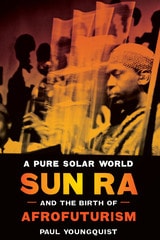
A Pure Solar World
Sun Ra and the Birth of AfrofuturismBy Paul Youngquist
University of Texas Press, 2016
Surveying the range of Sun Ra’s extraordinary creativity, this book explores how the father of Afrofuturism brought “space music” to a planet in need of transformation, supporting the aspirations of black people in an inhospitable white world.
Sun Ra said he came from Saturn. Known on earth for his inventive music and extravagant stage shows, he pioneered free-form improvisation in an ensemble setting with the devoted band he called the “Arkestra.” Sun Ra took jazz from the inner city to outer space, infusing traditional swing with far-out harmonies, rhythms, and sounds. Described as the father of Afrofuturism, Sun Ra created “space music” as a means of building a better future for American blacks here on earth.
A Pure Solar World: Sun Ra and the Birth of Afrofuturism offers a spirited introduction to the life and work of this legendary but underappreciated musician, composer, and poet. Paul Youngquist explores and assesses Sun Ra’s wide-ranging creative output—music, public preaching, graphic design, film and stage performance, and poetry—and connects his diverse undertakings to the culture and politics of his times, including the space race, the rise of technocracy, the civil rights movement, and even space-age bachelor-pad music. By thoroughly examining the astro-black mythology that Sun Ra espoused, Youngquist masterfully demonstrates that he offered both a holistic response to a planet desperately in need of new visions and vibrations and a new kind of political activism that used popular culture to advance social change. In a nation obsessed with space and confused about race, Sun Ra aimed not just at assimilation for the socially disfranchised but even more at a wholesale transformation of American society and a more creative, egalitarian world.
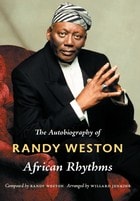
African Rhythms
The Autobiography of Randy WestonRandy Weston
Duke University Press, 2010
Africa is at the core of Weston’s music and spirituality. He has traversed the continent on a continuous quest to learn about its musical traditions, produced its first major jazz festival, and lived for years in Morocco, where he opened a popular jazz club, the African Rhythms Club, in Tangier. Weston’s narrative is replete with tales of the people he has met and befriended, and with whom he has worked. He describes his unique partnerships with Langston Hughes, the musician and arranger Melba Liston, and the jazz scholar Marshall Stearns, as well as his friendships and collaborations with Duke Ellington, Dizzy Gillespie, Coleman Hawkins, Thelonious Monk, Billy Strayhorn, Max Roach, Charlie Parker, Miles Davis, the novelist Paul Bowles, the Cuban percussionist Candido Camero, the Ghanaian jazz artist Kofi Ghanaba, the Gnawa musicians of Morocco, and many others. With African Rhythms, an international jazz virtuoso continues to create cultural history.

Avant-Garde Jazz Musicians
Performing "Out There"David G. Such
University of Iowa Press, 1993
Avant-Garde Jazz Musicians focuses on performers whose out styles, by definition, transcend traditional boundaries of jazz and most Western forms of music; some of these performers are well known, such as John Coltrane, Ornette Coleman, and Cecil Taylor, and others are not, including Daniel Carter, Billy Bang, and Jemeel Moondoc. David Such uses an interdisciplinary approach, ranging from philosophy to ethnomusicology to psychobiology, to examine how both cultural and personal factors have influenced the out musicians and their music and what the music symbolizes to listeners and to the musicians themselves.
Such strikes a balance between out music itself and the cultural domain as he explores the social contexts and economic pressures that affect out musical performance. Using material from extensive personal interviews, Such evaluates the impact of civil rights, postindustrialization, and urbanization on the beliefs and attitudes of out musicians.
By performing with many of the out musicians he interviews, Such is able to examine out music and the worldviews of out musicians in a uniquely comprehensive manner and to resolve some of the more controversial issues surrounding out jazz. In the process, he makes out music more understandable to jazz fans and scholars alike and clarifies its role in the overall development of jazz.