135 books match the query 'Landscape' and 8 start with a
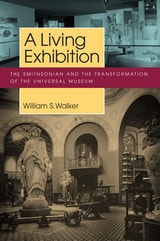
cover of A Living Exhibition: The Smithsonian and the Transformation of the Universal Museum

A Living Exhibition

The Smithsonian and the Transformation of the Universal Museum

William S. Walker

University of Massachusetts Press, 2013

Since its founding in 1846 “for the increase and diffusion of knowledge,” the Smithsonian Institution has been an important feature of the American cultural landscape. In A Living Exhibition, William S. Walker examines the tangled history of cultural exhibition at the Smithsonian from its early years to the chartering of the National Museum of the American Indian in 1989. He tracks the transformation of the institution from its original ideal as a “universal museum” intended to present the totality of human experience to the variegated museum and research complex of today.

Walker pays particular attention to the half century following World War II, when the Smithsonian significantly expanded. Focusing on its exhibitions of cultural history, cultural anthropology, and folk life, he places the Smithsonian within the larger context of Cold War America and the social movements of the 1960s, '70s, and '80s. Organized chronologically, the book uses the lens of the Smithsonian's changing exhibitions to show how institutional decisions become intertwined with broader public debates about pluralism, multiculturalism, and decolonization. 

Yet if a trend toward more culturally specific museums and exhibitions characterized the postwar history of the institution, its leaders and curators did not abandon the vision of the universal museum. Instead, Walker shows, even as the Smithsonian evolved into an extensive complex of museums, galleries, and research centers, it continued to negotiate the imperatives of cultural convergence as well as divergence, embodying both a desire to put everything together and a need to take it all apart.
[more]
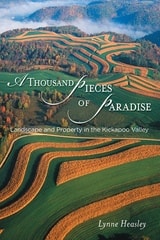
cover of A Thousand Pieces of Paradise: Landscape and Property in the Kickapoo Valley

A Thousand Pieces of Paradise

Landscape and Property in the Kickapoo Valley

Lynne Heasley

University of Wisconsin Press, 2012

A Thousand Pieces of Paradise is an ecological history of property and a cultural history of rural ecosystems set in one of the Midwest’s most historically significant regions, the Kickapoo River Valley. Whether examining the national war on soil erosion, Amish migration, a Corps of Engineers dam project, or Native American land claims, Lynne Heasley traces the history of modern American property debates. Her book holds powerful lessons for rural communities seeking to reconcile competing values about land and their place in it.
[more]
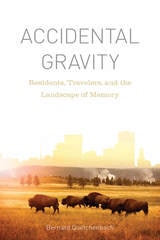
cover of Accidental Gravity: Residents, Travelers, and the Landscape of Memory

Accidental Gravity

Residents, Travelers, and the Landscape of Memory

Bernard Quetchenbach

Oregon State University Press, 2017

The compelling essays in Bernard Quetchenbach’s Accidental Gravity move from upstate New York to the western United States, from urban and suburban places to wild lands. In the first section of the book, he focuses on suburban neighborhoods, where residents respond ambivalently to golf-course geese and other unruly natural presences; in the second section, he juxtaposes these humanized places with Yellowstone National Park. Quetchenbach writes about current environmental issues in the Greater Yellowstone area—wildfire, invasive species, ever-increasing numbers of tourists—in the context of climate change and other contemporary pressures.
 
Accidental Gravity negotiates the difficult edge between a naive belief in an enduring, unassailable natural world and the equally naive belief that human life takes place in some unnatural, more mediated context. The title refers to the accidental but nonetheless meaningful nexus where the personal meets and combines with the universal—those serendipitous moments when the individual life connects to the larger rhythms of time and planet.

 
[more]
cover of Albrecht Altdorfer and the Origins of Landscape

Albrecht Altdorfer and the Origins of Landscape

Christopher S. Wood

University of Chicago Press, 1993
In the early sixteenth century, Albrecht Altdorfer promoted landscape from its traditional role as background to its new place as the focal point of a picture. His paintings, drawings, and etchings appeared almost without warning and mysteriously disappeared from view just as suddenly. In Albrecht Altdorfer and the Origins of Landscape,Christopher S. Wood shows how Altdorfer transformed what had been the mere setting for sacred and historical figures into a principal venue for stylish draftsmanship and idiosyncratic painterly effects. At the same time, his landscapes offered a densely textured interpretation of that quintessentially German locus—the forest interior.
 
This revised and expanded second edition contains a new introduction, revised bibliography, and fifteen additional illustrations.
 
“Excellent illustrations . . . [and] detailed exuberant comments leave the reader in no doubt about Altdorfer’s brilliance and originality.”—Anthony Grafton, New York Review of Books
 
“A study that is bound to become a standard work.”—Independent on Sunday
 
“Sumptuous.”—Daily Telegraph
[more]
cover of Alliance and Landscape on Perry Mesa in the Fourteenth Century

Alliance and Landscape on Perry Mesa in the Fourteenth Century

David R. Abbott

University of Utah Press, 2014

About forty miles north of Phoenix, Arizona, Perry Mesa is today part of Agua Fria National Monument, but during the late thirteenth and early fourteenth centuries, this windswept arid landscape became the site of numerous farming communities. This book explores why people moved to Perry Mesa at that time. Analyses of Perry Mesa contrast with those of the iconic large-scale migrations in the prehistoric Southwest such as the Kayenta diaspora and the gathering of the clans at Hopi. Unlike those long-distance movements into occupied regions, the Perry Mesa case is one of relatively localized aggregation on a largely vacant landscape. But, as was discovered with the iconic migrations, ethnogenesis (the creation of new identities) took hold on Perry Mesa, making it an extremely interesting counterpoint to the better-known migrations of the period.
     Contributors to this volume examine the migration process under two explanatory frameworks: alliance and landscape. These frameworks are used to explore competing hypotheses, positing either a rapid colonization associated with an alliance organized for warfare at a regional scale, or a more protracted migration as this landscape became comparatively more attractive for migrating farmers in the late thirteenth century.
     As the first major publication on the archaeology of Perry Mesa, this volume contributes to theoretical perspectives on migration and ethnogenesis, the study of warfare in the prehistoric Southwest, the study of intensive agricultural practices in a marginal environment, and the cultural history of a little studied and largely unknown portion of the ancient Southwest. It not only documents the migration but also the ensuing birth of a new ethnic identity that arose from the coalescence of diverse groups atop Perry Mesa.

[more]
cover of American Architects and Their Books, 1840-1915

American Architects and Their Books, 1840-1915

Kenneth Hafertepe

University of Massachusetts Press, 2007

Since the Renaissance, architects have been authors and architecture has been the subject of publications. Architectural forms and theories are spread not just by buildings, but by the distribution of images and descriptions fed through the printing press. The study of an architect's library is an essential avenue to understanding that architect's intentions and judging his or her achievements.

In this well-illustrated volume, a chronological sequel to American Architects and Their Books to 1848, twelve distinguished historians of architecture discuss from various points of view the books that inspired architects both famous and not-so-famous, and the books the architects themselves produced. They examine the multifaceted relationship of nineteenth- and early twentieth-century architects to print culture—the literary works that architects collected, used, argued over, wrote, illustrated, designed, printed, were inspired by, cribbed from, educated clients with, advertised their services through, designed libraries for, or just plain enjoyed. The result is a volume that presents the intersection of the history of architecture, the history of ideas, and the history of the book. Changes in print culture during this period had a significant impact on the architectural profession, as revealed in these well-informed scholarly essays.

In addition to the editors, contributors include Jhennifer A. Amundson, Edward R. Bosley, Ted Cavanagh, Elspeth Cowell, Elaine Harrington, Michael J. Lewis, Anne E. Mallek, Daniel D. Reiff, Earle G. Shettleworth, Jr., and Chris Szczesny-Adams. Among the architects discussed are A. J. Downing, Charles Sumner Greene, James Sims, Samuel Sloan, John Calvin Stevens, Thomas U. Walter, and Frank Lloyd Wright.
[more]
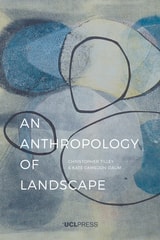
cover of Anthropology of Landscape: The Extraordinary in the Ordinary

Anthropology of Landscape

The Extraordinary in the Ordinary

Christopher Tilley and Kate Cameron-Daum

University College London, 2017
An Anthropology of Landscape tells the fascinating story of a heathland landscape in south-west England and the way different individuals and groups engage with it. Based on a long-term anthropological study, the book emphasises four individual themes: embodied identities, the landscape as a sensuous material form that is acted upon and in turn acts on people, the landscape as contested, and its relation to emotion. The landscape is discussed in relation to these themes as both ‘taskscape’ and ‘leisurescape’, and from the perspective of different user groups. First, those who manage the landscape and use it for work: conservationists, environmentalists, archaeologists, the Royal Marines, and quarrying interests. Second, those who use it in their leisure time: cyclists and horse riders, model aircraft flyers, walkers, people who fish there, and artists who are inspired by it. The book makes an innovative contribution to landscape studies and will appeal to all those interested in nature conservation, historic preservation, the politics of nature, the politics of identity, and an anthropology of Britain.
[more]
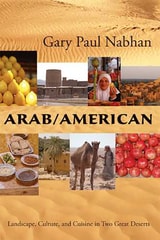
cover of Arab/American: Landscape, Culture, and Cuisine in Two Great Deserts

Arab/American

Landscape, Culture, and Cuisine in Two Great Deserts

Gary Paul Nabhan

University of Arizona Press, 2008

The landscapes, cultures, and cuisines of deserts in the Middle East and North America have commonalities that have seldom been explored by scientists—and have hardly been celebrated by society at large. Sonoran Desert ecologist Gary Nabhan grew up around Arab grandparents, aunts, uncles, and cousins in a family that has been emigrating to the United States and Mexico from Lebanon for more than a century, and he himself frequently travels to the deserts of the Middle East. In an era when some Arabs and Americans have markedly distanced themselves from one another, Nabhan has been prompted to explore their common ground, historically, ecologically, linguistically, and gastronomically. Arab/American is not merely an exploration of his own multicultural roots but also a revelation of the deep cultural linkages between the inhabitants of two of the world’s great desert regions. Here, in beautifully crafted essays, Nabhan explores how these seemingly disparate cultures are bound to each other in ways we would never imagine. With an extraordinary ear for language and a truly adventurous palate, Nabhan uncovers surprising convergences between the landscape ecology, ethnogeography, agriculture, and cuisines of the Middle East and the binational Desert Southwest. There are the words and expressions that have moved slowly westward from Syria to Spain and to the New World to become incorporated—faintly but recognizably—into the language of the people of the U.S.–Mexico borderlands. And there are the flavors—piquant mixtures of herbs and spices—that have crept silently across the globe and into our kitchens without our knowing where they came from or how they got here. And there is much, much more. We also learn of others whose work historically spanned these deserts, from Hadji Ali (“Hi Jolly”), the first Moslem Arab to bring camels to America, to Robert Forbes, an Arizonan who explored the desert oases of the Sahara. These men crossed not only oceans but political and cultural barriers as well. We are, we recognize, builders of walls and borders, but with all the talk of “homeland” today, Nabhan reminds us that, quite often, borders are simply lines drawn in the sand.
[more]