138 books match the query 'Logic' and 16 start with a
cover of A Manual of Intensional Logic: 2nd Edition

A Manual of Intensional Logic

2nd Edition

Johan van Benthem

CSLI, 1988

Intensional logic, as understood here, is based on the broad presupposition that so-called "intensional contexts" in natural language can be explained semantically by the idea of multiple reference. The text reviews tense, modality, and conditionals, then presents developments in intensional theory, including partiality and generalized quantifiers. JOHAN van BENTHEM is professor of mathematical logic at the University of Amsterdam.
[more]
cover of A Paradigm for Program Semantics

A Paradigm for Program Semantics

Chris Brink and Ingrid Rewitsky

CSLI, 2001
This book provides a synthesis of four versions of program semantic—srelational semantics, predicate transformer semantics, information systems, and domain theory—showing, through an exhaustive case study analysis, that it is possible to do back-and-forth translation from any of these versions of program semantics into any of the others, and demonstrating that while there are many variations of each, in principle they may be thought of as intertranslatable.
[more]
cover of A Philosophical Introduction to Probability

A Philosophical Introduction to Probability

Maria Carla Galavotti

CSLI, 2004
Not limited to merely mathematics, probability has a rich and controversial philosophical aspect. A Philosophical Introduction to Probability showcases lesser-known philosophical notions of probability and explores the debate over their interpretations. Galavotti traces the history of probability and its mathematical properties and then discusses various philosophical positions on probability, from the Pierre Simon de Laplace's “classical” interpretation of probability to the logical interpretation proposed by John Maynard Keynes. This book is a valuable resource for students in philosophy and mathematics and all readers interested in notions of probability.
[more]
cover of A Poetic for Sociology: Toward a Logic of Discovery for the Human Sciences

A Poetic for Sociology

Toward a Logic of Discovery for the Human Sciences

Richard Harvey Brown

University of Chicago Press, 1989

For too long, argues Richard Harvey Brown, social scientists have felt forced to choose between imitating science's empirical methodology and impersonating a romantic notion of art, the methods of which are seen as primarily a matter of intuition, interpretation, and opinion. Developing the idea of a "cognitive aesthetic," Brown shows how both science and art—as well as the human studies that stand between them—depend on metaphoric thinking as their "logic of discovery" and may be assessed in terms of such aesthetic criteria of adequacy as economy, elegance, originality, scope, congruence, and form.

By recognizing this "aesthetic" common ground between science and art, Brown demonstrates that a fusion can be achieved within the human sciences of these two principal ideals of knowledge—the scientific or positivist one and the artistic or intuitive one. A path, then, is opened for creating a knowledge of ourselves and society which is at once objective and subjective, at once valid scientifically and significantly humane.
[more]
cover of A Primer of Probability Logic

A Primer of Probability Logic

Ernest W. Adams

CSLI, 1996

This book is meant to be a primer, that is, an introduction, to probability logic, a subject that appears to be in its infancy. Probability logic is a subject envisioned by Hans Reichenbach and largely created by Adams. It treats conditionals as bearers of conditional probabilities and discusses an appropriate sense of validity for arguments such conditionals, as well as ordinary statements as premisses.

This is a clear well-written text on the subject of probability logic, suitable for advanced undergraduates or graduates, but also of interest to professional philosophers. There are well-thought-out exercises, and a number of advanced topics treated in appendices, while some are brought up in exercises and some are alluded to only in footnotes. By this means, it is hoped that the reader will at least be made aware of most of the important ramifications of the subject and its tie-ins with current research, and will have some indications concerning recent and relevant literature.
[more]
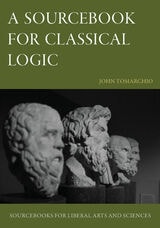
cover of A Sourcebook for Classical Logic

A Sourcebook for Classical Logic

John Tomarchio

Catholic University of America Press, 2023
This Sourcebook offers a brief sequence in classical Logic befitting an unspecialized study for students of liberal arts and sciences. The sequence is made up of select texts of the Aristotelian Organon, mostly the opening chapters of each treatise, in the traditional order, where Aristotle lays out the primary elements of reasoning. Study aids accompany these primary texts, providing students with mnemonics and diagrams developed for classroom use in the great books programs St. John’s College. The culmination of this Aristotelian Logic sequence is selections from the Posterior Analytics where Aristotle offers an account of the demonstrative reasoning of theoretical sciences. The interest of this Sourcebook, as of Aristotelian Logic, is search for such knowledge. This Aristotelian sequence is preceded by a sequence of readings in Medieval grammatica speculativa, or philosophy of language. This propaedeutic sequence begins with an ancient source to which that metaphysically minded ‘grammar’ recurred, namely Augustine’s De magistro, or On the Teacher. It is a dialogue between Augustine and his son about the triadic relation of the spoken word to the word thought and the thing thought about. This aporetic dialectic between Augustine and his son proves effective in awakening students to the theoretical stakes of Logic. Similarly, from later theological inquiries into language for purposes of scriptural interpretation more general theories of language emerged. The theoretical uses thus made of Aristotelian Logic by the Jewish theologian Maimonides and the Catholic Thomas Aquinas whet student appetite for the technical matter of the Organon sequence to follow.
[more]
cover of Abductive Analysis: Theorizing Qualitative Research

Abductive Analysis

Theorizing Qualitative Research

Iddo Tavory and Stefan Timmermans

University of Chicago Press, 2014
In Abductive Analysis, Iddo Tavory and Stefan Timmermans provide a new navigational map for theorizing qualitative research. They outline a way to think about observations, methods, and theories that nurtures theory formation without locking it into predefined conceptual boxes. The book provides novel ways to approach the challenges that plague qualitative researchers across the social sciences—how to conceptualize causality, how to manage the variation of observations, and how to leverage the researcher’s community of inquiry.  Abductive Analysis is a landmark work that shows how a pragmatist approach provides a productive and fruitful way to conduct qualitative research.
[more]
cover of Abductive Reasoning

Abductive Reasoning

Douglas Walton

University of Alabama Press, 2005

A study of the role of abductive inference in everyday argumentation and legal evidence

Examines three areas in which abductive reasoning is especially important: medicine, science, and law. The reader is introduced to abduction and shown how it has evolved historically into the framework of conventional wisdom in logic. Discussions draw upon recent techniques used in artificial intelligence, particularly in the areas of multi-agent systems and plan recognition, to develop a dialogue model of explanation. Cases of causal explanations in law are analyzed using abductive reasoning, and all the components are finally brought together to build a new account of abductive reasoning.
 
By clarifying the notion of abduction as a common and significant type of reasoning in everyday argumentation, Abductive Reasoning will be useful to scholars and students in many fields, including argumentation, computing and artificial intelligence, psychology and cognitive science, law, philosophy, linguistics, and speech communication and rhetoric.
 
[more]
cover of Acquaintance, Knowledge, and Logic: New Essays on Bertrand Russell's "The Problems of Philosophy"

Acquaintance, Knowledge, and Logic

New Essays on Bertrand Russell's "The Problems of Philosophy"

Edited and with an Introduction by Donovan Wishon and Bernard Linsky

CSLI, 2015
Bertrand Russell, the recipient of the 1950 Nobel Prize for Literature, was one of the most distinguished, influential, and prolific philosophers of the twentieth century. Acquaintance, Knowledge, and Logic brings together ten new essays on Russell’s best-known work, The Problems of Philosophy. These essays, by some of the foremost scholars of his life and works, reexamine Russell’s famous distinction between “knowledge by acquaintance” and “knowledge by description,” his developing views about our knowledge of physical reality, and his views about our knowledge of logic, mathematics, and other abstract matters. In addition, this volume includes an editors’ introduction, which summarizes Russell’s influential book, presents new biographical details about how and why Russell wrote it, and highlights its continued significance for contemporary philosophy.
[more]
cover of Ad Hominem Arguments

Ad Hominem Arguments

Douglas Walton

University of Alabama Press, 2009

A vital contribution to legal theory and media and civic discourse

In the 1860s, northern newspapers attacked Abraham Lincoln's policies by attacking his character, using the terms "drunk," "baboon," "too slow," "foolish," and "dishonest." Steadily on the increase in political argumentation since then, the argumentum ad hominem, or personal attack argument, has now been carefully refined as an instrument of "oppo tactics" and "going negative" by the public relations experts who craft political campaigns at the national level. In this definitive treatment of one of the most important concepts in argumentation theory and informal logic, Douglas Walton presents a normative framework for identifying and evaluating ad hominem or personal attack arguments.

Personal attack arguments have often proved to be so effective, in election campaigns, for example, that even while condemning them, politicians have not stopped using them. In the media, in the courtroom, and in everyday confrontation, ad hominem arguments are easy to put forward as accusations, are difficult to refute, and often have an extremely powerful effect on persuading an audience.

Walton gives a clear method for analyzing and evaluating cases of ad hominem arguments found in everyday argumentation. His analysis classifies the ad hominem argument into five clearly defined subtypes—abusive (direct), circumstantial, bias, "poisoning the well," and tu quoque ("you're just as bad") arguments—and gives methods for evaluating each type. Each subtype is given a well-defined form as a recognizable type of argument. The numerous case studies show in concrete terms many practical aspects of how to use textual evidence to identify and analyze fallacies and to evaluate argumentation as fallacious or not in particular cases.


[more]
cover of Advances in Modal Logic, Volume 1

Advances in Modal Logic, Volume 1

Edited by Marcus Kracht, Maarten de Rijke, Heinrich Wansing, and Michael Zakhary

CSLI, 1998
Modal logic originated in philosophy as the logic of necessity and possibility. Nowadays it has reached a high level of mathematical sophistication and found many applications in a variety of disciplines, including theoretical and applied computer science, artificial intelligence, the foundations of mathematics, and natural language syntax and semantics. This volume represents the proceedings of the first international workshop on Advances in Modal Logic, held in Berlin, Germany, October 8-10, 1996. It offers an up-to-date perspective on the field, with contributions covering its proof theory, its applications in knowledge representation, computing and mathematics, as well as its theoretical underpinnings. "This collection is a useful resource for anyone working in modal logic. It contains both interesting surveys and cutting-edge technical results" --Edwin D. Mares The Bulletin of Symbolic Logic, March 2002
[more]
cover of Alien Capital: Asian Racialization and the Logic of Settler Colonial Capitalism

Alien Capital

Asian Racialization and the Logic of Settler Colonial Capitalism

Iyko Day

Duke University Press, 2016

In Alien Capital Iyko Day retheorizes the history and logic of settler colonialism by examining its intersection with capitalism and the racialization of Asian immigrants to Canada and the United States. Day explores how the historical alignment of Asian bodies and labor with capital's abstract and negative dimensions became one of settler colonialism's foundational and defining features. This alignment allowed white settlers to gloss over and expunge their complicity with capitalist exploitation from their collective memory. Day reveals this process through an analysis of a diverse body of Asian North American literature and visual culture, including depictions of Chinese railroad labor in the 1880s, filmic and literary responses to Japanese internment in the 1940s, and more recent examinations of the relations between free trade, national borders, and migrant labor. In highlighting these artists' reworking and exposing of the economic modalities of Asian racialized labor, Day pushes beyond existing approaches to settler colonialism as a Native/settler binary to formulate it as a dynamic triangulation of Native, settler, and alien populations and positionalities.
 
[more]
cover of Alienhood: Citizenship, Exile, And The Logic Of Difference

Alienhood

Citizenship, Exile, And The Logic Of Difference

Katarzyna Marciniak

University of Minnesota Press, 2006

“Alien” has a double meaning in the United States, suggesting both “foreigner” and “extraterrestrial creature.” In Alienhood, Katarzyna Marciniak explores this semantic duality. Interrogating the dominant images of aliens in American popular culture—and in legal, historical, linguistic, and literary discourses—Marciniak examines “alienhood” and the impact it has on the daily experiences of migrants, legal or illegal.

Using examples from exilic literature and cinema, including the works of Julia Alvarez, Eva Hoffman, Gregory Nava, and Roman Polanski, Alienhood theorizes multicultural experiences of liminal characters that belong in the interstices between nations. Investigating gendered, racialized, and ideological formations of “aliens,” Marciniak’s readings put into dialogue narratives from both the second world and the third world in relation to “first worldness.” This dialogue problematizes the meanings of “transnational” and brings the so-called second world into these debates. In doing so, Marciniak reorients the study of immigrant or exile subjects beyond the celebrated notion of transnationalism.

With its unique focus on “aliens” in relation to discourses of immigration, exile, and displacement, Alienhood shows how transnationality is, for many dislocated people, an unattainable privilege.

Katarzyna Marciniak is associate professor of English at Ohio University.
[more]
cover of An Essay on Contraction

An Essay on Contraction

André Fuhrmann

CSLI, 1996
Subject: Philosophy; Belief and Doubt; Logic
[more]
cover of Arrow Logic and Multi-Modal Logic

Arrow Logic and Multi-Modal Logic

Edited by Maarten Marx, László Pólos, and Michael Masuch

CSLI, 1996

Conceived by Johan van Benthem and Yde Venema, arrow logic started as an attempt to give a general account of the logic of transitions. The generality of the approach provided a wide application area ranging from philosophy to computer science. The book gives a comprehensive survey of logical research within and around arrow logic. Since the natural operations on transitions include composition, inverse and identity, their logic, arrow logic can be studied from two different perspectives, and by two (complementary) methodologies: modal logic and the algebra of relations. Some of the results in this volume can be interpreted as price tags. They show what the prices of desirable properties, such as decidability, (finite) axiomatisability, Craig interpolation property, Beth definability etc. are in terms of semantic properties of the logic. The research program of arrow logic has considerably broadened in the last couple of years and recently also covers the enterprise to explore the border between decidable and undecidable versions of other applied logics. The content of this volume reflects this broadening. The editors included a number of papers which are in the spirit of this generalised research program.
[more]
cover of Averroes' Middle Commentaries on Aristotles Categories and De Interpretatione

Averroes' Middle Commentaries on Aristotles Categories and De Interpretatione

St. Augustine's Press, 1998

[more]