Results by title
175 books match the query 'Mayas' and 21 start with a
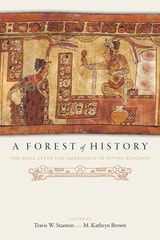
A Forest of History
The Maya after the Emergence of Divine KingshipTravis W. Stanton
University Press of Colorado, 2020
These original papers present new, cutting-edge research focusing on the social changes leading up to the spread of divine kingship across the lowlands in the first part of the Early Classic. The contributors continue avenues of inquiry such as the timing of the Classic Maya collapse across the southern lowlands, the nature of Maya warfare, the notion of usurpation and “stranger-kings” in the Classic period, the social relationships between the ruler and elite of the Classic period Yaxchilán polity, and struggles for sociopolitical dominance among the later Classic period polities of Chichén Itzá, Cobá, and the Puuc kingdoms.
Many of the interpretations and approaches in A Forest of Kings have withstood the test of time, while others have not; a complete understanding of the Classic Maya world is still developing. In A Forest of History recent discoveries are considered in the context of prior scholarship, illustrating both the progress the field has made in the past quarter century and the myriad questions that remain. The volume will be a significant contribution to the literature for students, scholars, and general readers interested in Mesoamerican and Maya archaeology.
Contributors:
Wendy Ashmore, Arlen F. Chase, Diane Z. Chase, Wilberth Cruz Alvarado, Arthur A. Demarest, Keith Eppich, David A. Freidel, Charles W. Golden, Stanley P. Guenter, Annabeth Headrick, Aline Magnoni, Joyce Marcus, Marilyn A. Masson, Damaris Menéndez, Susan Milbrath, Olivia C. Navarro-Farr, José Osorio León, Carlos Peraza Lope, Juan Carlos Pérez Calderón, Griselda Pérez Robles, Francisco Pérez Ruíz, Michelle Rich, Jeremy A. Sabloff, Andrew K. Scherer, Karl A. Taube
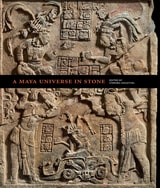
A Maya Universe in Stone
Stephen Houston
J. Paul Getty Trust, The, 2021
In 1950, Dana Lamb, an explorer of some notoriety, stumbled on a Maya ruin in the tropical forests of northern Guatemala. Lamb failed to record the location of the site he called Laxtunich, turning his find into the mystery at the center of this book. The lintels he discovered there, long since looted, are probably of a set with two others that are among the masterworks of Maya sculpture from the Classic period. Using fieldwork, physical evidence, and Lamb’s expedition notes, the authors identify a small area with archaeological sites where the carvings were likely produced.
Remarkably, the vividly colored lintels, replete with dynastic and cosmic information, can be assigned to a carver, Mayuy, who sculpted his name on two of them. To an extent nearly unique in ancient America, Mayuy can be studied over time as his style developed and his artistic ambition grew. An in-depth analysis of Laxtunich Lintel 1 examines how Mayuy grafted celestial, seasonal, and divine identities onto a local magnate and his overlord from the kingdom of Yaxchilan, Mexico. This volume contextualizes the lintels and points the way to their reprovenancing and, as an ultimate aim, repatriation to Guatemala.

A Return to Servitude
Maya Migration and the Tourist Trade in CancúnM. Bianet Castellanos
University of Minnesota Press, 2010
A Return to Servitude is an ethnography of Maya migration within Mexico that analyzes the foundational role indigenous peoples play in the development of the modern nation-state. Focusing on tourism in the Yucatán Peninsula, M. Bianet Castellanos examines how Cancún came to be equated with modernity, how this city has shaped the political economy of the peninsula, and how indigenous communities engage with this vision of contemporary life. More broadly, she demonstrates how indigenous communities experience, resist, and accommodate themselves to transnational capitalism.
Tourism and the social stratification that results from migration have created conflict among the Maya. At the same time, this work asserts, it is through engagement with modernity and its resources that they are able to maintain their sense of indigeneity and community.
A World of Many
Ontology and Child Development among the Maya of Southern MexicoNorbert Ross
Rutgers University Press, 2023
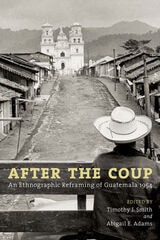
After the Coup
An Ethnographic Reframing of Guatemala 1954Edited by Timothy J. Smith and Abigail E. Adams
University of Illinois Press, 2011
Recent research and the release of newly declassified U.S. government documents underscore the importance of reading Guatemala's current history through the lens of 1954. Scholars and researchers who have worked in Guatemala from the 1940s to the present articulate how the coup fits into ethnographic representations of Guatemala. Highlighting the voices of individuals with whom they have lived and worked, the contributors also offer an unmatched understanding of how the events preceding and following the coup played out on the ground.
Contributors are Abigail E. Adams, Richard N. Adams, David Carey Jr., Christa Little-Siebold, Judith M. Maxwell, Victor D. Montejo, June C. Nash, and Timothy J. Smith.
America's First Cuisines
By Sophie D. Coe
University of Texas Press, 1994
After long weeks of boring, perhaps spoiled sea rations, one of the first things Spaniards sought in the New World was undoubtedly fresh food. Probably they found the local cuisine strange at first, but soon they were sending American plants and animals around the world, eventually enriching the cuisine of many cultures.
Drawing on original accounts by Europeans and native Americans, this pioneering work offers the first detailed description of the cuisines of the Aztecs, the Maya, and the Inca. Sophie Coe begins with the basic foodstuffs, including maize, potatoes, beans, peanuts, squash, avocados, tomatoes, chocolate, and chiles, and explores their early history and domestication. She then describes how these foods were prepared, served, and preserved, giving many insights into the cultural and ritual practices that surrounded eating in these cultures. Coe also points out the similarities and differences among the three cuisines and compares them to Spanish cooking of the period, which, as she usefully reminds us, would seem as foreign to our tastes as the American foods seemed to theirs. Written in easily digested prose, America's First Cuisines will appeal to food enthusiasts as well as scholars.
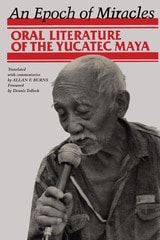
An Epoch of Miracles
Oral Literature of the Yucatec MayaTranslated with Commentaries by Allan F. Burns
University of Texas Press, 1983
“Mr. Allan Burns, I am here to tell you an example, the example of the Hunchbacks.” So said Paulino Yamá, traditionalist and storyteller, to Allan Burns, anthropologist and linguist, as he began one story that found its way into this book.
Paulino Yamá was just one of several master storytellers from the Yucatán Peninsula of Mexico from whom Burns learned not only the Mayan language but also the style and performance of myths, stories, riddles, prayers, and other forms of speech of their people. The result is An Epoch of Miracles, a wonderfully readable yet thoroughly scholarly set of translations from the oral literature of the Yucatec Maya, an important New World tradition never before systematically described.
An Epoch of Miracles brings us over thirty-five long narratives of things large, small, strange, and “regular” and as many delightful short pieces, such as bird lore, riddles, and definitions of anteaters, rainbows, and other commonplaces of the Mayan world. Here are profound narratives of the Feathered Serpent, the mighty Rain God Chac and his helpers, and the mysterious cult of the Speaking Cross. But because these are modern, “Petroleum Age” Maya, here too are a discussion with Cuba’s Fidel Castro and a greeting to former president Richard Nixon.
All pieces are translated ethnopoetically; examples of several genres are presented bilingually. An especially valuable feature is the indication of performance style, such as pauses and voice quality, given with each piece.
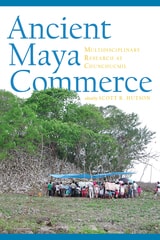
Ancient Maya Commerce
Multidisciplinary Research at ChunchucmilScott R. Hutson
University Press of Colorado, 2017
Ancient Maya Commerce presents nearly two decades of multidisciplinary research at Chunchucmil, Yucatan, Mexico—a thriving Classic period Maya center organized around commercial exchange rather than agriculture. An urban center without a king and unable to sustain agrarian independence, Chunchucmil is a rare example of a Maya city in which economics, not political rituals, served as the engine of growth. Trade was the raison d’être of the city itself.
Using a variety of evidence—archaeological, botanical, geomorphological, and soil-based—contributors show how the city was a major center for both short- and long-distance trade, integrating the Guatemalan highlands, the Gulf of Mexico, and the interior of the northern Maya lowlands. By placing Chunchucmil into the broader context of emerging research at other Maya cities, the book reorients the understanding of ancient Maya economies. The book is accompanied by a highly detailed digital map that reveals the dense population of the city and the hundreds of streets its inhabitants constructed to make the city navigable, shifting the knowledge of urbanism among the ancient Maya.
Ancient Maya Commerce is a pioneering, thoroughly documented case study of a premodern market center and makes a strong case for the importance of early market economies in the Maya region. It will be a valuable addition to the literature for Mayanists, Mesoamericanists, economic anthropologists, and environmental archaeologists.
Contributors: Anthony P. Andrews, Traci Ardren, Sheryl Luzzadder-Beach, Timothy Beach, Chelsea Blackmore, Tara Bond-Freeman, Bruce H. Dahlin, Patrice Farrell, David Hixson, Socorro Jimenez, Justin Lowry, Aline Magnoni, Eugenia Mansell, Daniel E. Mazeau, Travis Stanton, Ryan V. Sweetwood, Richard E. Terry
Ancient Maya Commoners
Edited by Jon C. Lohse and Fred Valdez, Jr.
University of Texas Press, 2004
Much of what we currently know about the ancient Maya concerns the activities of the elites who ruled the societies and left records of their deeds carved on the monumental buildings and sculptures that remain as silent testimony to their power and status. But what do we know of the common folk who labored to build the temple complexes and palaces and grew the food that fed all of Maya society?
This pathfinding book marshals a wide array of archaeological, ethnohistorical, and ethnographic evidence to offer the fullest understanding to date of the lifeways of ancient Maya commoners. Senior and emerging scholars contribute case studies that examine such aspects of commoner life as settlement patterns, household organization, and subsistence practices. Their reports cover most of the Maya area and the entire time span from Preclassic to Postclassic. This broad range of data helps resolve Maya commoners from a faceless mass into individual actors who successfully adapted to their social environment and who also held primary responsibility for producing the food and many other goods on which the whole Maya society depended.
Ancient Maya Embedded Economies
Rachel A. Horowitz
University Press of Colorado, 2026
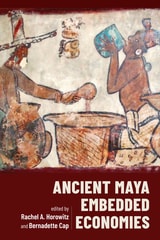
Ancient Maya Embedded Economies provides an in-depth discussion of the relationships between economic activities and other aspects of the daily lives of the ancient Maya. Through a series of casestudies spanning the Preclassic through the Late Classic periods, this volume addresses the entangled relationship of ancient Maya economies within social, political, and religious practices.
Contributors use cutting-edge data from a variety of sources to address the interrelatedness between economy and other aspects of Maya life and point to the complexity of interactions among ancient Maya peoples of all socioeconomic statuses—interactions guided by not only economies but also political-religious frameworks. Ancient Maya Embedded Economies provides a unique viewpoint into how economies functioned in the past and advances scholarly understandings of Maya economies and the ways in which archaeological data can examine such systems, as well as contribute to broader understandings of pre-modern economic organization on a global level.
Ancient Maya Life in the Far West Bajo
Social and Environmental Change in the Wetlands of BelizeJulie L. Kunen
University of Arizona Press, 2004
In this lively story of life in the wetlands on the outskirts of the major site of La Milpa, Julie Kunen documents a hitherto unrecognized form of intensive agriculture in the Maya lowlands—one that relied on the construction of terraces and berms to trap soil and moisture around the margins of low-lying depressions called bajos. She traces the intertwined histories of residential settlements on nearby hills and ridges and agricultural terraces and other farming-related features around the margins of the bajo as they developed from the Late Preclassic perios (400 BC-AD 250) until the area's abandonment in the Terminal Classic period (about AD 850).
Kunen examines the organization of three bajo communities with respect to the use and management of resources critical to agricultural production. She argues that differences in access to spatially variable natural resources resulted in highly patterned settlement remains and that community founders and their descendents who had acquired the best quality and most diverse set of resources maintained an elevated status in the society.
The thorough integration of three lines of evidence—the settlement system, the agricultural system, and the ancient environment—breaks new ground in landscape research and in the study of Maya non-elite domestic organization. Kunen reports on the history of settlement and farming in a small corner of the Maya world but demonstrates that for any study of human-environment interactions, landscape history consists equally of ecological and cultural strands of influence.
Ancient Maya Teeth
Dental Modification, Cosmology, and Social Identity in MesoamericaVera Tiesler
University of Texas Press, 2024
A study of Maya dental modification from archaeological sites spanning three millennia.
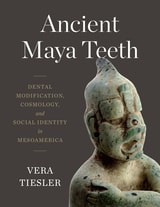
Dental modification was common across ancient societies, but perhaps none were more avid practitioners than the Maya. They filed their teeth flat or pointy, polished and drilled them, and crafted decorative inlays of jade and pyrite. Unusually, Maya of all social classes, ages, and professions engaged in dental modification. What did it mean to them?
Ancient Maya Teeth is the most comprehensive study of Maya dental modification ever published, based on thousands of teeth recovered from 130 sites spanning three millennia. Esteemed archaeologist Vera Tiesler sifts the evidence, much of it gathered with her own hands and illustrated here with more than a hundred photographs. Exploring the underlying theory and practice of dental modification, Tiesler raises key questions. How did modifications vary across the individual’s lifespan? What tools were used? How did the Maya deal with pain—and malpractice? How did they keep their dentitions healthy, functioning, and beautiful? What were the relationships among gender, social identity, and religious identifications? Addressing these and other issues, Ancient Maya Teeth reveals how dental-modification customs shifted over the centuries, indexing other significant developments in Mayan cultural history.
Ancient Maya Traders of Ambergris Caye
Thomas H. Guderjan
University of Alabama Press, 2007
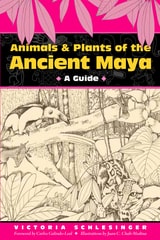
Animals and Plants of the Ancient Maya
A GuideBy Victoria Schlesinger
University of Texas Press, 2002
A growing interest in all things Maya brings an increasing number of visitors to prehistoric Maya ruins and contemporary Maya communities in Guatemala, Belize, El Salvador, western Honduras, the Yucatán Peninsula, and the southern areas of Chiapas and Tabasco, Mexico. For these visitors and indeed everyone with an interest in the Maya, this field guide highlights nearly 100 species of plants and animals that were significant to the ancient Maya and that continue to inhabit the Maya region today.
Drawing from the disciplines of biology, ecology, and anthropology, Victoria Schlesinger describes each plant or animal's habitat and natural history, identifying characteristics (also shown in a black-and-white drawing), and cultural significance to the ancient and contemporary Maya. An introductory section explains how to use the book and offers a concise overview of the history, lifeways, and cosmology of the ancient Maya. The concluding section describes the collapse of ancient Maya society and briefly traces the history of the Maya region from colonial times to the present.
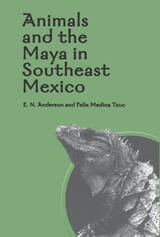
Animals and the Maya in Southeast Mexico
E. N. Anderson and Felix Medina Tzuc
University of Arizona Press, 2005
This book combines the insights of an anthropologist with the hands-on experience of a Maya campesino with the aim of improving the management of Quintana Roo’s wild lands and animal resources. E. N. Anderson and Felix Medina Tzuc pool their knowledge to document Yucatec Maya understanding and use of animals and to address practical matters related to wider conservation issues.
The book reflects a wealth of knowledge gathered from individuals regarded as experts on particular aspects of animal management, whether hunting, herding, or beekeeping. It also offers case studies of conservation successes and failures in various communities, pointing to the need for cooperation by the Mexican government and Maya people to save wildlife. Appendixes provide an extensive animal classification and a complete list of all birds identified in the area.
Even though sustainable forestry has finally come to the Yucatán, sustainable game use is practiced by only a few communities. Animals and the Maya in Southeast Mexico is a complete ethnozoology for the region, offered in the hope that it will encourage the recognition of Quintana Roo’s forests and wildlife as no less deserving of protection than ancient Maya cities.
Anthropology and History in Yucatán
Edited by Grant D. Jones
University of Texas Press, 1977
Anthropology and History in Yucatán is a collection of ten essays that offer new evidence and interpretations of the survival and adaptation of lowland Maya culture from its earliest contact with the Spanish to the 1970s. These case studies reflect a growing interest in the use of historical approaches in the development of models of cultural change that will integrate archaeological, historical, and ethnographic data.
The portrait of the Maya emerging from this collection is that of a remarkably vital people who have skillfully resisted total incorporation with their neighbors and who continue even today to emphasize their cultural independence and historical uniqueness. In his introduction, Grant D. Jones synthesizes previous studies of the anthropological history of Yucatán and summarizes the theoretical issues underlying the volume. Section I, which focuses on continuity and change in the boundaries of Maya ethnicity in Yucatán, includes contributions by the late Sir Eric Thompson, France V. Scholes, and O. Nigel Bolland. Section II presents comparative regional perspectives of Maya adaptations to external forces of change and contains essays by D. E. Dumond, Grant D. Jones, James W. Ryder, and Anne C. Collins. In the closing section, three articles, by Victoria Reifler Bricker, Allan F. Burns, and Irwin Press, treat Maya concepts of their own history.
Throughout the book, the authors demonstrate that models far more complex than Robert Redfield’s folk-urban continuum must be developed to account for the great regional variations in responses by the Maya to the pressures of economic, cultural, and political control as exerted by Spanish, Mexican, Guatemalan, and British authorities over the past four centuries. The essays demonstrate a variety of methodological approaches that will be of interest to historians, ethnohistorians, ethnologists, archaeologists, and those who have a general interest in the survival of Maya culture.
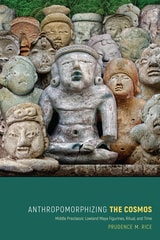
Anthropomorphizing the Cosmos
Middle Preclassic Lowland Maya Figurines, Ritual, and TimePrudence M. Rice
University Press of Colorado, 2019
Presenting original data, Anthropomorphizing the Cosmos offers insight into the synchronous appearance of fired-clay figurines with the emergence of societal complexity in and beyond Mesoamerica. Rice situates these Preclassic Maya figurines in the broader context of Mesoamerican human figural representation, identifies possible connections between anthropomorphic figurine heads and the origins of calendrics and other writing in Mesoamerica, and examines the role of anthropomorphic figurines and zoomorphic musical instruments in Preclassic Maya ritual. The volume shows how community rituals involving the figurines helped to mitigate the uncertainties of societal transitions, including the beginnings of settled agricultural life, the emergence of social differentiation and inequalities, and the centralization of political power and decision-making in the Petén lowlands.
Literature on Maya ritual, cosmology, and specialized artifacts has traditionally focused on the Classic period, with little research centering on the very beginnings of Maya sociopolitical organization and ideological beliefs in the Middle Preclassic. Anthropomorphizing the Cosmos is a welcome contribution to the understanding of the earliest Maya and will be significant to Mayanists and Mesoamericanists as well as nonspecialists with interest in these early figurines
Archaeology and Identity on the Pacific Coast and Southern Highlands of Mesoamerica
Edited by Claudia García-Des Lauriers and Michael W. Love
University of Utah Press, 2016
The Pacific coast and southern highlands of Chiapas and Guatemala is a region significant to debates about the origins of social complexity, interaction, and colonialism. The area, however, has received uneven attention and much of what we know is largely restricted to the Preclassic period. This theoretically eclectic volume presents greater temporal coverage, is geographically unified, and engages some of the most important questions of each period through a discussion of the archaeology of identity.
Chapters range from traditional assessments of identity to discussion of practice and relational personhood; all share a concern for how archaeology and ethnohistory provide opportunities and challenges in the reconstruction of identities. The region is one with a multifaceted history of interactions between local populations and those from other parts of Mesoamerica. Linguistic diversity, landscape, and artistic representations have added to the complexities of understanding identity formation here. Rather than providing a unified voice on the issues, Archaeology and Identity on the Pacific Coast and Southern Highlands of Mesoamerica is a dialogue presented through case studies, one that will hopefully encourage future research in this complex and little understood region of Mesoamerica.
Archaeology at El Perú-Waka'
Ancient Maya Performances of Ritual, Memory, and PowerEdited by Olivia C. Navarro-Farr and Michelle Rich
University of Arizona Press, 2014
El Perú-Waka’ is an ancient Maya city located in present-day northwestern Petén, Guatemala. Rediscovered by petroleum exploration workers in the mid-1960s, it is the largest known archaeological site in the Laguna del Tigre National Park in Guatemala’s Maya Biosphere Reserve. The El Perú-Waka’ Regional Archaeological Project initiated scientific investigations in 2003, and through excavation and survey, researchers established that Waka’ was a key political and economic center well integrated into Classic-period lowland Maya civilization, and reconstructed many aspects of Maya life and ritual activity in this ancient community. The research detailed in this volume provides a wealth of new, substantive, and scientifically excavated data, which contributors approach with fresh theoretical insights. In the process, they lay out sound strategies for understanding the ritual manipulation of monuments, landscapes, buildings, objects, and memories, as well as related topics encompassing the performance and negotiation of power throughout the city’s extensive sociopolitical history.
Archeology and Volcanism in Central America
The Zapotitán Valley of El SalvadorEdited by Payson D. Sheets
University of Texas Press, 1983
Scientists have long speculated on the impact of extreme natural catastrophes on human societies. Archeology and Volcanism in Central America provides dramatic evidence of the effects of several volcanic disasters on a major civilization of the Western Hemisphere, that of the Maya.
During the past 2,000 years, four volcanic eruptions have taken place in the Zapotitán Valley of southern El Salvador. One, the devastating eruption of Ilopango around A.D. 300, forced a major migration, pushing the Mayan people north to the Yucatán Peninsula. Although later eruptions did not have long-range implications for cultural change, one of the subsequent eruptions preserved the Cerén site—a Mesoamerican Pompeii where the bodies of the villagers, the palm-thatched roofs of their houses, the pots of food in their pantries, even the corn plants in their fields were preserved with remarkable fidelity.
Throughout 1978, a multidisciplinary team of anthropologists, archeologists, geologists, biologists, and others sponsored by the University of Colorado's Protoclassic Project researched and excavated the results of volcanism in the Zapotitan Valley—a key Mesoamerican site that contemporary political strife has since rendered inaccessible.
The result is an outstanding contribution to our understanding of the impact of volcanic eruptions on early Mayan civilization. These investigations clearly demonstrate that the Maya inhabited this volcanically hazardous valley in order to reap the short-term benefits that the volcanic ash produced—fertile soil, fine clays, and obsidian deposits.
As the Gods Kill
Morality and Social Violence among the Precolonial MayaAndrew K. Scherer
University of Texas Press, 2025
An exploration of war, violence, and sacrifice in precolonial Maya culture and its importance in religious practices.
As the Gods Kill delivers new insights into warfare, weaponry, violence, and human sacrifice among the ancient Maya. While attending to the particularity of a singular historical context, anthropologist and archaeologist Andrew Scherer also suggests that Maya practices have something to tell us about human propensities toward violence more broadly.
Focusing on moral frameworks surrounding deliberate injury and killing, Scherer examines Maya justifications of violence—in particular the obligations to one another, to ancestors, and to the gods that made violence not only permissible but necessary. The analysis isolates key themes underpinning the morality of violence—including justice, vengeance, payment, and costumbre (ritual)—and explores the ethics of violent agents, including warriors, ritual specialists, and the gods. Finally, Scherer addresses motivations for warfare, including the acquisition of spoils, tribute, captives, and slaves. An interdisciplinary case study of morality in an ancient society, As the Gods Kill synthesizes scholarship on an important dimension of precolonial American culture while taking stock of its implications for the social sciences at large.