193 books match the query 'Modernism (Literature)' and 16 start with a
cover of A Change in the Weather: Modernist Imagination, African American Imaginary

A Change in the Weather

Modernist Imagination, African American Imaginary

Geoffrey Jacques

University of Massachusetts Press, 2009
This book explores the impact of African American culture on modernist poetic language by placing black literature and culture at the center of an inquiry into the genealogy of avant-garde poetics. Geoffrey Jacques looks at how blackface minstrelsy, ragtime, vernacular languages, advertising copy, Freud's idea of the Uncanny, vaudeville, the cliché, and Tin Pan Alley–style song all influenced modernist poetry. In a key insight, Jacques points out that the black urban community in the United States did not live in ghettos during the years before World War I, but in smaller enclaves spread out among the general population. This circumstance helped catalyze African American culture's dramatic and surprising impact on the emergent avant-garde. By using a wide range of theoretical tools, Jacques poses new questions about literary, cultural, and social history, the history and structure of modernist poetic language, canon formation, and the history of criticism.This contribution to the ongoing debate over early twentieth-century culture presents modernism as an interracial, cross-cultural project, arguing for a new appreciation of the central role black culture played within it. Writers and artists whose works are discussed include Marianne Moore, Charles Chesnutt, Jean Toomer, Wallace Stevens, James A. Bland, Paul Laurence Dunbar, Gertrude Stein, Bert Williams, Zora Neale Hurston, Samuel Beckett, W. C. Handy, Hart Crane, and Clement Greenberg.
[more]
cover of A Different Order of Difficulty: Literature after Wittgenstein

A Different Order of Difficulty

Literature after Wittgenstein

Karen Zumhagen-Yekplé

University of Chicago Press, 2020
Is the point of philosophy to transmit beliefs about the world, or can it sometimes have higher ambitions? In this bold study, Karen Zumhagen-Yekplé makes a critical contribution to the “resolute” program of Wittgenstein scholarship, revealing his Tractatus Logico-Philosophicus as a complex, mock-theoretical puzzle designed to engage readers in the therapeutic self-clarification Wittgenstein saw as the true work of philosophy. Seen in this light, Wittgenstein resembles his modernist contemporaries more than might first appear. Like the literary innovators of his time, Wittgenstein believed in the productive power of difficulty, in varieties of spiritual experience, in the importance of age-old questions about life’s meaning, and in the possibility of transfigurative shifts toward the right way of seeing the world. In a series of absorbing chapters, Zumhagen-Yekplé shows how Kafka, Woolf, Joyce, and Coetzee set their readers on a path toward a new way of being. Offering a new perspective on Wittgenstein as philosophical modernist, and on the lives and afterlives of his indirect teaching, A Different Order of Difficulty is a compelling addition to studies in both literature and philosophy.
[more]
cover of A Dream of Arcadia: Anti-Industrialism in Spanish LIterature, 1895–1905

A Dream of Arcadia

Anti-Industrialism in Spanish LIterature, 1895–1905

By Lily Litvak

University of Texas Press, 1975

The dream of “progress” that animated many nineteenth-century artistic and political movements gave way at the turn of the century to a dissatisfaction with the Industrial Civilization and a recurrent pessimism about a future dominated by mechanization. Art Nouveau, which was both a style and a movement, embodied this dissatisfaction, marking the turn-of-the-century period with an aesthetic that consciously set out to revolutionize literature, the arts, and society within the framework of a brutalizing, wildly burgeoning Industrial Civilization. Generally associated with northern European culture, Art Nouveau also had a great impact in the south, particularly in Spain.

A Dream of Arcadia is the first work to explore Spain’s fertile and imaginative Art Nouveau. Through the eyes of four major Spanish writers, Lily Litvak views several different aspects of the turn-of-the-century struggle against the advances of industrialism in Spain. Her interpretation of the early works of Ramón del Valle Inclán, Miguel de Unamuno, José Martínez Ruiz (Azorín), and Pío Baroja exposes a longing for a preindustrial arcadia based on a return to nature, the revival of handicrafts and medieval art, an attraction to rural primitive societies, and a revulsion against the modern city. Set against the European literary and artistic background of the period, her observations place the Spanish manifestations of Art Nouveau within the context of the better-known northern phenomena. Of particular interest is her discussion of the influences of John Ruskin, William Morris, and the Pre-Raphaelites, which demonstrates how the general European mood was articulated in Spain.

Litvak concludes that Valle Inclán, Unamuno, Azorín, and Baroja must be considered as more than simply fin de siècle writers, for they became part of a general movement, generated by Art Nouveau, that spans an entire century. A Dream of Arcadia demonstrates that Art Nouveau was more than a flash on Europe's artistic horizon; it is a philosophy with ramifications that have led to communes, handcrafted articles, and nomadic adolescents in search of truth.
[more]
cover of A Jewish Word or Two: Charles Reznikoff's Modernism

A Jewish Word or Two

Charles Reznikoff's Modernism

Joel Bettridge

University of Iowa Press, 2026

The son of Jewish immigrants from Russia to New York, Charles Reznikoff found himself at the intersection of modernist innovation, ethnic otherness, and economic hardship. He both appreciated the modernists’ formal radicalism and critiqued their political failings—a task he accomplished by writing short lyric poems depicting the hardship and charm of urban life, as well as long poems presenting histories of horrific violence, from factory accidents to the Holocaust. But despite his contributions to American poetry, Reznikoff has remained a somewhat secondary figure, in part because his work—at times—is painful to read.

A Jewish Word or Two recasts Reznikoff ’s poetry as pleasurable and masterful even when disturbing. In their humor, their encounters with Jewish history, holiness, and identity, as well as their use of drama, horror, joy, and beauty, Reznikoff ’s poems help us celebrate what is simultaneously strange, surprising, lovely, and uncanny in our everyday lives.
[more]
cover of A Menorah for Athena: Charles Reznikoff and the Jewish Dilemmas of Objectivist Poetry

A Menorah for Athena

Charles Reznikoff and the Jewish Dilemmas of Objectivist Poetry

Stephen Fredman

University of Chicago Press, 2001

The first major Jewish poet in America and a key figure of the Objectivist movement, Charles Reznikoff was a crucial link between the generation of Pound and Williams, and the more radical modernists who followed in their wake. A Menorah for Athena, the first extended treatment of Reznikoff's work, appears at a time of renewed interest in his contribution to American poetry.

Stephen Fredman illuminates the relationship of Jewish intellectuals to modernity through a close look at Reznikoff's life and writing. He shows that when we regard the Objectivists as modern Jewish poets, we can see more clearly their distinctiveness as modernists and the reasons for their profound impact upon later poets, such as Allen Ginsberg and Charles Bernstein. Fredman also argues that to understand Reznikoff's work more completely, we must see it in the context of early, nonsectarian attempts to make the study of Jewish culture a force in the construction of a more pluralistic society. According to Fredman, then, the indelible images in Reznikoff's poetry open a window onto the vexed but ultimately successful entry of Jewish immigrants and their children into the mainstream of American intellectual life.
[more]
cover of A THOUSAND WORDS: PORTRAITURE, STYLE, AND QUEER MODERNISM

A THOUSAND WORDS

PORTRAITURE, STYLE, AND QUEER MODERNISM

Jaime Hovey

The Ohio State University Press, 2006

A Thousand Words argues that there is such a thing as queer modernism, and that the (mostly) literary portrait—one of the more prominent forms of experimentalism in late-nineteenth- and early-twentieth-century writing—functions as one of its most important erotically dynamic aesthetic mechanisms, one modeled on visual portraiture’s relationships of looking between the artists, sitters, and spectators of paintings. Jaime Hovey looks at how the dynamic structure of visual portraiture was appropriated by modernist writers—including Oscar Wilde, Gertrude Stein, T. S. Eliot, Virginia Woolf, Ernest Hemingway, and Colette, among others, who used the self-conscious literary portrait.

Portraiture speaks to the complex relationship between identity, sexuality, and art, and the presence of so many portraits in this era suggests that sexual, gender, and racial aspects of character, personality, and personal identity were of major concern to most modernist writers. Yet it took most of the twentieth century for critical work to appear that meaningfully explored these themes, and very little has been said about the queerness of literary portraiture. This book demonstrates that literary portraiture is enamored of its own self-consciousness, with the pleasures of looking at itself seeing itself, and that its texts circulate this pleasure between writers, narrators and other characters, and readers as a perverse aesthetics
[more]
cover of Action Writing: Jack Kerouac's Wild Form

Action Writing

Jack Kerouac's Wild Form

Michael Hrebeniak

Southern Illinois University Press, 2008

Action Writing: Jack Kerouac's Wild Form connects the personal and creative development of the Beat generation's famous icon with cultural changes in postwar America. Michael Hrebeniak asserts that Jack Kerouac's "wild form"—self-organizing narratives free of literary, grammatical, and syntactical conventions—moves within an experimental continuum across the arts to generate a Dionysian sense of writing as raw process. Action Writing highlights how Kerouac made concrete his 1952 intimation of "something beyond the novel" by assembling ideas from Beat America, modernist poetics, action painting, bebop, and subterranean oral traditions.

Geared to scholars and students of American literature, Beat studies, and creative writing, Action Writing places Kerouac's writing within the context of the American art scene at midcentury. Reframing the work of Kerouac and the Beat generation within the experimental modernist and postmodernist literary tradition, this probing inquiry offers a direct engagement with the social and cultural history at the foreground of Kerouac's career from the 1940s to the late 1960s.
[more]
cover of Aesthetics of Self-Invention: Oscar Wilde To David Bowie

Aesthetics of Self-Invention

Oscar Wilde To David Bowie

Shelton Waldrep

University of Minnesota Press, 2004

Traces the influence of Oscar Wilde as the precursor of twentieth-century artists of self-performance

By printing the title “Professor of Aesthetics” on his visiting cards, Oscar Wilde announced yet another transformation—and perhaps the most significant of his career, proclaiming his belief that he could redesign not just his image but his very self. Shelton Waldrep explores the cultural influences at play in Wilde’s life and work and his influence on the writing and performance of the twentieth century, particularly on the lives and careers of some of its most aestheticized performers: Truman Capote, Andy Warhol, David Hockney, and David Bowie. As Waldrep reveals, Wilde’s fusing of art with commerce foresaw the coming century’s cultural producers who would blend works of both “high art” and mass-market appeal.

Whether as a gay man or as a postmodern performance artist ahead of his time, Wilde ultimately emerges here as the embodiment of the twentieth-century media-savvy artist who is both subject and object of the aesthetic and economic systems in which he is enmeshed.
[more]
cover of Afterlives of Modernism: Liberalism, Transnationalism, and Political Critique

Afterlives of Modernism

Liberalism, Transnationalism, and Political Critique

John Carlos Rowe

Dartmouth College Press, 2015
In times of liberal despair it helps to have someone like John Carlos Rowe put things into perspective, in this case, with a collection of essays that asks the question, “Must we throw out liberalism’s successes with the neoliberal bathwater?” Rowe first lays out a genealogy of early twentieth-century modernists, such as Gertrude Stein, John Dos Passos, William Faulkner, and Ralph Ellison, with an eye toward stressing their transnationally engaged liberalism and their efforts to introduce into the literary avant-garde the concerns of politically marginalized groups, whether defined by race, class, or gender. The second part of the volume includes essays on the works of Harper Lee, Thomas Berger, Louise Erdrich, and Philip Roth, emphasizing the continuity of efforts to represent domestic political and social concerns. While critical of the increasingly conservative tone of the neoliberalism of the past quarter-century, Rowe rescues the value of liberalism’s sympathetic and socially engaged intent, even as he criticizes modern liberalism’s inability to work transnationally.
[more]
cover of Albert Camus' Critique of Modernity

Albert Camus' Critique of Modernity

Ronald D. Srigley

University of Missouri Press, 2011
Nobel Prize winner Albert Camus’ contributions to political and cultural analysis make him one of the most important writers of the twentieth century. Camus’ writing has been heavily researched and analyzed in academia, with many scholars concentrating on the formal tri-part structure he adhered to in his later work: the cycle that divided his books into stages of the absurd, rebellion, and love. Yet other aspects of Camus’ work—his preoccupation with modernity and its association with Christianity, his fixations on Greek thought and classical imagery—have been largely neglected by critical study. These subjects of Camus’ have long deserved critical analysis, and Ronald D. Srigley finally pays them due attention in Albert Camus’ Critique of Modernity.

The straightforward, chronological readings of Camus’ cycles perceive them as simple advancement—the absurd is bad, rebellion is better, and love is best of all. Yet the difficulty with that perspective, Srigley argues, is that it ignores the relationships between the cycles. As the cycles progress, far from denoting improvement, they describe experiences that grow darker and more violent.

Albert Camus’ Critique of Modernity also ventures into new interpretations of seminal works—The Myth ofSisyphus, The Rebel, and The Fall—that illuminate Camus’ critique of Christianity and modernity and his return to the Greeks. The book explores how those texts relate to the cyclical structure of Camus’ works and examines the limitations of the project of the cycles as Camus originally conceived it.

Albert Camus’ Critique of Modernity presents the decisive vision of that ultimate project: to critique Christianity, modernity, and the relationship between them and also to restore the Greek wisdom that had been eclipsed by both traditions. In contrast to much current scholarship, which interprets Camus’ concerns as modern or even postmodern, Srigley contends that Camus’ ambition ran in the opposite direction of history—that his principal aim was to articulate the themes of the ancients, highlighting Greek anthropology and political philosophy.

This book follows the trajectory of Camus’ work, examining the structure and content of Camus’ writing through a new lens. This assessment of Camus, in its unique approach and perspective, opens up new avenues of research regarding the accomplishments of this prominent philosopher and invigorates Camus studies. A thoroughly sourced text, Albert Camus’ Critique of Modernity makes a valuable resource for study of existentialism, modernity, and modern political thought.
[more]
cover of Amy Lowell, American Modern

Amy Lowell, American Modern

Bradshaw, Melissa

Rutgers University Press, 2004

For decades, the work of one of America’s most influential poets, 1925 Pulitzer Prize–winner Amy Lowell (1874–1925), has been largely overlooked. This vigorous, courageous poet gave voice to an erotic, thoroughly American sensibility. Cigar-smoker, Boston Brahmin, lesbian, impresario, entrepreneur, and prolific poet, Lowell heralded the rush of an American poetic flowering. A best-selling poet as well as a wildly popular lecturer (autograph-seeking fans were sometimes so boisterous that she required a police escort), she was a respected authority on modern poetry, forging the path that led to the works of Allen Ginsberg, May Sarton, Sylvia Plath, and beyond. Yet, since her death, her work has suffered critical neglect.

This volume presents an essential revaluation of Lowell, and builds a solid critical basis for evaluating her poetry, criticism, politics, and influence. Essays explore the varied contributions of Lowell as a woman poet, a modernist, and a significant force of the literary debates of early twentieth-century poetics. In addition to placing Lowell in her proper historical context, contributors demonstrate her centrality to current critical and theoretical discussions: feminist, gay and lesbian, and postcolonial, in as well as in disability, American, and cultural studies. The book includes a transatlantic group of literary critics and scholars.

Amy Lowell, American Modern
offers the most sustained examination of Lowell to date. It returns her to conversation and to literary history where she belongs.
 

[more]
cover of Analogical Thinking: Post-Enlightenment Understanding in Language, Collaboration, and Interpretation

Analogical Thinking

Post-Enlightenment Understanding in Language, Collaboration, and Interpretation

Ronald Schleifer

University of Michigan Press, 2001

Analogical Thinking argues that sometime around the turn of the twentieth century, a new mode of comprehension arose, supplementing received Enlightenment ideas concerning the nature of understanding and explanation. Focusing on the innovations of structural linguistics and its poststructural legacy, the individualism of Enlightenment knowledge and the collaborations of post-Enlightenment information, and practices of reading and interpretation across the arts and sciences, Analogical Thinking examines the ways in which analogical presentations of similarities respond to the experiences of twentieth-century culture.
The book traces this mode of thinking in linguistics, collaborative intellectual work in the arts and sciences, and interpretations of literary and sacred texts, concluding with a reading of the concept of Enlightenment in a comparison of Descartes and Foucault. The book examines the poststructuralism of Derrida; the collaborations of information theory and modern science as opposed to the individualism of Adam Smith and others, and analogical interpretations of Yeats, Dinesen, the Bible, Dreiser, and Mailer. Its overall aim is to present an interdisciplinary examination of a particular kind of understanding that responds to the experiences of our time.
Ronald Schleifer is Professor of English, University of Oklahoma. His books include Rhetoric and Death: The Language of Modernism and Postmodern Discourse Theory, Criticism and Culture; and Culture and Cognition: The Boundaries of Literary and Scientific Inquiry.
[more]
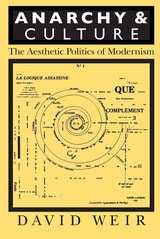
cover of Anarchy and Culture: The Aesthetic Politics of Modernism

Anarchy and Culture

The Aesthetic Politics of Modernism

David Weir

University of Massachusetts Press, 1997

Anarchism is generally understood as a failed ideology, a political philosophy that once may have had many followers but today attracts only cranks and eccentrics. This book argues that the decline of political anarchism is only half the story; the other half is a tale of widespread cultural success. 

David Weir develops this thesis in several ways. He begins by considering the place of culture in the political thought of the classical anarchist thinkers William Godwin, Pierre-Joseph Proudhon, Mikhail Bakunin, and Peter Kropotkin. He then shows how the perceived “anarchy” of nineteenth-century society induced writers such as Matthew Arnold, Henry James, and Fyodor Dostoyevsky to turn away from politics and seek unity in the idea of a common culture. 

Yet as other late-nineteenth-century writers and artists began to sympathize with anarchism, the prospect of a common culture became increasingly remote. In Weir's view, the affinity for anarchism that developed among members of the artistic avant-garde lies behind much of fin de siècle culture. Indeed, the emergence of modernism itself can be understood as the aesthetic realization of anarchist politics. In support of this contention, Weir shows that anarchism is the key aesthetic principle informing the work of a broad range of modernist figures, from Henrik Ibsen and James Joyce to Dadaist Hugo Ball and surrealist Luis Buñuel. 

Weir concludes by reevaluating the phenomenon of postmodernism as only the most recent case of the migration of politics into aesthetics, and by suggesting that anarchism is still very much with us as a cultural condition.
[more]
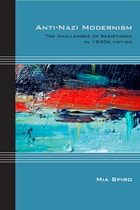
cover of Anti-Nazi Modernism: The Challenges of Resistance in 1930s Fiction

Anti-Nazi Modernism

The Challenges of Resistance in 1930s Fiction

Mia Spiro

Northwestern University Press, 2013
Mia Spiro's Anti-Nazi Modernism marks a major step forward in the critical debates over the relationship between modernist art and politics. Spiro analyzes the antifascist, and particularly anti-Nazi, narrative methods used by key British and American fiction writers in the 1930s. Focusing on works by Djuna Barnes, Christopher Isherwood, and Virginia Woolf, Spiro illustrates how these writers use an "anti-Nazi aesthetic" to target and expose Nazism’s murderous discourse of exclusion. The three writers challenge the illusion of harmony and unity promoted by the Nazi spectacle in parades, film, rallies, and propaganda. Spiro illustrates how their writings, seldom read in this way, resonate with the psychological and social theories of the period and warn against Nazism’s suppression of individuality.  Her approach also demonstrates how historical and cultural contexts complicate the works, often reinforcing the oppressive discourses they aim to attack. This book explores the textual ambivalences toward the "Others" in society—most prominently the Modern Woman, the homosexual, and the Jew. By doing so, Spirouncovers important clues to the sexual and racial politics that were widespread in Europe and the United States in the years leading up to World War II.


[more]
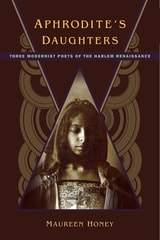
cover of Aphrodite's Daughters: Three Modernist Poets of the Harlem Renaissance

Aphrodite's Daughters

Three Modernist Poets of the Harlem Renaissance

Honey, Maureen

Rutgers University Press, 2016

The Harlem Renaissance was a watershed moment for racial uplift, poetic innovation, sexual liberation, and female empowerment. Aphrodite’s Daughters introduces us to three amazing women who were at the forefront of all these developments, poetic iconoclasts who pioneered new and candidly erotic forms of female self-expression.  
 
Maureen Honey paints a vivid portrait of three African American women—Angelina Weld Grimké, Gwendolyn B. Bennett, and Mae V. Cowdery—who came from very different backgrounds but converged in late 1920s Harlem to leave a major mark on the literary landscape. She examines the varied ways these poets articulated female sexual desire, ranging from Grimké’s invocation of a Sapphic goddess figure to Cowdery’s frank depiction of bisexual erotics to Bennett’s risky exploration of the borders between sexual pleasure and pain. Yet Honey also considers how they were united in their commitment to the female body as a primary source of meaning, strength, and transcendence.
 
The product of extensive archival research, Aphrodite’s Daughters draws from Grimké, Bennett, and Cowdery’s published and unpublished poetry, along with rare periodicals and biographical materials, to immerse us in the lives of these remarkable women and the world in which they lived. It thus not only shows us how their artistic contributions and cultural interventions were vital to their own era, but also demonstrates how the poetic heart of their work keeps on beating.  
 
[more]
cover of Ashes Taken for Fire: Aesthetic Modernism and the Critique of Identity

Ashes Taken for Fire

Aesthetic Modernism and the Critique of Identity

Kevin M. Bell

University of Minnesota Press, 2007

For years critics have held that literary modernism was both apolitical and solipsistic. While the former charge began to give way with the recession of New Criticism, the latter has grown in strength as a lead-in to the claim that postmodernism is apolitical and solipsistic. Against this backdrop, Kevin Bell surveys fiction by Conrad, Woolf, Faulkner, West, Ellison, and Himes to show that modernism is a sharply philosophical archive. In Ashes Taken for Fire, he argues that modernism exposes cultural identities such as blackness as mere strategies of conforming the self into belonging. Bell’s examination pursues the question of nonidentity through sound, silence, and gesture, treating these as technologies of reading the contradictions, breakdowns, and erasures that constitute subjectivity. His analysis of these texts reveals that the aesthetic investigations they perform undo the logic of cultural identity, devastating such reductive rubrics as “race” or “gender.”Ashes Taken for Fire explores the experience of blackness in both its chromatic/ocular and “racial” registers. For while blackness operates as a standard figural expression for disorientation, its presumably “voided” character is reprojected in this work as an immanent force of possibility and experimentation.Kevin Bell is assistant professor of English and comparative literary studies at Northwestern University.
[more]