Results by title
99 books match the query 'Motion picture producers and directors' and 5 start with a
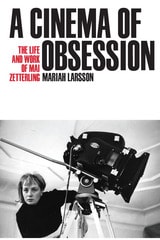
A Cinema of Obsession
The Life and Work of Mai ZetterlingMariah Larsson
University of Wisconsin Press, 2020
Mai Elizabeth Zetterling (1925–94) is among the most exceptional postwar female filmmakers. Born in Sweden, she lived in England and France for most of her life, making her directorial debut in 1964 with the Swedish art film Loving Couples after a fraught transition from working in front of the camera as a successful actress.
Critics have compared her work to that of Ingmar Bergman, Luis Buñuel, and Federico Fellini, but Zetterling had a distinct style—alternately radical and reactionary—that straddled the gendered divide between high art and mass culture. Tackling themes of sexuality, isolation, and creativity, her documentaries, short and feature films, and television works are visually striking. Her oeuvre provoked controversy and scandal through her sensational representations of reproduction and motherhood.
Mariah Larsson provides a lively and authoritative take on Zetterling's legacy and complicated position within film and women's history. A Cinema of Obsession provides necessary perspective on how the breadth of an artist's collected works keeps gatekeepers from recognizing their achievements, and questions why we still distinguish between national and global visual cultures and the big and small screens in the #MeToo era.
[more]
Alejandro González Iñárritu
Celestino Deleyto and Maria del Mar Azcona
University of Illinois Press, 2010
This in-depth study of Mexican film director Alejandro González Iñárritu explores his role in moving Mexican filmmaking from a traditional nationalist agenda towards a more global focus. Working in the United States and in Mexico, Iñárritu crosses national borders while his movies break the barriers of distribution, production, narration, and style. His features also experiment with transnational identity as characters emigrate and settings change.
In studying the international scope of Iñárritu's influential films Amores Perros, 21 Grams, and Babel, Celestino Deleyto and María del Mar Azcona trace common themes such as human suffering and redemption, chance, and accidental encounters. The authors also analyze the director's powerful visual style and his consistent use of multiple characters and a fragmented narrative structure. The book concludes with a new interview with Iñárritu that touches on the themes and subject matter of his chief works.
[more]

Aleksandr Askoldov
The CommissarMarat Grinberg
Intellect Books, 2016
Filmed in1966 and ’67, but kept from release for twenty years, The Commissar is unquestionably one of the most important and compelling films of the Soviet era. Based on a short story by Vasily Grossman, it tells of a female Red Army commissar who is forced to stay with a Jewish family near the frontlines of the battle between the Red and White Armies as she waits to give birth. The film drew the ire of censors for its frank portrayal of the violence faced by Russian Jews in the wake of the revolution.
This book is the first companion to the film in any language. It recounts the film’s plot and turbulent production history, and it also offers a close analysis of the artistic vision of its director, Aleksandr Askoldov, and the ways that viewers can trace in the film not only his complex aesthetics, but also the personal crises he endured in the years leading up to the film. The result is an indispensable companion to an unforgettable film.
This book is the first companion to the film in any language. It recounts the film’s plot and turbulent production history, and it also offers a close analysis of the artistic vision of its director, Aleksandr Askoldov, and the ways that viewers can trace in the film not only his complex aesthetics, but also the personal crises he endured in the years leading up to the film. The result is an indispensable companion to an unforgettable film.
[more]
Aleksandr Sokurov
Russian ArkBirgit Beumers
Intellect Books, 2016
Released in 2002, Russian Ark drew astonished praise for its technique: shot with a Steadicam in one ninety-six-minute take, it presented a dazzling whirl of movement as it followed the Marquis de Custine as he wandered through the vast Winter Palace in St. Petersburg—and through three hundred years of Russian history.
This companion to Russian Ark addresses all key aspects of the film, beginning with a comprehensive synopsis, an in-depth analysis, and an account of the production history. Birgit Beumers goes on from there to discuss the work that went into the now-legendary Steadicam shot—which required two thousand actors and three orchestras—and she also offers an account of the film’s critical and public reception, showing how it helped to establish director Aleksandr Sokurov as perhaps the leading filmmaker in Russia today.
This companion to Russian Ark addresses all key aspects of the film, beginning with a comprehensive synopsis, an in-depth analysis, and an account of the production history. Birgit Beumers goes on from there to discuss the work that went into the now-legendary Steadicam shot—which required two thousand actors and three orchestras—and she also offers an account of the film’s critical and public reception, showing how it helped to establish director Aleksandr Sokurov as perhaps the leading filmmaker in Russia today.
[more]
Andrei Tarkovsky
Elements of CinemaRobert Bird
Reaktion Books, 2008
The masters of Russian arts and letters are a prestigious fraternity that includes such renowned artists as Tolstoy, Rachmaninoff, and Shostakovich. But alongside these luminaries stands a lesser-known but equally revered figure, filmmaker Andrei Tarkovsky. Robert Bird offers in Andrei Tarkovsky an unprecedented investigation of Tarkovsky’s oeuvre and its far-reaching influence on world cinema.
Bird brings a novel approach to his dissection of Tarkovsky’s wholly original techniques and sensibilities, arranging the films into elemental categories of Water, Fire, Earth, and Air. Solaris, Ivan’s Childhood, Mirror, Nostalgia, Andrei Rublev, and Sacrifice all get their due here; through them, Bird explores how the filmmaker probed the elusive correlation between cinematic representation and a more primeval perception of the world. Though the book also considers Tarkovsky’s work in radio, theatre, and opera—as well as his work as an actor, screenwriter, and film theorist—Bird throughout keeps his focus firmly on Tarkovsky as a consummate filmmaker.
Anchored by a wealth of film stills and photographs, Andrei Tarkovsky is a must-read for all film buffs and admirers of European cinema.
[more]