Results by title
57 books match the query 'Multiracial people' and 6 start with a

Adrienne Kennedy Reader
Adrienne Kennedy
University of Minnesota Press, 2001
Adrienne Kennedy has been a force in American theatre since the early 1960s, influencing generations of playwrights with her hauntingly fragmentary lyrical dramas. Exploring the violence racism visits upon people’s lives, Kennedy’s plays express poetic alienation, transcending the particulars of character and plot through ritualistic repetition and radical structural experimentation. Frequently produced, read, and taught, they continue to hold a significant place among the most exciting dramas of the past fifty years.
This first comprehensive collection of her most important works traces the development of Kennedy’s unique theatrical oeuvre from her Obie-winning Funnyhouse of a Negro (1964) through significant later works such as A Movie Star Has to Star in Black and White (1976), Ohio State Murders (1992), and June and Jean in Concert, for which she won an Obie in 1996. The entire contents of Kennedy’s groundbreaking collections In One Act and The Alexander Plays are included, as is her earliest work "Because of the King of France" and the play An Evening with Dead Essex (1972). More recent prose writings "Secret Paragraphs about My Brother," "A Letter to Flowers," and "Sisters Etta and Ella" are fascinating refractions of the themes and motifs of her dramatic works, even while they explore new material on teaching and writing. An introduction by Werner Sollors provides a valuable overview of Kennedy’s career and the trajectory of her literary development.
Adrienne Kennedy (b. 1931) is a three-time Obie-award winning playwright whose works have been widely performed and anthologized. Among her many honors are the American Academy of Arts and Letters award and the Guggenheim fellowship. In 1995-6, the Signature Theatre Company dedicated its entire season to presenting her work. She has been commissioned to write works for the Public Theater, Jerome Robbins, the Royal Court Theatre, the Mark Taper Forum, and Juilliard, and she has been a visiting professor at Yale, Princeton, Brown, the University of California at Berkeley, and Harvard. She lives in New York City.
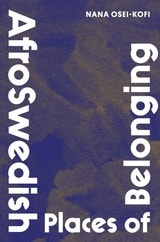
AfroSwedish Places of Belonging
Nana Osei-Kofi
Northwestern University Press, 2024
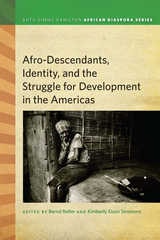
Afrodescendants, Identity, and the Struggle for Development in the Americas
Bernd Reiter
Michigan State University Press, 2012
Indigenous people and African descendants in Latin America and the Caribbean have long been affected by a social hierarchy established by elites, through which some groups were racialized and others were normalized. Far from being “racial paradises” populated by an amalgamated “cosmic race” of mulattos and mestizos, Latin America and the Caribbean have long been sites of shifting exploitative strategies and ideologies, ranging from scientific racism and eugenics to the more sophisticated official denial of racism and ethnic difference. This book, among the first to focus on African descendants in the region, brings together diverse reflections from scholars, activists, and funding agency representatives working to end racism and promote human rights in the Americas. By focusing on the ways racism inhibits agency among African descendants and the ways African-descendant groups position themselves in order to overcome obstacles, this interdisciplinary book provides a multi-faceted analysis of one of the gravest contemporary problems in the Americas.
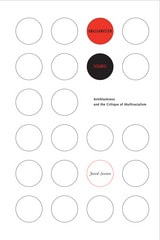
Amalgamation Schemes
Antiblackness and the Critique of MultiracialismJared Sexton
University of Minnesota Press, 2008
Despite being heralded as the answer to racial conflict in the post–civil rights United States, the principal political effect of multiracialism is neither a challenge to the ideology of white supremacy nor a defiance of sexual racism. More accurately, Jared Sexton argues in Amalgamation Schemes, multiculturalism displaces both by evoking long-standing tenets of antiblackness and prescriptions for normative sexuality.
In this timely and penetrating analysis, Sexton pursues a critique of contemporary multiracialism, from the splintered political initiatives of the multiracial movement to the academic field of multiracial studies, to the melodramatic media declarations about “the browning of America.” He contests the rationales of colorblindness and multiracial exceptionalism and the promotion of a repackaged family values platform in order to demonstrate that the true target of multiracialism is the singularity of blackness as a social identity, a political organizing principle, and an object of desire. From this vantage, Sexton interrogates the trivialization of sexual violence under chattel slavery and the convoluted relationship between racial and sexual politics in the new multiracial consciousness.
An original and challenging intervention, Amalgamation Schemes posits that multiracialism stems from the conservative and reactionary forces determined to undo the gains of the modern civil rights movement and dismantle radical black and feminist politics.
Jared Sexton is assistant professor of African American studies and film and media studies at the University of California, Irvine.
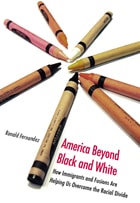
America Beyond Black and White
How Immigrants and Fusions Are Helping Us Overcome the Racial DivideRonald Fernandez
University of Michigan Press, 2007
“This book is both powerful and important. Powerful for the testimony it provides from Americans of many different (and even mixed races) about their experiences. And important because there is a racial revolution underway that will upend race as we know it during the twenty-first century.”
—John Kenneth White, Catholic University of America
America Beyond Black and White is a call for a new way of imagining race in America. For the first time in U.S. history, the black-white dichotomy that has historically defined race and ethnicity is being challenged, not by a small minority, but by the fastest-growing and arguably most vocal segment of the increasingly diverse American population—Mexicans, Chinese, Japanese, Koreans, Indians, Arabs, and many more—who are breaking down and recreating the very definitions of race.
Drawing on interviews with hundreds of Americans who don’t fit conventional black/white categories, the author invites us to empathize with these “doubles” and to understand why they may represent our best chance to throw off the strictures of the black/white dichotomy.
The revolution is already underway, as newcomers and mixed-race “fusions” refuse to engage in the prevailing Anglo- Protestant culture. Americans face two choices: understand why these individuals think as they do, or face a future that continues to define us by what divides us rather than by what unites us.
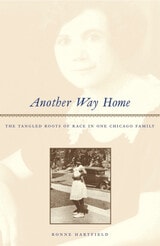
Another Way Home
The Tangled Roots of Race in One Chicago FamilyRonne Hartfield
University of Chicago Press, 2004
Hartfield begins with the early life of her mother, Day Shepherd. Born to a wealthy British plantation owner and the mixed-race daughter of a former slave, Day negotiates the complicated circumstances of plantation life in the border country of Louisiana and Mississippi and, as she enters womanhood, the quadroon and octoroon societies of New Orleans. Equally a tale of the Great Migration, Another Way Home traces Day's journey to Bronzeville, the epicenter of black Chicago during the first half of the twentieth century. Here, through the eyes of Day and, ultimately, her daughter, we witness the bustling city streets and vibrant middle-class culture of this iconic black neighborhood. We also relive crucial moments in African American history as they are experienced by the author's family and others in Chicago's South Side black community, from the race riots of 1919 and the Great Depression to the murder of Emmett Till and the dawn of the civil rights movement.
Throughout her book, Hartfield portrays mixed-race Americans navigating the challenges of their lives with resilience and grace, making Another Way Home an intimate and compelling encounter with one family's response to our racially charged culture.