Results by title
72 books match the query 'Museums' and 4 start with a
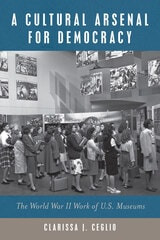
A Cultural Arsenal for Democracy
The World War II Work of US MuseumsClarissa J. Ceglio
University of Massachusetts Press, 2022
Unsurprisingly, exhibitions served as the primary vehicle through which museums, large and small, engaged their publics with wartime topics with fare ranging from displays on the cultures of Allied nations to "living maps" that charted troop movements and exhibits on war preparedness. Clarissa J. Ceglio chronicles debates, experiments, and collaborations from the 1930s to the immediate postwar years, investigating how museums re-envisioned the exhibition as a narrative medium and attempted to reconcile their mission with new modes of storytelling.

A Theory of Assembly
From Museums to MemesKyle Parry
University of Minnesota Press, 2022
A vital reckoning with how we understand the basic categories of cultural expression in the digital era
Digital and social media have transformed how much and how fast we communicate, but they have also altered the palette of expressive strategies: the cultural forms that shape how citizens, activists, and artists speak and interact. Most familiar among these strategies are storytelling and representation. In A Theory of Assembly, Kyle Parry argues that one of the most powerful and pervasive cultural forms in the digital era is assembly.
Whether as subtle photographic sequences, satirical Venn diagrams, or networked archives, projects based in assembly do not so much narrate or represent the world as rearrange it. This work of rearranging can take place at any scale, from a simple pairing of images, undertaken by one person, to the entire history of internet memes, undertaken by millions. With examples ranging from GIFs and paintings to museum exhibitions and social movement hashtags, Parry shows how, in the internet age, assembly has come to equal narrative and representation in its reach and influence, particularly as a response to ecological and social violence. He also emphasizes the ambivalence of assembly—the way it can be both emancipatory and antidemocratic.
As the world becomes ever hotter, more connected, and more algorithmic, the need to map—and remake—assembly’s powers and perils becomes all the more pressing. Interdisciplinary, engaging, and experimental, A Theory of Assembly serves as a playbook of strategies and critical frameworks for artists, activists, and content creators committed to social and environmental justice, ultimately arguing for a collective reenvisioning of which cultural forms matter.
Cover alt text: Letters from the title appear in a jumble, each colored in a blue-orange gradient. Readable title and author sits below the jumble.
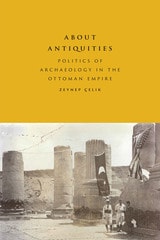
About Antiquities
Politics of Archaeology in the Ottoman EmpireBy Zeynep Çelik
University of Texas Press, 2016
Antiquities have been pawns in empire-building and global rivalries; power struggles; assertions of national and cultural identities; and cross-cultural exchanges, cooperation, abuses, and misunderstandings—all with the underlying element of financial gain. Indeed, “who owns antiquity?” is a contentious question in many of today’s international conflicts.
About Antiquities offers an interdisciplinary study of the relationship between archaeology and empire-building around the turn of the twentieth century. Starting at Istanbul and focusing on antiquities from the Ottoman territories, Zeynep Çelik examines the popular discourse surrounding claims to the past in London, Paris, Berlin, and New York. She compares and contrasts the experiences of two museums—Istanbul’s Imperial Museum and the Metropolitan Museum of Art—that aspired to emulate European collections and gain the prestige and power of owning the material fragments of ancient history. Going beyond institutions, Çelik also unravels the complicated interactions among individuals—Westerners, Ottoman decision makers and officials, and local laborers—and their competing stakes in antiquities from such legendary sites as Ephesus, Pergamon, and Babylon.
Recovering perspectives that have been lost in histories of archaeology, particularly those of the excavation laborers whose voices have never been heard, About Antiquities provides important historical context for current controversies surrounding nation-building and the ownership of the past.
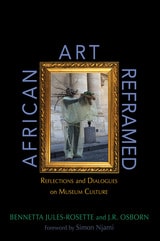
African Art Reframed
Reflections and Dialogues on Museum CultureBennetta Jules-Rosette and J. R. Osborn; Foreword by Simon Njami
University of Illinois Press, 2020
The authors take a three-pronged approach. Part One ranges from curiosity cabinets to virtual websites to offer a history of ethnographic and art museums and look at their organization and methods of reaching out to the public. In the second part, the authors examine museums as ecosystems and communities within communities, and they use semiotic methods to analyze images, signs, and symbols drawn from the experiences of curators and artists. The third part introduces innovative strategies for displaying, disseminating, and reclaiming African art. The authors also propose how to reinterpret the art inside and outside the museum and show ways of remixing the results.
Drawing on extensive conversations with curators, collectors, and artists, African Art Reframed is an essential guide to building new exchanges and connections in the dynamic worlds of African and global art.