Results by title
1947 books match the query 'Music' and 127 start with a

A Basic Music Library
Essential Scores and Sound Recordings, Volume 1: Popular MusicAmerican Library Association, 2022

A Beautiful Fight
The Racial Politics of Capoeira in Backland BahiaEsther Viola Kurtz
University of Michigan Press, 2025
2026 Dance Studies Association de la Torre Bueno First Book Award Shortlist Finalist
A Beautiful Fight examines the potentials and limits of capoeira Angola to cohere a multiracial community committed to antiracist struggle. Capoeira, a musical fight-game that originated among enslaved Africans in Brazil, holds special significance for Black Brazilian activists as a spiritual and political practice that affirms the value of Black lives, thus countering anti-Black violence sanctioned by the Brazilian state. However, many capoeira groups count more white practitioners than Black, especially groups of the politicized, Afrocentric style capoeira Angola, raising debates about appropriation of Black culture that resonate across the Americas. A Beautiful Fight addresses these tensions. Drawing on ethnographic research with a multiracial capoeira Angola group in Brazil’s Bahian sertão or backlands, Esther Viola Kurtz explores diverse group members’ understandings of capoeira’s spiritual and political meanings and considers how white participation impacts capoeira’s antiracist politics. A Beautiful Fight argues that white practitioners occupying space in capoeira divert attention from Black members’ concerns and reproduce racist and colonialist ideologies, albeit unintentionally. In this way, the book complicates claims that shared music and dance bridge differences and facilitate cross-racial unity, yet Kurtz proposes that capoeira still transmits knowledge and tools that, when used with intention, commitment, and care, can be wielded to collaboratively contest racism and imagine a more just world.
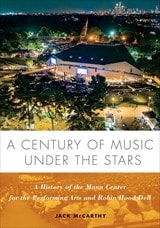
A Century of Music Under the Stars
A History of the Mann Center for the Performing Arts and Robin Hood DellMcCarthy, Jack, and The Mann Center for the Performing Arts
Temple University Press, 2025
The Dell, which opened in 1930, and the Mann, which opened in 1976, were initially built as summer homes for The Philadelphia Orchestra. As McCarthy fondly recounts, the Mann Center evolved to host the world’s top artists across many musical genres. Contemporary audiences have gathered on the Great Lawn for concerts by performers including James Taylor, The Roots, Phish, Diana Ross, John Legend, and others.
The venues, however, are more than just the music; they are about the beautiful natural setting, communal atmosphere, and spectacular view of the Philadelphia skyline. A Century of Music Under the Stars is a revealing and celebratory look back at beloved Philadelphia cultural icons. This informative and illuminating history will provide happy memories for generations of music lovers.
A Change Is Gonna Come
Music, Race & the Soul of AmericaCraig Werner
University of Michigan Press, 2006
—Notes
"No one has written this way about music in a long, long time. Lucid, insightful, with real spiritual, political, intellectual, and emotional grasp of the whole picture. A book about why music matters, and how, and to whom."
—Dave Marsh, author of Louie, Louie and Born to Run: The Bruce Springsteen Story
"This book is urgently needed: a comprehensive look at the various forms of black popular music, both as music and as seen in a larger social context. No one can do this better than Craig Werner."
—Henry Louis Gates, Jr., W.E.B. Du Bois Professor of the Humanities, Harvard University
"[Werner has] mastered the extremely difficult art of writing about music as both an aesthetic and social force that conveys, implies, symbolizes, and represents ideas as well as emotion, but without reducing its complexities and ambiguities to merely didactic categories."
—African American Review
A Change Is Gonna Come is the story of more than four decades of enormously influential black music, from the hopeful, angry refrains of the Freedom movement, to the slick pop of Motown; from the disco inferno to the Million Man March; from Woodstock's "Summer of Love" to the war in Vietnam and the race riots that inspired Marvin Gaye to write "What's Going On."
Originally published in 1998, A Change Is Gonna Come drew the attention of scholars and general readers alike. This new edition, featuring four new and updated chapters, will reintroduce Werner's seminal study of black music to a new generation of readers.
Craig Werner is Professor of Afro-American Studies at the University of Wisconsin, and author of many books, including Playing the Changes: From Afro-Modernism to the Jazz Impulse and Up Around the Bend: An Oral History of Creedence Clearwater Revival. His most recent book is Higher Ground: Stevie Wonder, Aretha Franklin, Curtis Mayfield, and the Rise and Fall of American Soul.
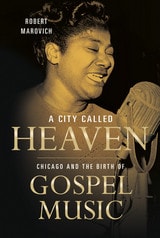
A City Called Heaven
Chicago and the Birth of Gospel MusicRobert Marovich
University of Illinois Press, 2015
A City Called Heaven celebrates a sound too mighty and too joyous for even church walls to hold.
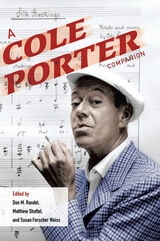
A Cole Porter Companion
Edited by Don M. Randel, Matthew Shaftel, and Susan Forscher
University of Illinois Press, 2016
In A Cole Porter Companion, a parade of performers and scholars offers essays on little-known aspects of the master tunesmith's life and art. Here are Porter's days as a Yale wunderkind and his nights as the exemplar of louche living; the triumph of Kiss Me Kate and shocking failure of You Never Know; and his spinning rhythmic genius and a turkey dinner into "You're the Top" while cultural and economic forces take "Ev'ry Time We Say Goodbye" in unforeseen directions. Other entries explore notes on ongoing Porter scholarship and delve into his formative works, performing career, and long-overlooked contributions to media as varied as film and ballet.
Prepared with the cooperation of the Porter archives, A Cole Porter Companion is an invaluable guide for the fans and scholars of this beloved American genius.
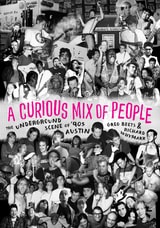
A Curious Mix of People
The Underground Scene of '90s AustinGreg Beets
University of Texas Press, 2023
A twisting path through Austin’s underground music scene in the twentieth century’s last decade, narrated by the people who were there.
It’s 1990 in Austin, Texas. The next decade will be a tipping point in the city's metamorphosis from sleepy college town to major city. Beneath the increasingly slick exterior, though, a group of like-minded contrarians were reimagining an underground music scene. Embracing a do-it-yourself ethos, record labels emerged to release local music, zines cheered and jeered acts beneath the radar of mainstream media outlets, and upstart clubs provided a home venue for new bands to build their sound.
This vibrant scene valued expression over erudition, from the razor-sharp songcraft of Spoon to the fuzzed-out poptones of Sixteen Deluxe, and blurred the boundaries between observer and participant. Evolving in tandem with the city’s emergence on the national stage via the film Slacker and the SXSW conference and festivals, Austin’s musical underground became a spiritual crucible for the uneasy balance between commercial success and cultural authenticity, a tension that still resonates today.
The first book about Austin underground music in the ’90s, A Curious Mix of People is an oral history that tells the story of this transformative decade through the eyes of the musicians, writers, DJs, club owners, record-store employees, and other key figures who were there.
A Dance to the Music of Time
First MovementAnthony Powell
University of Chicago Press, 1995
A Dance to the Music of Time is a landmark work of fiction, praised by readers and critics and other novelists throughout the 75 years since the first volume was published. Equal parts funny and heartbreaking, clever and moving, Anthony Powell's universally acclaimed epic encompasses a four-volume panorama of twentieth century London.
Hailed by Time as "brilliant literary comedy as well as a brilliant sketch of the times," A Dance to the Music of Time opens just after World War I and carries through the 1950s, with all the changes of society, characters, and relationships that those shifting eras bring.
Four very different young men on the threshold of manhood dominate this opening volume of A Dance to the Music of Time. The narrator, Jenkins—a budding writer—shares a room with Templer, already a passionate womanizer, and Stringham, aristocratic and reckless. Widmerpool, as hopelessly awkward as he is intensely ambitious, lurks on the periphery of their world. Amid the fever of the 1920s and the first chill of the 1930s, these four gain their initiations into sex, society, business, and art. A masterpiece of modern fiction, Powell's epic creates a rich portrait of life in England between the wars.
"Reading Powell," says the New York Times, "is like living someone else's life, inextricably entangled with your own." Give this first volume a try, and you'll find characters and scenes and insights that will stay with you for the rest of your life.
Includes these novels:
A Question of Upbringing
A Buyer's Market
The Acceptance World
A Dance to the Music of Time
Fourth MovementAnthony Powell
University of Chicago Press, 1995
A Dance to the Music of Time is a landmark work of fiction, praised by readers and critics and other novelists throughout the 75 years since the first volume was published. Equal parts funny and heartbreaking, clever and moving, Anthony Powell's universally acclaimed epic encompasses a four-volume panorama of twentieth century London. Hailed by Time as "brilliant literary comedy as well as a brilliant sketch of the times," A Dance to the Music of Time opens just after World War I and carries through the 1950s, with all the changes to society, character, and relationships those shifting eras bring.
In this final volume of A Dance to the Music of Time, Nick Jenkins describes a world of ambition, intrigue, and dissolution. England has won the war, but its costs, physical and moral, were vast. Widmerpool's wife sets a snare for the young writer X. Trapnel, while her husband suffers private agony and public humiliation. Set against a background of politics, business, high society, and the counterculture in England and Europe, this magnificent work of art sounds an unforgettable requiem for an age.
"Reading Powell," says the New York Times, "is like living someone else's life, inextricably entangled with your own." Give this first volume a try, and you'll find characters and scenes and insights that will stay with you for the rest of your life.
Includes these novels:
Books Do Furnish a Room
Temporary Kings
Hearing Secret Harmonies
A Dance to the Music of Time
Second MovementAnthony Powell
University of Chicago Press, 1995
A Dance to the Music of Time is a landmark work of fiction, praised by readers and critics and other novelists throughout the 75 years since the first volume was published. Equal parts funny and heartbreaking, clever and moving, Anthony Powell's universally acclaimed epic encompasses a four-volume panorama of twentieth century London. Hailed by Time as "brilliant literary comedy as well as a brilliant sketch of the times," A Dance to the Music of Time opens just after World War I and continues through the 1950s.
In the background of this second volume of A Dance to the Music of Time, the rumble of distant events in Germany and Spain presages the storm of World War II. In England, even as the whirl of marriages and adulteries, fashions and frivolities, personal triumphs and failures gathers speed, men and women find themselves on the brink of fateful choices.
"Reading Powell," says the New York Times, "is like living someone else's life, inextricably entangled with your own." Give this first volume a try, and you'll find characters and scenes and insights that will stay with you for the rest of your life
Includes these novels:
At Lady Molly's
Casanova's Chinese Restaurant
The Kindly Ones
A Dance to the Music of Time
Third MovementAnthony Powell
University of Chicago Press, 1995
A Dance to the Music of Time is a landmark work of fiction, praised by readers and critics and other novelists throughout the 75 years since the first volume was published. Equal parts funny and heartbreaking, clever and moving, Anthony Powell's universally acclaimed epic encompasses a four-volume panorama of twentieth century London. Hailed by Time as "brilliant literary comedy as well as a brilliant sketch of the times," A Dance to the Music of Time opens just after World War I and continues through the 1950s and all the changes to life, society, and relationships those shifting eras bring.
In this third volume of A Dance to the Music of Time, we again meet Widmerpool, doggedly rising in rank; Jenkins, shifted from one dismal army post to another; Stringham, heroically emerging from alcoholism; Templer, still on his eternal sexual quest. Here, too, we are introduced to Pamela Flitton, one of the most beautiful and dangerous women in modern fiction. Wickedly barbed in its wit, uncanny in its seismographic recording of human emotions and social currents, this saga stands as an unsurpassed rendering of England's finest yet most costly hour.
"Reading Powell," says the New York Times, "is like living someone else's life, inextricably entangled with your own." Give Dance a try, and you'll find characters and scenes and insights that will stay with you for the rest of your life.
Includes these novels:
The Valley of Bones
The Soldier's Art
The Military Philosophers
A Day for Dancing
The Life and Music of Lloyd PfautschKenneth W. Hart
University of North Texas Press, 2014
A Day for the Hunter, a Day for the Prey
Popular Music and Power in HaitiGage Averill
University of Chicago Press, 1997
Averill explores such diverse genres as Haitian jazz, troubadour traditions, Vodou-jazz, konpa, mini-djaz, new generation, and roots music. He examines the complex interaction of music with power in contexts such as honorific rituals, sponsored street celebrations, Carnival, and social movements that span the political spectrum.
With firsthand accounts by musicians, photos, song texts, and ethnographic descriptions, this book explores the profound manifestations of power and song in the day-to-day efforts of ordinary Haitians to rise above political repression.

A Deeper Blue
The Life and Music of Townes Van ZandtRobert Earl Hardy
University of North Texas Press, 2008
A Feast of Astonishments
Charlotte Moorman and the Avant-Garde, 1960s-1980sEdited by Lisa Graziose Corrin and Corrine Granof
Northwestern University Press, 2015
Charlotte Moorman was a bold, barrier-breaking musician and performance artist and a tireless champion of experimental art, whose avant-garde festivals in New York City brought new art forms to a broad public. To date, recognition of Moorman has been limited mostly to her collaborations with other artists, including composer John Cage and pioneering multimedia artist Nam June Paik, and to her 1967 performance of Paik’s "Opera Sextronique," for which she became known as the "topless cellist" after being arrested on indecency charges. A Feast of Astonishments looks deeper to portray Moorman as a leading international figure in her own right.
With more than 150 color images and essays by art historians, curators, and musicologists, this catalog will offer a fresh perspective and complement an exhibition that opens at Northwestern University’s Mary and Leigh Block Museum of Art in January 2016 before traveling to New York University’s Grey Art Gallery in Manhattan and the Museum der Moderne in Salzburg, Austria. The exhibition will feature original sculptures, photographs, video, props and costumes, annotated music scores, archival materials, film clips, and audio recordings, many drawn from the Charlotte Moorman Archive at the Charles Deering McCormick Library of Special Collections, Northwestern University Library. The exhibition is a partnership between the Block Museum and the Northwestern University Libraries.
A Feminist Ethnomusicology
Writings on Music and GenderEllen Koskoff
University of Illinois Press, 2014
In this intellectual memoir, Koskoff describes her journey through the maze of social history and scholarship related to her work examining the intersection of music and gender. Koskoff collects new, revised, and hard-to-find published material from mid-1970s through 2010 to trace the evolution of ethnomusicological thinking about women, gender, and music, offering a perspective of how questions emerged and changed in those years, as well as Koskoff's reassessment of the early years and development of the field. Her goal: a personal map of the different paths to understanding she took over the decades, and how each inspired, informed, and clarified her scholarship. For example, Koskoff shows how a preference for face-to-face interactions with living people served her best in her research, and how her now-classic work within Brooklyn's Hasidic community inflamed her feminist consciousness while leading her into ethnomusicological studies.
An uncommon merging of retrospective and rumination, A Feminist Ethnomusicology: Writings on Music and Gender offers a witty and disarmingly frank tour through the formative decades of the field and will be of interest to ethnomusicologists, anthropologists, scholars of the history and development of feminist thought, and those engaged in fieldwork.
Includes a foreword by Suzanne Cusick framing Koskoff's career and an extensive bibliography provided by the author.
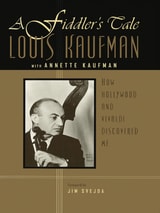
A Fiddler's Tale
How Hollywood and Vivaldi Discovered MeLouis Kaufman with Annette Kaufman; Foreword by Jim Svejda
University of Wisconsin Press, 2003
Once called by the New York Times "a violinist's violinist and a musician's musician," Louis Kaufman was born in 1905 in Portland, Oregon. He studied violin with Franz Kneisl at New York's Institute of Musical Art. He was the original violist of the Musical Art Quartet (1926-1933) and won the Naumburg Award in 1928, the year of his American solo recital debut in New York's Town Hall.
During these early years, he played chamber music with Pablo Casals, Mischa Elman, Jascha Heifetz, Fritz Kreisler, Gregor Piatigorsky, and Efrem Zimbalist, among others. After performing the violin solos for Ernst Lubitsch's 1934 film The Merry Widow, Kaufman became the most sought after violin soloist in Hollywood, playing in some 500 films, including Casablanca, Gone with the Wind, The Diary of Anne Frank, Wuthering Heights, The Grapes of Wrath, and Spartacus. He worked closely with Robert Russell Bennett, Bernard Herrmann, Erich Wolfgang Korngold, Alfred Newman, Miklós Rózsa, Max Steiner, Franz Waxman, and Victor Young.
Extraordinary as it seems today, Kaufman was largely responsible for bringing the once-forgotten music of Antonio Vivaldi to its current popularity worldwide among both classical musicians and the general population of music lovers.
The book includes a music CD with Kaufman’s performances of Vivaldi’s Concerto 2 of op. 9, Havanaise by Camille Saint Saëns, Nocturne for Violin and Piano by Aaron Copland, Much Ado about Nothing Suite for violin and piano by Erich Wolfgang Korngold, and Smoke Gets in Your Eyes by Jerome Kern, among other favorites.
A Florentine Chansonnier from the Time of Lorenzo the Magnificent
Edited by Howard M. Brown
University of Chicago Press, 1983

A Florida Fiddler
The Life and Times of Richard SeamanGregory Hansen
University of Alabama Press, 2007
Exploring Florida's cultural landscape through the life of a legendary fiddler.
This biography of 97-year-old Richard Seaman, who grew up in Kissimmee Park, Florida, relies on oral history and folklore research to define the place of musicianship and storytelling in the state's history from one artist's perspective. Gregory Hansen presents Seaman’s assessment of Florida’s changing cultural landscape through his tall tales, personal experience narratives, legends, fiddle tune repertory, and descriptions of daily life.
Seaman’s childhood memories of fiddling performances and rural dances explain the role such gatherings played in building and maintaining social order within the community. As an adult, Seaman moved to Jacksonville, Florida, where he worked as a machinist and performed with his family band. The evolution of his musical repertory from the early 1920s through the 1950s provides a resource for reconstructing social life in the rural south and for understanding how changes in musical style reflect the state's increasingly urban social structure. Hansen includes a set of Seaman's fiddle tunes, transcribed for the benefit of performer and researcher alike. The thirty tall tales included in the volume constitute a representative sample of Florida’s oral tradition in the early years of the 20th century.

A Gift of Madrigals and Motets
Edited by H. Colin Slim
University of Chicago Press, 1972
At first encounter, these partbooks yield no clues concerning their provenance, their composers' names, or the reasons for their dispatch to England. In his search for this information, Professor Slim used the musicologists' customary tools, namely, biobibliography, concordances, and textual and musical analysis. But he also used bibliographers' tools not always employed by musicologists: watermarks, bindings, script, orthography, and illuminations.
As a result of his efforts, the author was able to identify nearly all the works' composers and the manuscripts' expert illuminator. He also presents a detailed description of the binding process and the probably background of the scribe, places the political and social references in the works, and determines the route the volumes may have taken after they left Henry's library.
By placing the date of the partbooks' arrival in England around 1528, Professor Slim suggests that the musical culture of the early Tudor court was less French than has hitherto been thought. Indeed, the presence of the partbooks in Henry's library makes them the earliest evidence of the Italian madrigal in England. The author also provides new and significant data on the artistic and historical position of Philippe Verdelot, the partbooks' most extensively represented composer.
Volume I of this set contains two parts. The first, dealing with the manuscript itself, contains the history of the partbooks, information on their origin, composers, texts, and their importance as a gift to Henry VIII. Part II, dealing with the music, discusses general musical traits, the motets, the madrigals, the results of collation, and the appearance of some of the Newberry motets and madrigals in other sources.
A Gift of Madrigals and Motets, Volume 2
TranscriptionEdited by H. Colin Slim
University of Chicago Press, 1972
At first encounter, these partbooks yield no clues concerning their provenance, their composers' names, or the reasons for their dispatch to England. In his search for this information, Professor Slim used the musicologists' customary tools, namely, biobibliography, concordances, and textual and musical analysis. But he also used bibliographers' tools not always employed by musicologists: watermarks, bindings, script, orthography, and illuminations.
As a result of his efforts, the author was able to identify nearly all the works' composers and the manuscripts' expert illuminator. He also presents a detailed description of the binding process and the probably background of the scribe, places the political and social references in the works, and determines the route the volumes may have taken after they left Henry's library.
By placing the date of the partbooks' arrival in England around 1528, Professor Slim suggests that the musical culture of the early Tudor court was less French than has hitherto been thought. Indeed, the presence of the partbooks in Henry's library makes them the earliest evidence of the Italian madrigal in England. The author also provides new and significant data on the artistic and historical position of Philippe Verdelot, the partbooks' most extensively represented composer.
In Volume II, Professor Slim has transcribed the music of the thirty motets and thirty madrigals for modern performance. The parts are cantus, tenor, bassus, and quintus et VI; the altus partbook is missing. Concordant sources provide the altus parts for all but four of the motets and six of the madrigals. These ten have been composed by Professor Slim. Notes at the end of each selection provide variant readings for both music and text. The Latin texts of the motets, the Italian of the madrigals, and an English translation of each appear at the end of the volume.
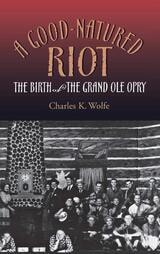
A Good-Natured Riot
The Birth of the Grand Ole OpryCharles K. Wolfe
Vanderbilt University Press, 1999
Winner of the ASCAP Deems Taylor Award
On November 28, 1925, a white-bearded man sat before one of Nashville radio station WSM's newfangled carbon microphones to play a few old-time fiddle tunes. Uncle Jimmy Thompson played on the air for an hour that night, and throughout the region listeners at their old crystal sets suddenly perked up. Back in Nashville the response at the offices of National Life Insurance Company, which owned radio station WSM ("We Shield Millions"), was dramatic; phone calls and telegrams poured into the station, many of them making special requests. It was not long before station manager George D. Hay was besieged by pickers and fiddlers of every variety, as well as hoedown bands, singers, and comedians--all wanting their shot at the Saturday night airwaves. "We soon had a good-natured riot on our hands," Hay later recalled. And, thus, the Opry was born.
Or so the story goes. In truth, the birth of the Opry was a far more complicated event than even Hay, "the solemn old Judge," remembered. The veteran performers of that era are all gone now, but since the 1970s pioneering country music historian Charles K. Wolfe has spent countless hours recording the oral history of the principals and their families and mining archival materials from the Country Music Foundation and elsewhere to understand just what those early days were like. The story that he has reconstructed is fascinating. Both a detailed history and a group biography of the Opry's early years, A Good-Natured Riot provides the first comprehensive and thoroughly researched account of the personalities, the music, and the social and cultural conditions that were such fertile ground for the growth of a radio show that was to become an essential part of American culture.
Wolfe traces the unsure beginnings of the Opry through its many incarnations, through cast tours of the South, the Great Depression, commercial sponsorship by companies like Prince Albert Tobacco, and the first national radio linkups. He gives colorful and engaging portraits of the motley assembly of the first Opry casts--amateurs from the hills and valleys surrounding Nashville, like harmonica player Dr. Humphrey Bate ("Dean of the Opry") and fiddler Sid Harkreader, virtuoso string bands like the Dixieliners, colorful hoedown bands like the Gully Jumpers and the Fruit Jar Drinkers, the important African American performer DeFord Bailey, vaudeville acts and comedians like Lasses and Honey, through more professional groups such as the Vagabonds, the Delmore Brothers, Bill Monroe and the Blue Grass Boys, and perennial favorite Roy Acuff and his Smoky Mountain Boys.
With dozens of wonderful photographs and a complete roster of every performer and performance of these early Opry years, A Good-Natured Riot gives a full and authoritative portrayal of the colorful beginnings of WSM's barn dance program up to 1940, by which time the Grand Ole Opry had found its national audience and was poised to become the legendary institution that it remains to this day.
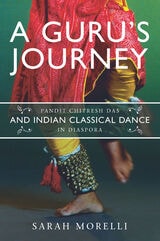
A Guru’s Journey
Pandit Chitresh Das and Indian Classical Dance in DiasporaSarah Morelli
University of Illinois Press, 2019
A Guru's Journey provides an ethnographic study of the dance form in the San Francisco Bay Area community formed by Das. Sarah Morelli, a kathak dancer and one of Das's former students, investigates issues in teaching, learning, and performance that developed around Das during his time in the United States. In modifying kathak's form and teaching for Western students, Das negotiates questions of Indianness and non-Indianness, gender, identity, and race. Morelli lays out these issues for readers with the goal of deepening their knowledge of kathak aesthetics, technique, and theory. She also shares the intricacies of footwork, facial expression in storytelling, and other aspects of kathak while tying them to the cultural issues that inform the dance.
A History of the Rutgers University Glee Club
David F. Chapman
Rutgers University Press, 2022
Founded in 1872, the Glee Club is Rutgers University’s oldest continuously active student organization, as well as one of the first glee clubs in the United States. For the past 150 years, it has represented the university and presented an image of the Rutgers man on a national and international stage.
This volume offers a comprehensive history of the Rutgers Glee Club, from its origins adopting traditions from the German Männerchor and British singing clubs to its current manifestation as a world-recognized ensemble. Along the way, we meet the colorful and charismatic men who have directed the group over the years, from the popular composer and minstrel performer Loren Bragdon to the classically-trained conductor Patrick Gardner. And of course, we learn what the club has meant to the generations of talented and dedicated young men who have sung in it.
A History of the Rutgers University Glee Club recounts the origins of the group’s most beloved traditions, including the composition of the alma mater’s anthem “On the Banks of the Old Raritan” and the development of the annual Christmas in Carol and Song concerts. Meticulously researched, including a complete discography of the club’s recordings, this book is a must-have for all the Rutgers Glee Club’s many fans and alumni.

A Jewish Orchestra in Nazi Germany
Musical Politics and the Berlin Jewish Culture LeagueLily E. Hirsch
University of Michigan Press, 2011
"Offers a clear introduction to a fascinating, yet little known, phenomenon in Nazi Germany, whose very existence will be a surprise to the general public and to historians. Easily blending general history with musicology, the book provides provocative yet compelling analysis of complex issues."
---Michael Meyer, author of The Politics of Music in the Third Reich
"Hirsch poses complex questions about Jewish identity and Jewish music, and she situates these against a political background vexed by the impossibility of truly viable responses to such questions. Her thorough archival research is complemented by her extensive use of interviews, which gives voice to those swept up in the Holocaust. A Jewish Orchestra in Nazi Germany is a book filled with the stories of real lives, a collective biography in modern music history that must no longer remain in silence."
---Philip V. Bohlman, author of Jewish Music and Modernity
"An engaging and downright gripping history. The project is original, the research is outstanding, and the presentation lucid."
---Karen Painter, author of Symphonic Aspirations: German Music and Politics, 1900-1945
The Jewish Culture League was created in Berlin in June 1933, the only organization in Nazi Germany in which Jews were not only allowed but encouraged to participate in music, both as performers and as audience members. Lily E. Hirsch's A Jewish Orchestra in Nazi Germany is the first book to seriously investigate and parse the complicated questions the existence of this unique organization raised, such as why the Nazis would promote Jewish music when, in the rest of Germany, it was banned. The government's insistence that the League perform only Jewish music also presented the organization's leaders and membership with perplexing conundrums: what exactly is Jewish music? Who qualifies as a Jewish composer? And, if it is true that the Nazis conceived of the League as a propaganda tool, did Jewish participation in its activities amount to collaboration?
Lily E. Hirsch is Assistant Professor of Music at Cleveland State University.

A Kiss across the Ocean
Transatlantic Intimacies of British Post-Punk and US LatinidadRichard T. Rodríguez
Duke University Press, 2022
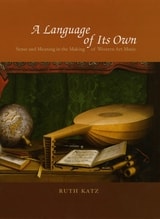
A Language of Its Own
Sense and Meaning in the Making of Western Art MusicRuth Katz
University of Chicago Press, 2009
The Western musical tradition has produced not only music, but also countless writings about music that remain in continuous—and enormously influential—dialogue with their subject. With sweeping scope and philosophical depth, A Language of Its Own traces the past millennium of this ongoing exchange.
Ruth Katz argues that the indispensible relationship between intellectual production and musical creation gave rise to the Western conception of music. This evolving and sometimes conflicted process, in turn, shaped the art form itself. As ideas entered music from the contexts in which it existed, its internal language developed in tandem with shifts in intellectual and social history. Katz explores how this infrastructure allowed music to explain itself from within, creating a self-referential and rational foundation that has begun to erode in recent years.
A magisterial exploration of a frequently overlooked intersection of Western art and philosophy, A Language of Its Own restores music to its rightful place in the history of ideas.
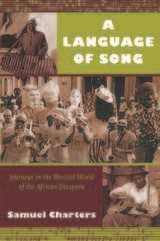
A Language of Song
Journeys in the Musical World of the African DiasporaSamuel Charters
Duke University Press, 2009
Each of the book’s fourteen chapters is a vivid rendering of a particular location that Charters visited. While music is always his focus, the book is filled with details about individuals, history, landscape, and culture. In first-person narratives, Charters relates voyages including a trip to the St. Louis home of the legendary ragtime composer Scott Joplin and the journey to West Africa, where he met a man who performed an hours-long song about the Europeans’ first colonial conquests in Gambia. Throughout the book, Charters traces the persistence of African musical culture despite slavery, as well as the influence of slaves’ songs on subsequent musical forms. In evocative prose, he relates a lifetime of travel and research, listening to brass bands in New Orleans; investigating the emergence of reggae, ska, and rock-steady music in Jamaica’s dancehalls; and exploring the history of Afro-Cuban music through the life of the jazz musician Bebo Valdés. A Language of Song is a unique expedition led by one of music’s most observant and well-traveled explorers.
A Latin American Music Reader
Views from the SouthJavier F Leon
University of Illinois Press, 2016
Contributors include Marina Alonso Bolaños, Gonzalo Camacho Díaz, José Jorge de Carvalho, Claudio F. Díaz, Rodrigo Cantos Savelli Gomes, Juan Pablo González, Rubén López-Cano, Angela Lühning, Jorge Martínez Ulloa, Maria Ignêz Cruz Mello, Julio Mendívil, Carlos Miñana Blasco, Raúl R. Romero, Iñigo Sánchez Fuarros, Carlos Sandroni, Carolina Santamaría-Delgado, Rodrigo Torres Alvarado, and Alejandro Vera.

A Life in Music from the Soviet Union to Canada
Memoirs of a Madrigal Ensemble SingerAlexander Tumanov
University of North Texas Press, 2019
A Listener's Guide to Free Improvisation
John Corbett
University of Chicago Press, 2016
Corbett equips his reader for a journey into a difficult musical landscape, where there is no steady beat, no pre-ordained format, no overarching melodic or harmonic framework, and where tones can ring with the sharpest of burrs. In “Fundamentals,” he explores key areas of interest, such as how the musicians interact, the malleability of time, overcoming impatience, and watching out for changes and transitions; he grounds these observations in concrete listening exercises, a veritable training regime for musical attentiveness. Then he takes readers deeper in “Advanced Techniques,” plumbing the philosophical conundrums at the heart of free improvisation, including topics such as the influence of the audience and the counterintuitive challenge of listening while asleep. Scattered throughout are helpful and accessible lists of essential resources—recordings, books, videos— and a registry of major practicing free improvisors from Noël Akchoté to John Zorn, particularly essential because this music is best experienced live.
The result is a concise, humorous, and inspiring guide, a unique book that will help transform one of the world’s most notoriously unapproachable artforms into a rewarding and enjoyable experience.
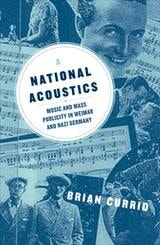
A National Acoustics
Music and Mass Publicity in Weimar and Nazi GermanyBrian Currid
University of Minnesota Press, 2006
Offering a nuanced analysis of how publicity was constructed through radio programming, print media, popular song, and film, Currid examines how German citizens developed an emotional investment in the nation and other forms of collectivity that were tied to the sonic experience. Reading in detail popular genres of music—the Schlager (or “hit”), so-called gypsy music, and jazz—he offers a complex view of how they played a part in the creation of German culture.
A National Acoustics contributes to a new understanding of what constitutes the public sphere. In doing so, it illustrates the contradictions between Germany’s social and cultural histories and how the technologies of recording not only were vital to the emergence of a national imaginary but also exposed the fault lines in the contested terrain of mass communication.
Brian Currid is an independent scholar who lives in Berlin.
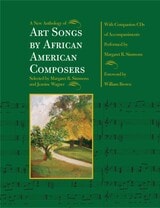
A New Anthology of Art Songs by African American Composers
Selected by Margaret R. Simmons and Jeanine Wagner. Foreword by William Brown
Southern Illinois University Press, 2004
A diverse repertoire of art songs for piano and voice
The art song—a delicate and inspiring blend of music and poetry—has been performed by singers and pianists and appreciated by audiences around the world for more than two hundred years. While collections of art songs abound, this welcome volume and its accompanying compact discs make readily available the contributions of contemporary African American composers to the popular genre. Including thirty-nine pieces for voice and piano created since 1968 by eighteen artists, ANew Anthology of Art Songs by African American Composers navigates a varied musical terrain from classical European traditions to jazz and spirituals. With nearly half of the featured songs composed by women and with others by lesser-known and emerging composers, this important collection offers a diverse, representative sampling of African American art songs and works to secure the places of these songs and artists in the canon of contemporary American music.
Selected by Jeanine Wagner and Margaret R. Simmons, prolific and celebrated performers who have presented recitals throughout the world featuring the art songs of African American composers, this dazzling new repertoire of twentieth-century music is cogently framed by a thorough introduction and substantial biographies of each composer. The compact discs feature piano tracks of all thirty-nine compositions.
The featured composers are H. Leslie Adams, Mable Bailey, Charles S. Brown, Wallace McClain Cheatham, Adolphus Hailstork, Jacqueline B. Hairston, William H. Henderson, Jeraldine Saunders Herbison, Betty Jackson King, William Foster
McDaniel, Undine Smith Moore, Byron Motley, Barbara Sherrill, Robert Owens, Nadine Shanti, Frederick Tillis, Dolores White, and Julius P. Williams.
A New-World Collection of Polyphony for Holy Week and the Salve Service
Guatemala City, Cathedral Archive, Music MS 4Edited by Robert J. Snow
University of Chicago Press, 1996
Shortly after 1600, the organist and choir director of the cathedral collected, organized, and copied into choirbooks all of the then-extant music used by the choir. The manuscript presented here in modern edition, one of at least five choirbooks prepared at the time, contains a number of otherwise unknown works by such major Old World composers as Francisco Guerrero and Cristóbal de Morales. Significant works by Hernando Franco and Pedro Bermúdez, choirmasters of the Guatemala City Cathedral, are also included. The manuscript presents a unified repertory for Holy Week and for the Salve services in Lent, including four settings of the Passion, for which the Spanish were famous throughout Christendom. Some of the works predate the sixteenth-century reform of the Roman Breviary and Missal, among them the original versions of several Vespers hymns and Magnificat settings by Guerrero that are otherwise known only in later versions found in Spanish sources. An extensive historical introduction by Robert J. Snow discusses the formation of the cathedral's musical repertory and illuminates both Old and New World practices of sixteenth-century Spanish liturgical music.
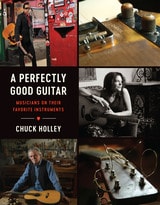
A Perfectly Good Guitar
Musicians on Their Favorite InstrumentsBy Chuck Holley
University of Texas Press, 2017
Ask guitar players about their instruments, and you’re likely to get a story—where the guitar came from, or what makes it unique, or why the player will never part with it. Most guitarists have strong feelings about their primary tool, and some are downright passionate about their axes. Chuck Holley is a professional photographer and writer who loves music and listening to musicians talk about their trade. For several years, he has been photographing guitarists with their prized instruments and collecting their stories. This beautifully illustrated book presents these stories in revelatory photographs and words.
The guitarists included in this book range from high-profile performers, including Rosanne Cash, Guy Clark, Laurence Juber, Jorma Kaukonen, JD Souther, Bill Frisell, Dave Alvin, and Kelly Willis, to renowned studio musicians and band members. Holley’s beautifully composed photographs portray them with their favorite guitar, including detail shots of the instrument. Accompanying the photographs are the musicians’ stories about the Gibsons, Fenders, Martins, and others that have become the guitar in their lives, the one that has a special lineage or intangible qualities of sustain, tone, clarity, and comfort that make it irreplaceable. Several musicians talk about how the guitar chose them, while others recount stories of guitars lost or stolen and then serendipitously recovered. Together, these photographs and stories underscore the great pleasure of performing with an instrument that’s become a trusted friend with a personality all its own.
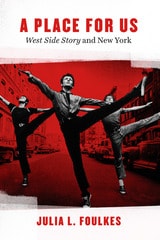
A Place for Us
“West Side Story” and New YorkJulia L. Foulkes
University of Chicago Press, 2016
That vision of postwar New York is at the heart of Julia L. Foulkes’s A Place for Us. A lifelong fan of the show, Foulkes became interested in its history when she made an unexpected discovery: scenes for the iconic film version were shot on the demolition site destined to become part of the Lincoln Center redevelopment area—a crowning jewel of postwar urban renewal. Foulkes interweaves the story of the creation of the musical and film with the remaking of the Upper West Side and the larger tale of New York’s postwar aspirations. Making unprecedented use of director and choreographer Jerome Robbins’s revelatory papers, she shows the crucial role played by the political commitments of Robbins and his fellow gay, Jewish collaborators, Leonard Bernstein and Arthur Laurents. Their determination to evoke life in New York as it was actually lived helped give West Side Story its unshakable sense of place even as it put forward a vision of a new, vigorous, determinedly multicultural American city.
Beautifully written and full of surprises for even the most dedicated West Side Story fan, A Place for Us is a revelatory new exploration of an American classic.

A Poetry Precise and Free
Selected Madrigals of GuariniNicholas R. Jones
University of Michigan Press, 2018
This volume is organized into ten sections, grouping the madrigals around themes such as the anguish of passion, the asymmetry of desire, the incursions of jealousy, and the possibility of mutual bliss. Nicholas R. Jones renders Guarini’s poetry into accessible contemporary English verse that nevertheless stays true to the substance and form of the original texts, reflecting their roots in the Petrarchan poetic tradition and displaying the emotion and musicality that made these lyrics so popular from the start. A substantive introduction provides cultural context for the madrigals and their musical settings; brief commentaries follow each translation to illuminate aspects of poetic and rhetorical craft. An extensive appendix lists the madrigal compositions that set these lyrics for vocal performance.
The book fills a major gap in the scholarship on Guarini’s literary legacy. It will appeal to scholars of literature, Renaissance studies, and musicology, early-music performers, and general readers interested in poetry and classical music.
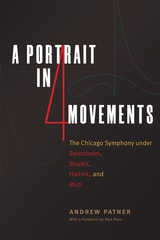
A Portrait in Four Movements
The Chicago Symphony under Barenboim, Boulez, Haitink, and MutiAndrew Patner
University of Chicago Press, 2019
The Chicago Symphony Orchestra has been led by a storied group of conductors. And from 1994 to 2015, through the best work of Daniel Barenboim, Pierre Boulez, Bernard Haitink, and Riccardo Muti, Andrew Patner was right there. As a classical music critic for the Chicago Sun-Times and WFMT radio, Patner was able to trace the arc of the CSO’s changing repertories, all while cultivating a deep rapport with its four principal conductors.
This book assembles Patner’s reviews of the concerts given by the CSO during this time, as well as transcripts of his remarkable radio interviews with these colossal figures. These pages hold tidbits for the curious, such as Patner’s “driving survey” that playfully ranks the Maestri he knew on a scale of “total comfort” to “fright level five,” and the observation that Muti appears to be a southpaw on the baseball field. Moving easily between registers, they also open revealing windows onto the sometimes difficult pasts that brought these conductors to music in the first place, including Boulez’s and Haitink’s heartbreaking experiences of Nazi occupation in their native countries as children. Throughout, these reviews and interviews are threaded together with insights about the power of music and the techniques behind it—from the conductors’ varied approaches to research, preparing scores, and interacting with other musicians, to how the sound and personality of the orchestra evolved over time, to the ways that we can all learn to listen better and hear more in the music we love. Featuring a foreword by fellow critic Alex Ross on the ethos and humor that informed Patner’s writing, as well as an introduction and extensive historical commentary by musicologist Douglas W. Shadle, this book offers a rich portrait of the musical life of Chicago through the eyes and ears of one of its most beloved critics.
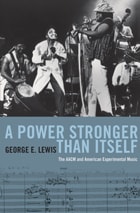
A Power Stronger Than Itself
The AACM and American Experimental MusicGeorge E. Lewis
University of Chicago Press, 2008
Founded in 1965 and still active today, the Association for the Advancement of Creative Musicians (AACM) is an American institution with an international reputation. George E. Lewis, who joined the collective as a teenager in 1971, establishes the full importance and vitality of the AACM with this communal history, written with a symphonic sweep that draws on a cross-generational chorus of voices and a rich collection of rare images.
Moving from Chicago to New York to Paris, and from founding member Steve McCall’s kitchen table to Carnegie Hall, A Power Stronger Than Itself uncovers a vibrant, multicultural universe and brings to light a major piece of the history of avant-garde music and art.
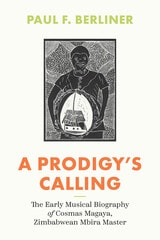
A Prodigy's Calling
The Early Musical Biography of Cosmas Magaya, Zimbabwean Mbira MasterPaul F. Berliner
University of Chicago Press, 2024
Ethnomusicologist Paul F. Berliner has been studying Zimbabwean mbira for more than fifty years. When he first arrived in what was then Rhodesia after the nation declared independence from the United Kingdom, he met Cosmas Magaya, a mbira player who would become his teacher and lifelong collaborator. A Prodigy’s Calling chronicles the early years of Magaya’s life, documenting the master mbira player’s journey from child prodigy to established expert. As a child, Magaya was immersed in mbira music through his father’s work as a healer and spirit medium. As Magaya grew, so too did his world; his performances extended beyond the family compound as his skill and knowledge increased, bringing him into contact with a society fraught with decolonial conflict.
Following Magaya’s childhood, readers will learn how his upbringing guided his journey through the community’s social networks and how his early sensibilities, proclivities, and talents shaped his development. At the same time, his deepening engagement with music and the ancestors was affected by overlapping tensions between Shona cosmology and Christian ideology, rural and urban lifestyles, and the escalating African nationalist struggle and the white supremacist state. While Magaya’s story reflects profound social changes in the nation, it is also a story of musical apprenticeship. Readers following Magaya’s discovery of ever finer details in the music’s richly layered patterns will enhance their ability to hear mbira music’s forms, variations, and sonic qualities. Linocut illustrations by South African artist Lucas Bambo bring the narrative to life, and Berliner’s spirited storytelling is accompanied by QR codes that take readers directly to recordings of music as Magaya learns it. Appendices for musicians interested in learning or improving their mbira playing complement the story of Magaya’s early life. Inviting the reader into the very tradition it recounts, the book offers intimate insights into the relationships among music, Shona cosmology, and colonial politics in everyday life.
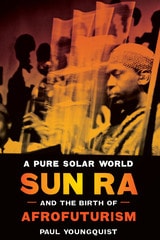
A Pure Solar World
Sun Ra and the Birth of AfrofuturismBy Paul Youngquist
University of Texas Press, 2016
Surveying the range of Sun Ra’s extraordinary creativity, this book explores how the father of Afrofuturism brought “space music” to a planet in need of transformation, supporting the aspirations of black people in an inhospitable white world.
Sun Ra said he came from Saturn. Known on earth for his inventive music and extravagant stage shows, he pioneered free-form improvisation in an ensemble setting with the devoted band he called the “Arkestra.” Sun Ra took jazz from the inner city to outer space, infusing traditional swing with far-out harmonies, rhythms, and sounds. Described as the father of Afrofuturism, Sun Ra created “space music” as a means of building a better future for American blacks here on earth.
A Pure Solar World: Sun Ra and the Birth of Afrofuturism offers a spirited introduction to the life and work of this legendary but underappreciated musician, composer, and poet. Paul Youngquist explores and assesses Sun Ra’s wide-ranging creative output—music, public preaching, graphic design, film and stage performance, and poetry—and connects his diverse undertakings to the culture and politics of his times, including the space race, the rise of technocracy, the civil rights movement, and even space-age bachelor-pad music. By thoroughly examining the astro-black mythology that Sun Ra espoused, Youngquist masterfully demonstrates that he offered both a holistic response to a planet desperately in need of new visions and vibrations and a new kind of political activism that used popular culture to advance social change. In a nation obsessed with space and confused about race, Sun Ra aimed not just at assimilation for the socially disfranchised but even more at a wholesale transformation of American society and a more creative, egalitarian world.
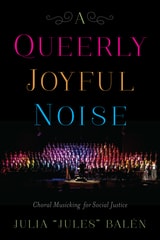
A Queerly Joyful Noise
Choral Musicking for Social JusticeJulia "Jules" Balén
Rutgers University Press, 2017
Honorable Mention, 2019 Herndon Book Prize - (SEM-GST)
A Queerly Joyful Noise examines how choral singing can be both personally transformative and politically impactful. As they blend their different voices to create something beautiful, LGBTIQ singers stand together and make themselves heard. Comparing queer choral performances to the uses of group singing within the civil rights and labor movements, Julia “Jules” Balén maps the relationship between different forms of oppression and strategic musical forms of resistance. She also explores the potential this queer communal space creates for mobilizing progressive social action.
A proud member of numerous queer choruses, Balén draws from years of firsthand observations, archival research, and extensive interviews to reveal how queer chorus members feel shared vulnerability, collective strength, and even moments of ecstasy when performing. A Queerly Joyful Noise serves as a testament to the power of music, intimately depicting how participation in a queer chorus is more than a pastime, but a meaningful form of protest through celebration.
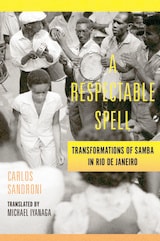
A Respectable Spell
Transformations of Samba in Rio de JaneiroCarlos Sandroni
University of Illinois Press, 2021
Incisive and comprehensive, A Respectable Spell tells the compelling story of an iconic Brazilian musical genre.
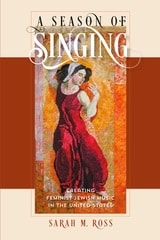
A Season of Singing
Creating Feminist Jewish Music in the United StatesSarah M. Ross
Brandeis University Press, 2016

A Singing Army
Zilphia Horton and the Highlander Folk SchoolBy Kim Ruehl
University of Texas Press, 2021
Zilphia Horton was a pioneer of cultural organizing, an activist and musician who taught people how to use the arts as a tool for social change, and a catalyst for anthems of empowerment such as “We Shall Overcome” and “We Shall Not Be Moved.” Her contributions to the Highlander Folk School, a pivotal center of the labor and civil rights movements in the mid-twentieth century, and her work creating the songbook of the labor movement influenced countless figures, from Woody Guthrie to Eleanor Roosevelt to Rosa Parks. Despite her outsized impact, Horton’s story is little known. A Singing Army introduces this overlooked figure to the world.
Drawing on extensive archival and oral history research, as well as numerous interviews with Horton's family and friends, Kim Ruehl chronicles her life from her childhood in Arkansas coal country, through her formative travels and friendship with radical Presbyterian minister Claude C. Williams, and into her instrumental work in desegregation and fostering the music of the civil rights era. Revealing these experiences—as well as her unconventional marriage and controversial death by poisoning—A Singing Army tells the story of an all-but-forgotten woman who inspired thousands of working-class people to stand up and sing for freedom and equality.
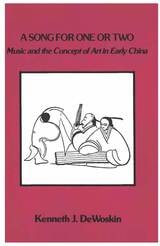
A Song for One or Two
Music and the Concept of Art in Early ChinaKenneth J. DeWoskin
University of Michigan Press, 1982
A Song for the Horses
Musical Heritage for More-than-Human Futures in MongoliaK. G. Hutchins
University of Arizona Press, 2025
Hutchins’s ethnographic research, spanning more than a decade, provides a vivid and intimate portrayal of Mongolian life. Musicians use the morin khuur, or ‘horse fiddle,’ to engage with the subjectivities and agencies of nonhuman animals and other beings. This work is a significant contribution to the posthuman turn in social sciences, engaging with theories from prominent scholars such as Donna Haraway and Anna Tsing .
As climate change continues to impact communities worldwide, this book offers a unique perspective on how cultural heritage can be mobilized to address environmental challenges, providing valuable lessons for global efforts to build sustainable and resilient futures. At the intersection of music, environment, and posthumanism, A Song for the Horses shows how Mongolian musicians use cultural traditions to imagine and build toward alternative futures beyond climate change and neoliberalism.
A Song of Longing
AN ETHIOPIAN JOURNEYKay Kaufman Shelemay
University of Illinois Press, 1992
-- Library Journal
"Highly recommended to generalists in music as well as to specialists interested in Ethiopia. . . . Also makes an excellent case study text for university-level courses examining fieldwork issues and conditions."
-- Notes
"Highly recommended for both undergraduate and graduate collections in ethnomusicology, anthropology, African, and Judaic studies."
-- Choice
A Sound History
Lawrence Gellert, Black Musical Protest, and White DenialSteven P. Garabedian
University of Massachusetts Press, 2020
Lawrence Gellert has long been a mysterious figure in American folk and blues studies, gaining prominence in the left-wing folk revival of the 1930s for his fieldwork in the U.S. South. A “lean, straggly-haired New Yorker,” as Time magazine called him, Gellert was an independent music collector, without formal training, credentials, or affiliation. At a time of institutionalized suppression, he worked to introduce white audiences to a tradition of black musical protest that had been denied and overlooked by prior white collectors.
By the folk and blues revival of the 1960s, however, when his work would again seem apt in the context of the civil rights movement, Gellert and his collection of Negro Songs of Protest were a conspicuous absence. A few leading figures in the revival defamed Gellert as a fraud, dismissing his archive of black vernacular protest as a fabrication—an example of left-wing propaganda and white interference. A Sound History is the story of an individual life, an excavation of African American musical resistance and dominant white historiography, and a cultural history of radical possibility and reversal in the defining middle decades of the U.S. twentieth century.
A Spy in the House of Loud
New York Songs and StoriesBy Chris Stamey
University of Texas Press, 2018
Popular music was in a creative upheaval in the late 1970s. As the singer-songwriter and producer Chris Stamey remembers, “the old guard had become bloated, cartoonish, and widely co-opted by a search for maximum corporate profits, and we wanted none of it.” In A Spy in the House of Loud, he takes us back to the auteur explosion happening in New York clubs such as the Bowery’s CBGB as Television, Talking Heads, R.E.M., and other innovative bands were rewriting the rules. Just twenty-two years old and newly arrived from North Carolina, Stamey immersed himself in the action, playing a year with Alex Chilton before forming the dB’s and recording the albums Stands for deciBels and Repercussion, which still have an enthusiastic following.
A Spy in the House of Loud vividly captures the energy that drove the music scene as arena rock gave way to punk and other new streams of electric music. Stamey tells engrossing backstories about creating in the recording studio, describing both the inspiration and the harmonic decisions behind many of his compositions, as well as providing insights into other people’s music and the process of songwriting. Photos, mixer-channel and track assignment notes, and other inside-the-studio materials illustrate the stories. Revealing another side of the CBGB era, which has been stereotyped as punk rock, safety pins, and provocation, A Spy in the House of Loud portrays a southern artist’s coming-of-age in New York’s frontier abandon as he searches for new ways to break the rules and make some noise.