Results by title
19 books match the query 'Hate'
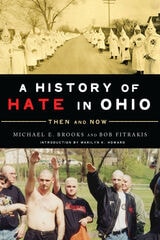
A History of Hate in Ohio
Then and NowMichael E. Brooks and Bob Fitrakis with an introduction by Marilyn K. Howard
The Ohio State University Press, 2021
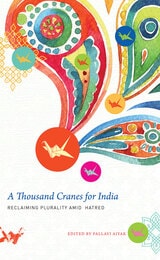
A Thousand Cranes for India
Reclaiming Plurality Amid HatredEdited by Pallavi Aiyar
Seagull Books, 2020
This anthology uses origami cranes as a way for some of India’s best-known writers, poets, and artists to form a shared civic space for a conversation about the fault lines in India at a time of darkness. The twenty-three pieces collected here encompass reportage, stories, poems, memoir, and polemic—the kind of complex and enriching diversity that India demands and deserves. The paper crane becomes a motif of connection, beauty, and reclamation in an otherwise degraded country, enabling those who fight with words to become the best army they can be.

Autophobia
Love and Hate in the Automotive AgeBrian Ladd
University of Chicago Press, 2008
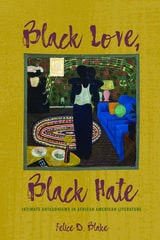
Black Love, Black Hate
Intimate Antagonisms in African American LiteratureFelice D. Blake
The Ohio State University Press, 2018
Most importantly, the book shows how literature constitutes an alternative public sphere for Black people. In a society largely controlled by white supremacist actors and institutions, Black authors have conjured fiction into a space where hard questions can be asked and answered and where the work of combatting collective, racist suppression can occur without replicating oppressive hierarchies. Intimate Antagonisms uncovers a key theme in Black fiction and argues that literature itself is a vital institutional site within Black life. Through the examination of intimate conflicts in a wide array of twentieth- and twenty-first-century novels, Blake demonstrates the centrality of intraracial relations to the complexity and vision of Black social movements and liberation struggles and the power and promise of Black narrative in reshaping struggle.
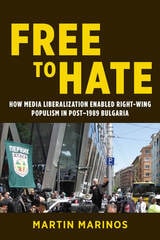
Free to Hate
How Media Liberalization Enabled Right-Wing Populism in Post-1989 BulgariaMartin Marinos
University of Illinois Press, 2023
Bulgaria’s media-driven pivot to right-wing populism parallels political developments taking place around the world. Martin Marinos applies a critical political economy approach to place Bulgarian right-wing populism within the structural transformation of the country’s media institutions. As Marinos shows, media concentration under Western giants like Westdeutsche Allgemeine Zeitung and News Corporation have led to a neoliberal turn of commercialization, concentration, and tabloidization across media. The Right have used the anticommunism and racism bred by this environment to not only undermine traditional media but position their own outlets to boost new political entities like the nationalist party Ataka. Marinos’s ethnographic observations and interviews with local journalists, politicians, and media experts add on-the-ground detail to his account. He also examines several related issues, including the performative appeal of populist media and the money behind it.
A timely and innovative analysis, Free to Hate reveals where structural changes in media intersect with right-wing populism.
From Hate to Hallows
Reframing Black Church ArsonTodne Thomas
Duke University Press, 2026
Hate the Game
Economic Cheat Codes for Life, Love, and WorkDaryl Fairweather
University of Chicago Press, 2025
Should I buy or rent? Do I ask for a promotion? Should I tell people I’m pregnant? What salary do I deserve? Should I just quit this job? Common anxieties about life are often grounded in economics. In an increasingly win-lose society, these economic decisions—where to work, where to live, even how to live—have a way of feeling fixed and mistakes terminal.
Daryl Fairweather is no stranger to these dynamics. As the first Black woman to receive an economics PhD from the famed University of Chicago, she saw firsthand how concepts of behavioral economics and game theory were deployed in the real world—and in her own life—to great effect. Hate the Game combines Fairweather’s elite knowledge of these principles with her singular voice in describing how they can be harnessed. Her great talent, unique among economists, is her ability to articulate economic trends in a way that is not just informative, but also accounts for life’s other anxieties.
In Hate the Game, Fairweather fixes her expertise and service on navigating the earliest economic inflection points of adult life: whether to go to college and for how long; partnering, having kids, both, or neither; getting, keeping, and changing jobs; and where to live and how to pay for it. She speaks in actionable terms about what the economy means for individual people, especially those who have the sneaking suspicion they’re losing out. Set against her own experiences and enriched with lessons from history, science, and pop culture, Fairweather instructs readers on how to use game theory and behavioral science to map out options and choose directions while offering readers a sense of control and agency in an economy where those things are increasingly rare.
Hate the Game
Economic Cheat Codes for Life, Love, and WorkDaryl Fairweather
University of Chicago Press, 2025
The secret insights of economics, translated for the rest of us.
Should I buy or rent? Do I ask for a promotion? Should I tell people I’m pregnant? What salary do I deserve? Should I just quit this job? Common anxieties about life are often grounded in economics. In an increasingly win-lose society, these economic decisions—where to work, where to live, even how to live—have a way of feeling fixed and mistakes terminal.
Daryl Fairweather is no stranger to these dynamics. As the first Black woman to receive an economics PhD from the famed University of Chicago, she saw firsthand how concepts of behavioral economics and game theory were deployed in the real world—and in her own life—to great effect. Hate the Game combines Fairweather’s elite knowledge of these principles with her singular voice in describing how they can be harnessed. Her great talent, unique among economists, is her ability to articulate economic trends in a way that is not just informative, but also accounts for life’s other anxieties.
In Hate the Game, Fairweather fixes her expertise and service on navigating the earliest economic inflection points of adult life: whether to go to college and for how long; partnering, having kids, both, or neither; getting, keeping, and changing jobs; and where to live and how to pay for it. She speaks in actionable terms about what the economy means for individual people, especially those who have the sneaking suspicion they’re losing out. Set against her own experiences and enriched with lessons from history, science, and pop culture, Fairweather instructs readers on how to use game theory and behavioral science to map out options and choose directions while offering readers a sense of control and agency in an economy where those things are increasingly rare.
Hating Jazz
A History of Its Disparagement, Mockery, and Other Forms of AbuseAndrew S. Berish
University of Chicago Press, 2025
A rock guitarist plays four notes in front of one thousand people, while a jazz guitarist plays one thousand notes in front of four people. You might laugh or groan at this jazz joke, but what is it about jazz that makes people want to disparage it in the first place?
Andrew S. Berish’s Hating Jazz listens to the voices who have denounced, disparaged, and mocked the music. By focusing on the rejection of the music, Berish says, we see more holistically jazz’s complicated place in American cultural life. Jazz is a display of Black creativity and genius, an art form that is deeply embedded in African American life. Though the explicit racial tenor of jazz jokes has become muted over time, making fun of jazz, either in a lighthearted or aggressive way, is also an engagement with the place of Blackness in America. An individual’s taste in music may seem personal, but Berish’s analysis of jazz hatred demonstrates that musical preferences and trends are a social phenomenon. Criticism of jazz has become inextricable from the ways we understand race in America, past and present. In addition to this form of criticism, Berish also considers jazz hate as a form of taste discrimination and as a conflict over genre boundaries within different jazz cultures.
Both enlightening and original, Hating Jazz shows that our response to music can be a social act, unique to our historical moment and cultural context—we react to music in certain ways because of who we are, where we are, and when we are.
Heritage and Hate
Old South Rhetoric at Southern UniversitiesStephen M. Monroe
University of Alabama Press, 2021
How southern universities continue to wrestle with the words and symbols that embody and perpetuate Old South traditions
The US South is a rhetorical landscape that pulsates with division, a place where words and symbols rooted in a deeply problematic past litter the ground and contaminate the soil. Stephen M. Monroe’s provocative study focuses on predominantly white southern universities where Old South rhetoric still reverberates, where rebel flags cast a shadow over attempts at racial harmony, school cheers to reinforce racial barriers, and student yearbooks to create and protect an oppressive culture of exclusion. Across the region, in college towns like Oxford, Mississippi; Athens, Georgia; and Tuscaloosa, Alabama—communities remain locked in a difficult, recursive, and inherently rhetorical struggle that wrestles with this troubling legacy.
Words, images, and symbols are not merely passive artifacts of southern history, Monroe argues, but formative agents that influence human behavior and shape historical events. Drawing on research from many disciplines, including rhetoric, southern studies, history, sociology, and African American studies, Monroe develops the concept of confederate rhetoric: the collection of Old South words and symbols that have been and remain central to the identity conflicts of the South. He charts examples of such rhetoric at work in southern universities from Reconstruction to the present day.
Tracing the long life and legacy of Old South words and symbols at southern universities, this book provides close and nuanced analysis of the rhetorical conflicts that have resulted at places like the University of Mississippi and the University of Missouri. Some conflicts erupted during the civil rights movement, when the first African American students sought admission to all-white southern universities and colleges, and others are brewing now, as African Americans (and their progressive white peers) begin to cement genuine agency and voice in these communities. Tensions have been, and remain, high.
Ultimately, Monroe offers hope and optimism, contending that if words and symbols can be used to damage and divide, then words and symbols can also be used to heal and unify. Racist rhetoric can be replaced by antiracist rhetoric. The old South can become new. While resisting naïve or facile arguments, Heritage and Hate ultimately finds the promise of progress within the tremendous power of language.

Love In A Time Of Hate
Hollander, Nancy Caro
Rutgers University Press, 1997
Men I Hate
A Memoir in EssaysLynette D'Amico
The Ohio State University Press, 2026
Can a lesbian who loves a trans man still call herself a lesbian? Against the backdrop of a traditional Sicilian American upbringing, Lynette D’Amico identified as a lesbian despite the expectation that her future hinged on the man she married. As a teenager, she fled her St. Louis home in the dark of night to escape her fate. No boys allowed, until one day D’Amico’s life was completely upended when her lover and spouse of twenty years—P. Carl, the acclaimed author of Becoming a Man: The Story of a Transition—told her he was a man.
Seemingly overnight, D’Amico no longer recognized her spouse in photos of past vacations or of the couple celebrating their legal gay marriage. In Men I Hate, she asks: What happens when the people we are closest to change? As D’Amico tries to engage more deeply with the man she is married to, she looks at all the men—historical figures, politicians, men in her family—in search of clear dividing lines between good men and bad, between the men she loves and the men she hates. These lines dissolve as she writes her way toward an understanding of the words marriage,husband, and home—and how we reconcile who we are with who we become.
Not Out of Hate
A Novel of BurmaMa Ma Lay
Ohio University Press, 1991
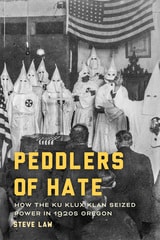
Peddlers of Hate
How the Ku Klux Klan Seized Power in 1920s OregonSteve Law
Oregon State University Press, 2026
The revived Knights of the Ku Klux Klan flourished in Oregon in the early 1920s. With more than sixty chapters established in both large and small communities like Portland, Medford, Astoria, and La Grande, the Klan’s power escalated in the region. Klan salesmen, working on commission, successfully enlisted Oregonians with a message of religious prejudice and racism. At the Klan’s peak, Portland was home to the sixth largest chapter in the country and there were more members per capita in Oregon than in any other state except one.
In Peddlers of Hate, journalist Steve Law draws on published and unpublished sources, new research, and interviews with leading scholars to provide a comprehensive account of how Oregon became one of the Klan’s strongest outposts. Representing the Klan as merely a fraternal lodge, Klan recruiters were trained to vilify Catholics, immigrants, Blacks, and Jews. They gained wide support, toppling an incumbent governor and congressman, persuading voters to ban Catholic schools, and winning control of the legislature and several local governments. From stories of “escaped nuns” to fiery crosses at mass Klan rallies at Salem’s state fairgrounds and Portland’s Mount Tabor Park, Law examines this divisive and forgotten time in Oregon’s history. He shows how it was finally greed, hypocrisy, and corruption that spurred the hate group’s demise—providing historical lessons that will resonate today.

Seeds of Hate
How America's Flawed Middle East Policy Ignited the JihadLawrence Pintak
Pluto Press, 2003
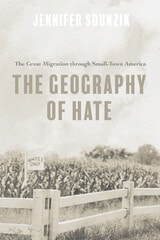
The Geography of Hate
The Great Migration through Small-Town AmericaJennifer Sdunzik
University of Illinois Press, 2023
During the Great Migration, Black Americans sought new lives in midwestern small towns only to confront the pervasive efforts of white residents determined to maintain their area’s preferred cultural and racial identity. Jennifer Sdunzik explores this widespread phenomenon by examining how it played out in one midwestern community. Sdunzik merges state and communal histories, interviews and analyses of population data, and spatial and ethnographic materials to create a rich public history that reclaims Black contributions and history. She also explores the conscious and unconscious white actions that all but erased Black Americans--and the terror and exclusion used against them--from the history of many midwestern communities.
An innovative challenge to myth and perceived wisdom, The Geography of Hate reveals the socioeconomic, political, and cultural forces that prevailed in midwestern towns and helps explain the systemic racism and endemic nativism that remain entrenched in American life.
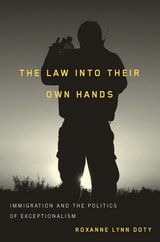
The Law Into Their Own Hands
Immigration and the Politics of ExceptionalismRoxanne Lynn Doty
University of Arizona Press, 2009
Doty examines the social and political contexts that have enabled these civilian groups to flourish and gain legitimacy amongst policy makers and the public. The sentiments underlying the vigilante movement both draw upon and are channeled through a diverse range of organizations whose messages are often reinforced by the media. Taking action when they believe official policy is lacking, groups ranging from elements of the religious right to anti-immigrant groups to white supremacists have created a social movement.
Doty seeks to alert us to the consequences related to this growing movement and to the restructuring of our society. She maintains that with immigrants being considered as enemies and denied basic human rights, it is irresponsible of both citizens and policy makers to treat this complicated issue as a simple black or white reality.
In this solid and theoretically grounded look at contemporary, post-9/11 border vigilantism, the author observes the dangerous and unproductive manner in which private citizens seek to draw firm and uncompromising lines between who is worthy of inclusion in our society and who is not.
The Politics of Hate
How the Christian Right Darkened America's Political SoulAngelia R. Wilson
Temple University Press, 2025
Based on original research, participant observation at events, and data collection, Wilson follows the money to provide a meticulous analysis of how Christian Right political elites operate. She traces the evolutionary development of the Christian Right’s political professionalism and their allegiance to a grand vision that articulates a grammar of war to fulfill their Biblical worldview.
The Politics of Hate demonstrates how Christian Right organizations educate and train networks of soldiers to tactically engage the enemy in local, state, and national legal and political battles. Wilson carefully documents their history of co-belligerency, their strategies of political warfare, and, importantly, the impact of this war that has, over the past fifty years, forever changed American politics.
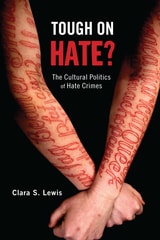
Tough on Hate?
The Cultural Politics of Hate CrimesLewis, Clara S
Rutgers University Press, 2013
Why do we know every gory crime scene detail about such victims as Matthew Shepard and James Byrd Jr. and yet almost nothing about the vast majority of other hate crime victims? Now that federal anti-hate-crimes laws have been passed, why has the number of these crimes not declined significantly? To answer such questions, Clara S. Lewis challenges us to reconsider our understanding of hate crimes. In doing so, she raises startling issues about the trajectory of civil and minority rights.
Tough on Hate is the first book to examine the cultural politics of hate crimes both within and beyond the law. Drawing on a wide range of sources—including personal interviews, unarchived documents, television news broadcasts, legislative debates, and presidential speeches—the book calls attention to a disturbing irony: the sympathetic attention paid to certain shocking hate crime murders further legitimizes an already pervasive unwillingness to act on the urgent civil rights issues of our time. Worse still, it reveals the widespread acceptance of ideas about difference, tolerance, and crime that work against future progress on behalf of historically marginalized communities.