Results by title
50 books match the query 'Music and race' and 3 start with a

A Change Is Gonna Come
Music, Race & the Soul of AmericaCraig Werner
University of Michigan Press, 2006
". . . extraordinarily far-reaching. . . . highly accessible."
—Notes
"No one has written this way about music in a long, long time. Lucid, insightful, with real spiritual, political, intellectual, and emotional grasp of the whole picture. A book about why music matters, and how, and to whom."
—Dave Marsh, author of Louie, Louie and Born to Run: The Bruce Springsteen Story
"This book is urgently needed: a comprehensive look at the various forms of black popular music, both as music and as seen in a larger social context. No one can do this better than Craig Werner."
—Henry Louis Gates, Jr., W.E.B. Du Bois Professor of the Humanities, Harvard University
"[Werner has] mastered the extremely difficult art of writing about music as both an aesthetic and social force that conveys, implies, symbolizes, and represents ideas as well as emotion, but without reducing its complexities and ambiguities to merely didactic categories."
—African American Review
A Change Is Gonna Come is the story of more than four decades of enormously influential black music, from the hopeful, angry refrains of the Freedom movement, to the slick pop of Motown; from the disco inferno to the Million Man March; from Woodstock's "Summer of Love" to the war in Vietnam and the race riots that inspired Marvin Gaye to write "What's Going On."
Originally published in 1998, A Change Is Gonna Come drew the attention of scholars and general readers alike. This new edition, featuring four new and updated chapters, will reintroduce Werner's seminal study of black music to a new generation of readers.
Craig Werner is Professor of Afro-American Studies at the University of Wisconsin, and author of many books, including Playing the Changes: From Afro-Modernism to the Jazz Impulse and Up Around the Bend: An Oral History of Creedence Clearwater Revival. His most recent book is Higher Ground: Stevie Wonder, Aretha Franklin, Curtis Mayfield, and the Rise and Fall of American Soul.
[more]
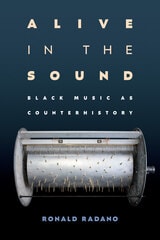
Alive in the Sound
Black Music as CounterhistoryRonald Radano
Duke University Press, 2025
In Alive in the Sound, Ronald Radano proposes a new understanding of US Black music by focusing on the key matter of value, manifested musically in its seemingly embodied qualities—spirit, soul, and groove. While acknowledging these qualities are always embedded in Black music, Radano shows they developed not simply from performance but from musicians’ status as laborers inhabiting an enduring racial-economic contradiction: Black music originated publicly as an exchangeable property owned by people whose subhuman status granted them—as “natural” musicians—indelible properties of sound. As a contradiction of the rules of ownership, wherein enslaved property was forbidden the right to own, modern Black music emerges after emancipation as a primary possession, moving dialectically into commercial markets and counterhistorically back into Black worlds. Slavery’s seminal contests of ownership underlie modern musical sensations of aliveness, which become the chief measure of value in popular music. By reconceiving US Black music history as a history of value, Radano rethinks the music’s place in US and global culture.
[more]

Amplifications of Black Sound from Colonial Mexico
Vocality and BeyondSarah Finley
Vanderbilt University Press, 2024
Thinkers like W. E. B. Du Bois and Paul Gilroy have long championed sound as an affective register of Black subjectivity, particularly in the African Atlantic. Prior studies in this vein focus on Anglophone or Caribbean contexts, a tendency that furthers Mexico’s marginalization within narratives of the Black and African diaspora and mutes Afro-descendant traditions that date back to the sixteenth century. Indeed, the New Spanish archive contains whispers of the region’s Black sound cultures, including monetary records for the voices of enslaved singers and representations of Black music in casta paintings. Despite such evidence, it is difficult to attend fully to these subaltern voices, for the cultural filters of the lettered elite often mute or misinterpret non-European sounds.
Amplifications of Black Sound from Colonial Mexico is the first extensive study of Afro-descendant sonorities in New Spain or elsewhere in colonial Latin America. In this context, it attends to Black sounds through a framework that remixes Jacques Derrida’s reading of the ear’s anatomy with theories like Gilroy’s lower frequencies or Fred Moten’s phonic materiality. Sarah Finley’s aim is to unsettle the divide between self and other so the auditory archive might emerge as a polyphonic record that exceeds dichotomies of sounding object / listening subject. Through sampling the Afro-descendant sounds of this archive, this book recovers and rearticulates Black voices and auditory practices in New Spain.
Amplifications of Black Sound from Colonial Mexico is the first extensive study of Afro-descendant sonorities in New Spain or elsewhere in colonial Latin America. In this context, it attends to Black sounds through a framework that remixes Jacques Derrida’s reading of the ear’s anatomy with theories like Gilroy’s lower frequencies or Fred Moten’s phonic materiality. Sarah Finley’s aim is to unsettle the divide between self and other so the auditory archive might emerge as a polyphonic record that exceeds dichotomies of sounding object / listening subject. Through sampling the Afro-descendant sounds of this archive, this book recovers and rearticulates Black voices and auditory practices in New Spain.
[more]