Results by title
72 books match the query 'Nature conservation' and 6 start with a
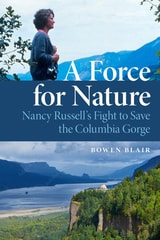
A Force for Nature
Nancy Russell's Fight to Save the Columbia GorgeBowen Blair
Oregon State University Press, 2022
The 85-mile-long Columbia Gorge forms part of the border between Oregon and Washington and is one of the nation’s most historic and scenic landscapes. Many of the region’s cultural divisions boil over here—urban versus rural, west of the mountains versus east—as well as clashes over private property rights, management of public lands, and tribal treaty rights.
In the early 1980s, as a new interstate bridge linked the City of Portland to rural counties in Washington, the Gorge’s renowned vistas were on the brink of destruction. Nancy Russell, forty-eight years old and with no experience in advocacy, fundraising, or politics, built a grassroots movement that overcame 70 years of failed efforts and bitter opposition from both Oregon and Washington governors, five of the six Gorge counties, 41,000 Gorge residents, and the Reagan administration. While building her campaign, Russell stopped subdivisions, factories, and government neglect through litigation brought by her organization, Friends of the Columbia Gorge, and last-second land purchases by the Trust for Public Land (TPL). Initially ignored, then demonized, Russell’s tires were slashed and her life threatened.
The Columbia River Gorge National Scenic Area Act barely passed—on the last day of the congressional session in 1986—and was signed by a reluctant President Reagan hours before the bill would die. Russell positioned the Friends to be a watchdog and orchestrated the purchase of thousands of acres of land for the public. Bowen Blair, an attorney, former executive director of Friends of the Columbia Gorge, and TPL senior vice president, brings an insider’s perspective to the tumultuous and inspiring story of this conservation battle.
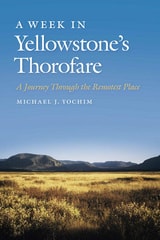
A Week in Yellowstone's Thorofare
A Journey Through the Remotest PlaceMichael J. Yochim
Oregon State University Press, 2016
Drawing upon the first-person accounts of rangers who have patrolled the area, archival documents, and Michael Yochim’s personal experiences over almost three decades, A Week in Yellowstone’s Thorofare distinguishes between the notions of wildness and wilderness. Through historic vignettes, descriptions of natural resources, and the author’s own experiences, it argues that wildness is the most precious, and easily lost, attribute of wilderness.
The Thorofare is remote not only from roads, but also largely unexplored in the vast body of wilderness literature. A Week in Yellowstone’s Thorofare aims to fill that void. Recognizing both the value and the fragility of wildness, the rangers who manage the area have struggled through many eras to preserve it. This book chronicles many of the struggles through which it has remained protected for visitors today.
Yochim offers poignant insight into the passions that motivate those who manage, defend, and journey through the Thorofare. His story demonstrates the importance of wild places for touching and understanding a fundamental part of the human experience. Part history, memoir, travelogue, natural history, and reflection, the book will appeal to readers interested in preservation, the wilderness movement, the history of National Parks, or the natural treasures of Yellowstone.
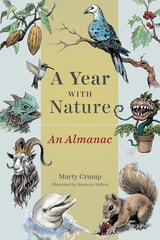
A Year with Nature
An AlmanacMarty Crump
University of Chicago Press, 2018
With Crump, we mark the publication of classics like Carson’s Silent Spring and White’s Charlotte’s Web, and even the musical premiere of Tchaikovsky’s Swan Lake. We note the discovery of the structure of DNA and the mountain gorilla, the rise of citizen science projects, and the work of people who’ve shaped how we view and protect nature—from Aristotle to E. O. Wilson. Some days feature US celebrations, like National Poinsettia Day and National Cat Day; others highlight country-specific celebrations, like Australia’s Wombat Day and Thailand’s Monkey Buffet Festival, during which thousands of macaques feast on an ornately arranged spread of fruits and vegetables. Crump also highlights celebrations that span borders, from World Wildlife Conservation Day to International Mountain Day and global festivities for snakes, sea turtles, and chocolate. Interweaving fascinating facts on everything from jellyfish bodies to monthly birth flowers with folkloric entries featuring the Loch Ness Monster, unicorns, and ancient Greek, Roman, and Egyptian mythology, the almanac is as exhaustive as it is enchanting.
A Year with Nature celebrates the wonder and beauty of our natural world as we have expressed it in visual arts, music, literature, science, natural history, and everyday experience. But more than this, the almanac’s vignettes encourage us to contemplate how we can help ensure that future generations will be able to enjoy the landscapes and rich biodiversity we so deeply cherish.
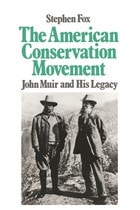
American Conservation Movement
John Muir And His LegacyStephen Fox
University of Wisconsin Press, 1986
John Muir and His Legacy is at once a biography of this remarkable man—the first work to make unrestricted use of all of Muir’s manuscripts and personal papers—and a history of the century-old fight to save the natural environment. Stephen Fox traces the conservation movement's diverse, colorful, and tumultuous history, from the successful campaign to establish Yosemite National Park in 1890 to the movement's present day concerns of nuclear waste and acid rain.
Conservation has run a cyclical course, Fox contends, from its origins in the 1890s when it was the province of amateurs, to its takeover by professionals with quasi-scientific notions, and back, in the 1960s to its original impetus. Since then man’s view of himself as “the last endangered species” has sparked an explosion of public interest in environmentalism.
First published in 1981 by Little, Brown, this book was warmly received as both a biography of Muir and a history of the American conservation movement. It is now available in this new Wisconsin paperback edition.
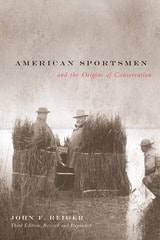
American Sportsmen and the Origins of Conservation, 3rd Ed
John F. Reiger
Oregon State University Press, 2001
Beginning in the 1870s, sportsmen across America formed hundreds of organizations that not only fostered responsibility for game habitats but also spearheaded the creation of national parks, forests, and wildlife refuges. Reiger tells how these "gentlemen" hunters and anglers, outdoor journals like Forest and Stream, and organizations such as the Boone and Crockett Club—founded by Theodore Roosevelt, George Bird Grinnell, and other prominent sportsmen—lobbied for laws regulating the taking of wildlife, and helped to arouse public interest in wilderness preservation.
In this new edition, Reiger traces the antecedents of the sportsmen's conservation movement to the years before the Civil War. He extends his coverage into the present by demonstrating how the nineteenth-century sportsman's code—with its demand for taking responsibility for the total environment—continues to be the cornerstone of the sporting ethic. A new Epilogue depicts leading environmental thinker Aldo Leopold as the best-known exponent of this hunter-conservationist ideal.
Praised as "one of the seminal works in conservation history" by historian Hal Rothman, Reiger's book continues to be essential reading for all concerned with how earlier Americans regarded the land, demonstrating even to those who oppose hunting that they share with sportsmen and sportswomen an awareness and appreciation of our fragile environment.
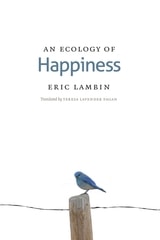
An Ecology of Happiness
Eric Lambin
University of Chicago Press, 2012
In this clever and wide-ranging work, Lambin draws on new scientific evidence in the fields of geography, political ecology, environmental psychology, urban studies, and disease ecology, among others, to answer such questions as: To what extent do we need nature for our well-being? How does environmental degradation affect our happiness? What can be done to protect the environment and increase our well-being at the same time? Drawing on case studies from Asia, Africa, Europe, and North America, Lambin makes a persuasive case for the strong link between healthy ecosystems and happy humans.
Unique in its scope and evenhanded synthesis of research from many fields, An Ecology of Happiness offers a compelling human-centered argument that is impossible to overlook when we marvel at murmurations of starlings or seek out the most brilliant fall foliage: nature makes our steps a little lighter and our eyes a little brighter. What better reason to protect an ecosystem or save a species than for our own pleasure?