Results by title
176 books match the query 'New Testament' and 14 start with a
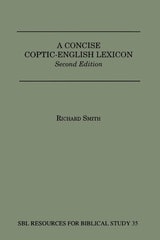
A Concise Coptic-English Lexicon, Second Edition
Richard Smith
SBL Press, 1999
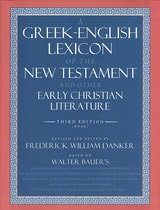
A Greek-English Lexicon of the New Testament and Other Early Christian Literature
Walter Bauer
University of Chicago Press, 2000
In this edition, Frederick W. Danker's broad knowledge of Greco-Roman literature, as well as papyri and epigraphs, provides a more panoramic view of the world of Jesus and the New Testament. Danker has also introduced a more consistent mode of reference citation, and has provided a composite list of abbreviations to facilitate easy access to this wealth of information.
Perhaps the single most important lexical innovation of Danker's edition is its inclusion of extended definitions for Greek terms. For instance, a key meaning of "episkopos" was defined in the second American edition as overseer; Danker defines it as "one who has the responsibility of safeguarding or seeing to it that something is done in the correct way, guardian." Such extended definitions give a fuller sense of the word in question, which will help avoid both anachronisms and confusion among users of the lexicon who may not be native speakers of English.
Danker's edition of Bauer's Wörterbuch will be an indispensable guide for Biblical and classical scholars, ministers, seminarians, and translators.
A Latin-Greek Index of the Vulgate New Testament
Theodore A. Bergren
SBL Press, 2003
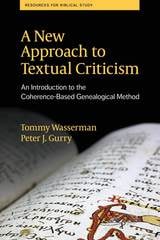
A New Approach to Textual Criticism
An Introduction to the Coherence-Based Genealogical MethodTommy Wasserman
SBL Press, 2017
An essential introduction for scholars and students of New Testament Greek
With the publication of the widely used 28th edition of Nestle-Aland’s Novum Testamentum Graece and the 5th edition of the United Bible Society Greek New Testament, a computer-assisted method known as the Coherence-Based Genealogical Method (CBGM) was used for the first time to determine the most valuable witnesses and establish the initial text. This book offers the first full-length, student-friendly introduction to this important new method. After setting out the method’s history, separate chapters clarify its key concepts, including genealogical coherence, textual flow diagrams, and the global stemma. Examples from across the New Testament are used to show how the method works in practice. The result is an essential introduction that will be of interest to students, translators, commentators, and anyone else who studies the Greek New Testament.
Features
- A clear explanation of how and why the text of the Greek New Testament is changing
- Step-by-step guidance on how to use the CBGM in textual criticism
- Diagrams, illustrations, and glossary of key terms
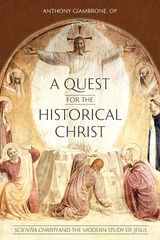
A Quest for the Historical Christ
Scientia Christi and the Modern Study of JesusAnthony Giambrone, OP
Catholic University of America Press, 2021
A Ransom for Israel
Jesus and Jewish Salvation in MatthewNicholas J. Schaser
SBL Press, 2025
A User's Guide to the Nestle-Aland 28 Greek New Testament
David Trobisch
SBL Press, 2013
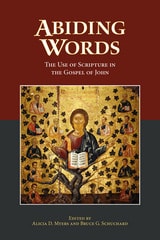
Abiding Words
The Use of Scripture in the Gospel of JohnAlicia D. Myers
SBL Press, 2015
A collection of essays by experts from around the world
Like the other New Testament Gospels, the Gospel of John repeatedly appeals to Scripture (Old Testament). Preferring allusions and “echoes” alongside more explicit quotations, however, the Gospel of John weaves Scripture as an authoritative source concerning its story of Jesus. Yet, this is the same Gospel that is often regarded as antagonistic toward “the Jews,” especially the Jewish religious leaders, depicted within it.
Features:
- Introduces and updates readers on the question of John’s employment of Scripture
- Showcases useful approaches to more general studies on the New Testament’s use of Scripture, sociological and rhetorical analyses, and memory theory
- Explores the possible implications surrounding Scripture usage for the Gospel audiences both ancient and contemporary
After the Corinthian Women Prophets
Reimagining Rhetoric and PowerJoseph A. Marchal
SBL Press, 2021
Rhetoric, Power, and Possibilities
Thirty years after the publication of Antoinette Clark Wire’s groundbreaking The Corinthian Women Prophets, an interdisciplinary, international, and intergenerational group of scholars reflects upon Wire’s impact on New Testament scholarship. Essays pursue further historical and theoretical possibilities, often in search of marginalized people, including the women of Corinth, using feminist, rhetorical, materialist, decolonizing, queer, and posthumanist approaches to interpret Paul’s letters and the history of ancient Mediterranean assemblies. Contributions from Cavan Concannon, Arminta Fox, Joseph A. Marchal, Shelly Matthews, Anna Miller, Jorunn Økland, and Antoinette Clark Wire reconsider how both the methods and results of Wire’s work reveal the possibilities of other people beside Paul who are worth our attention and effort. The essays in this collection introduce students and scholars to the possibilities of interdisciplinary and intersectional approaches for engaging the broader Pauline corpus.
Ambrosiaster's Commentary on the Pauline Epistles
RomansTheodore S. de Bruyn
SBL Press, 2017
A new translation for scholars and students of biblical interpretation and ancient Christianity
The ancient writer dubbed Ambrosiaster was a pioneer in the revival of interest in the Pauline Epistles in the later fourth century. He was read by Latin writers, including Pelagius and Augustine, and his writings, passed on pseudonymously, had a long afterlife in the biblical commentaries, theological treatises, and canonical literature of the medieval and the early modern periods. In addition to his importance as an interpreter of scripture, Ambrosiaster provides unique perspectives on many facets of Christian life in Rome, from the emergence of clerical celibacy to the development of liturgical practices to the subordination of women.
Features
- An up-to-date overview of what is known about Ambrosiaster, the transmission of his commentary on the Pauline Epistles, his exegetical method, his theological orientation, and aspects of Christianity in Rome in the fourth century
- A scholarly translation of the final version of the commentary, along with notes that identify significant variants from prior versions of the commentary
- Bibliography thatincludes a comprehensive list of the scholarly literature on Ambrosiaster
An Introduction to Empire in the New Testament
Adam Winn
SBL Press, 2016
Explore how empire is a crucial foreground for reading and interpreting the New Testament
In the last three decades, significant attention has been given to the way in which New Testament texts engage and respond to the imperial world in which they were written. The purpose of the present volume is to introduce students and non-specialists to the growing subfield of New Testament studies known as empire studies. Contributors seek to make readers aware of the significant work that has already been produced, while also pointing them to new ways in which this field is moving forward. The contributors are Bruce W. Longenecker, Richard A. Horsley, Warren Carter, Adam Winn, Eric D. Barreto, Beth M. Sheppard, Neil Elliot, James R. Harrison, Harry O. Maier, Deborah Krause, Jason A.Whitlark, Matthew R. Hauge, Kelly D. Liebengood, and Davina C. Lopez.
Features:
An Introductory New Testament Greek Course, Revised Edition
Francis T. Gignac, SJ
Catholic University of America Press, 2015
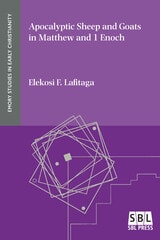
Apocalyptic Sheep and Goats in Matthew and 1 Enoch
Elekosi F. Lafitaga
SBL Press, 2022
An alternative understanding of apocalyptic eschatology in the Gospel of Matthew
Matthew’s eschatological imageries of judgment are often identified as apocalyptic and referred to as Matthew’s apocalyptic discourses. In this volume Elekosi F. Lafitaga reexamines Matthew’s vision of the sheep and goats in the judgment of the nations, which are often interpreted as metaphors for the saved and the condemned. Lafitaga views these images in the wider context of the rhetoric of apocalyptic communication stretching back to Matthew 3. This broader context reveals that the vision of Matthew 25 serves to exhort Israel in the here and now according to the torah, with salvation for Israel involving an indispensable responsibility to love and serve humanity. Central to Lafitaga’s analysis is the highly probable scenario that the material in Matthew is dependent on the Book of Dreams (1 Enoch 83–90).

Apocalyptic Sheep and Goats in Matthew and 1 Enoch
Elekosi F. Lafitaga
SBL Press, 2022