Results by title
59 books match the query 'Philosophy and aesthetics' and 3 start with a

A Language of Its Own
Sense and Meaning in the Making of Western Art MusicRuth Katz
University of Chicago Press, 2009
The Western musical tradition has produced not only music, but also countless writings about music that remain in continuous—and enormously influential—dialogue with their subject. With sweeping scope and philosophical depth, A Language of Its Own traces the past millennium of this ongoing exchange.
Ruth Katz argues that the indispensible relationship between intellectual production and musical creation gave rise to the Western conception of music. This evolving and sometimes conflicted process, in turn, shaped the art form itself. As ideas entered music from the contexts in which it existed, its internal language developed in tandem with shifts in intellectual and social history. Katz explores how this infrastructure allowed music to explain itself from within, creating a self-referential and rational foundation that has begun to erode in recent years.
A magisterial exploration of a frequently overlooked intersection of Western art and philosophy, A Language of Its Own restores music to its rightful place in the history of ideas.
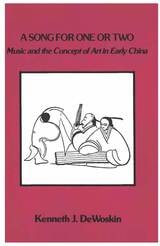
A Song for One or Two
Music and the Concept of Art in Early ChinaKenneth J. DeWoskin
University of Michigan Press, 1982
An Unnatural Attitude
Phenomenology in Weimar Musical ThoughtBenjamin Steege
University of Chicago Press, 2021
An Unnatural Attitude traces a style of musical thought that coalesced in the intellectual milieu of the Weimar Republic—a phenomenological style that sought to renew contact with music as a worldly circumstance. Deeply critical of the influence of naturalism in aesthetics and ethics, proponents of this new style argued for the description of music as something accessible neither through introspection nor through experimental research, but rather in an attitude of outward, open orientation toward the world. With this approach, music acquires meaning in particular when the act of listening is understood to be shared with others.
Benjamin Steege interprets this discourse as the response of a young, post–World War I generation amid a virtually uninterrupted experience of war, actual or imminent—a cohort for whom disenchantment with scientific achievement was to be answered by reasserting the value of imaginative thought. Steege draws on a wide range of published and unpublished texts from music theory, pedagogy, criticism, and philosophy of music, some of which appear for the first time in English translation in the book’s appendixes. An Unnatural Attitude considers the question: What are we thinking about when we think about music in non-naturalistic terms?