Results by title
64 books match the query 'Political corruption' and 7 start with a
A Culture of Corruption?
Coping with Government in Post-communist EuropeWilliam L. Miller
Central European University Press, 2001
A Just Cause
The Impeachment and Removal of Governor Rod BlagojevichBernard H. Sieracki. Foreword by Jim Edgar
Southern Illinois University Press, 2016
During the predawn hours of December 9, 2008, an FBI team swarmed the home of Illinois governor Rod Blagojevich and took him away in handcuffs. The shocking arrest, based on allegations of corruption and extortion, launched a chain of political events never before seen in Illinois. In A Just Cause, Bernard H. Sieracki delivers a dynamic firsthand account of this eight-week political crisis, beginning with Blagojevich’s arrest, continuing through his impeachment and trial, and culminating in his conviction and removal from office. Drawing on his own eyewitness observations of the hearings and trial, the comments of interviewees, trial transcripts, and knowledge gained from decades of work with the Illinois legislature, Sieracki tells the compelling story of the first impeachment and removal from office of an Illinois governor, while providing a close look at the people involved.
A Just Cause depicts Blagojevich as a master of political gamesmanship, a circus ringmaster driven by personal ambition and obsessed with private gain. Sieracki examines in depth the governor’s unethical behavior while in office, detailing a litany of partisan and personal hostilities that spanned years. He thoroughly covers the events leading to Blagojevich’s downfall and the reactions of the governor’s cohorts. The author discusses the numerous allegations against Blagojevich, including attempts to “sell” appointments, jobs, and contracts in exchange for financial contributions. Sieracki then exhaustively recounts Blagojevich’s senate trial and the governor’s removal from office.
This engrossing volume is both a richly detailed case study of the American checks-and-balances system and an eyewitness account of unprecedented events. It will appeal to anyone interested in the stunning, true tale of a state upholding the maxim “The welfare of the people is the supreme law.”
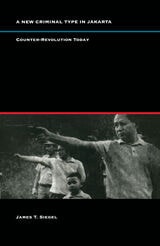
A New Criminal Type in Jakarta
Counter-Revolution TodayJames T. Siegel
Duke University Press, 1998
Examining the links between the concept of criminality and scandal, rumor, fear, and the state, Siegel analyzes daily life in Jakarta through the seemingly disparate but strongly connected elements of family life, gossip, and sensationalist journalism. He offers close analysis of the preoccupation with crime in Pos Kota (a newspaper directed toward the lower classes) and the middle-class magazine Tempo. Because criminal activity has been a sensationalized preoccupation in Jakarta’s news venues and among its people, criminality, according to Siegel, has pervaded the identities of its ordinary citizens. Siegel examines how and why the government, fearing revolution and in an attempt to assert power, has made criminality itself a disturbing rationalization for the spectacular massacre of the people it calls criminals—many of whom were never accused of particular crimes. A New Criminal Type in Jakarta reveals that Indonesians—once united by Sukarno’s revolutionary proclamations in the name of “the people”—are now, lacking any other unifying element, united through their identification with the criminal and through a “nationalization of death” that has emerged with Suharto’s strong counter-revolutionary measures.
A provocative introduction to contemporary Indonesia, this book will engage those interested in Southeast Asian studies, anthropology, history, political science, postcolonial studies, public culture, and cultural studies generally.
A Technomoral Politics
Good Governance, Transparency, and Corruption in IndiaAradhana Sharma
University of Minnesota Press, 2024
Examining anticorruption battles and transparency laws to ask: what makes for good governance, and can it limit liberal democratic politics as much as encourage it?
Good governance is meant to empower citizens, increase democratic participation, and make states transparent and accountable, yet this liberal democratic imperative can also promote populist authoritarian rule. Bringing together discourses on ethical goodness with the technicalities of governance as expressed in laws and policies, Aradhana Sharma develops the concept of “technomoral politics” to navigate this fraught topic. With a focus on the work of activists, citizens, and state officials, she offers an ethnographic account of the contradictions and dangers of good-governance politics in twenty-first-century India.
A Technomoral Politics follows the evolution of a group of activists in New Delhi led by Arvind Kejriwal from 2008 to 2014 as they morphed from a protransparency NGO to a mass movement against state corruption to a populist party that promised to change the political system through laws and policies. Sharma explores the technomoral framing of state opacity and corruption as well as the limits of the law in resolving these issues, probing such themes as the contradictory relationship between transparency and bureaucracy and the classed and gendered nature of democratic state institutions.
By examining scalar dimensions of good-governance politics, from the hyperlocal work of activists to global trends, A Technomoral Politics illuminates the paradoxes, limits, and risks of a system that is meant to spread liberal democratic principles but that also ends up promoting antidemocratic, populist-authoritarian forms of rule.
Retail e-book files for this title are screen-reader friendly.
America, Compromised
Lawrence Lessig
University of Chicago Press, 2018
So begins Lawrence Lessig's sweeping indictment of contemporary American institutions and the corruption that besets them. We can all see it—from the selling of Congress to special interests to the corporate capture of the academy. Something is wrong. It’s getting worse.
And it’s our fault. What Lessig shows, brilliantly and persuasively, is that we can’t blame the problems of contemporary American life on bad people, as our discourse all too often tends to do. Rather, he explains, “We have allowed core institutions of America’s economic, social, and political life to become corrupted. Not by evil souls, but by good souls. Not through crime, but through compromise.” Every one of us, every day, making the modest compromises that seem necessary to keep moving along, is contributing to the rot at the core of American civic life. Through case studies of Congress, finance, the academy, the media, and the law, Lessig shows how institutions are drawn away from higher purposes and toward money, power, quick rewards—the first steps to corruption.
Lessig knows that a charge so broad should not be levied lightly, and that our instinct will be to resist it. So he brings copious, damning detail gleaned from years of research, building a case that is all but incontrovertible: America is on the wrong path. If we don’t acknowledge our own part in that, and act now to change it, we will hand our children a less perfect union than we were given. It will be a long struggle. This book represents the first steps.
American Corruption Talk
A Political EtymologyRobert G. Boatright and Molly Brigid McGrath
Temple University Press, 2025
Robert Boatright and Molly Brigid McGrath focus on the role corruption talk plays in American political discourse. They distinguish between two ways people speak about corruption—corruption talk in the style of a purifier, who wishes to expunge the evil forces or drain the swamp, and corruption talk in the style of the mender, who thinks of managing, replacing, or repairing.
American Corruption Talk begins by tracing how the concept of political corruption was developed by philosophers and political thinkers, leading up to its use in the American context, especially in the Progressive Era. It also compares modes of contemporary corruption talk in different areas of public life. In doing so, the authors hope to resolve confusion and partisan disagreements about what corruption is and to discourage the tendency to label actions, events, and ideas that we merely disagree with as corrupt.
American Oligarchy
The Permanent Political ClassRon Formisano
University of Illinois Press, 2017