Results by title
73 books match the query 'Popular works' and 9 start with a
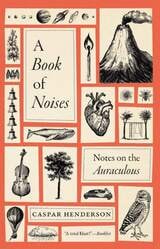
A Book of Noises
Notes on the AuraculousCaspar Henderson
University of Chicago Press, 2023
The crackling of a campfire. The scratch, hiss, and pop of a vinyl record. The first glug of wine as it is poured from a bottle. These are just a few of writer Caspar Henderson’s favorite sounds. In A Book of Noises, Henderson invites readers to use their ears a little better—to tune in to the world in all its surprising noisiness.
Describing sounds from around the natural and human world, the forty-eight essays that make up A Book of Noises are a celebration of all things “auraculous.” Henderson calls on his characteristic curiosity to explore sounds related to humans (anthropophony), other life (biophony), the planet (geophony), and space (cosmophony). Henderson finds the beauty in everyday sounds, like the ringing of a bell, the buzz of a bee, or the “earworm” songs that get stuck in our heads. A Book of Noises also explores the marvelous, miraculous sounds we may never get the chance to hear, like the deep boom of a volcano or the quiet, rustling sound of the Northern Lights.
A Book of Noises will teach readers to really listen to the sounds of the world around them, to broaden and deepen their appreciation of the humans, animals, rocks, and trees simultaneously broadcasting across the whole spectrum of sentience.
A Doctor's Dozen
Twelve Strategies for Personal Health and a Culture of WellnessCatherine Florio Pipas
Dartmouth College Press, 2018
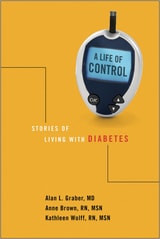
A Life of Control
Stories of Living with DiabetesAlan L. Graber
Vanderbilt University Press, 2010
The people who describe their experiences with diabetes range from teenagers to physicians, immigrants, athletes, pregnant women, accountants, a prisoner, and a dairy farmer. They speak of the variety of ways they handle monitoring, diet, insurance coverage, sports, and fashion. Some talk of how they manage to drive trucks for a living or, for recreation, fly airplanes or go spelunking. Many speak frankly of their anxieties and frustrations.
The authors acknowledge that both the patient and clinician have a story about their relationship, and describe the richness and tension in their interaction. Families, too, are sources of both support and conflict. These relationships are acknowledged in the organization of the book, which is divided into sections defined by the main elements of diabetes control: patient self-determination, the role of the family, the social situation, and the patient-clinician encounter.
The book provides a wealth of information about diabetes, including material on prevention, complications, and new technology, as well as a superb glossary, but it is not intended as a textbook on diabetes or as a self-care manual for patients. Rather the book provides a textured account of the health professional's view of diabetes control and the perspective of the patient whose life is complicated by diabetes.

A Parent’s Guide to Spina Bifida
Beth-Ann Bloom
University of Minnesota Press, 1988

A Planet of Viruses
Third EditionCarl Zimmer
University of Chicago Press, 2021
Fully revised and updated, with new illustrations and a new chapter about coronaviruses and the spread of Covid-19, this third edition of Carl Zimmer’s A Planet of Viruses pulls back the veil on this hidden world. It presents the latest research on how viruses hold sway over our lives and our biosphere, how viruses helped give rise to the first life-forms, how viruses are producing new diseases, how we can harness viruses for our own ends, and how viruses will continue to control our fate as long as life endures.

A User’s Guide to Bypass Surgery
Ted Klein
Ohio University Press, 1996
A Woman's Concise Guide to Common Medical Tests
Moore, M.D., Michele C
Rutgers University Press, 2005
Every year, millions of healthy women undergo a variety of screening tests without understanding why or the meaning of the outcome. If you are among those women, overwhelmed by information and baffled by results, this is the book you've been waiting for. In straightforward, personable prose, A Woman's Concise Guide to Common Medical Tests surveys a wide variety of standard tests commonly suggested by doctors.
Using the recommendations of the U.S. Preventative Health Services Task Force as a starting point, physicians Michele C. Moore and Caroline M. de Costa describe and explain screening tests for STDs and other communicable diseases, diabetes, thyroid disease, bone loss, various genetic tests, pregnancy, and cancer (including breast, colon, and skin). A section on common blood tests demystifies the numerical results that can be virtually impossible to interpret for women outside the medical profession. The authors detail what is considered "normal" as well as what's not-to help women make sense of their results.
As practicing physicians, both authors have fielded patients' questions about standard screening tests and understand what women should know but often feel afraid to ask about. For each test, there is an explanation of why it may be ordered, how it is done, what sort of preparation may be involved, and what risks may be incurred.
As the health-care industry continues to evolve, the amount of medical information available to women about their health can be overwhelming and confusing. Without being encyclopedic or intimidating, A Woman's Concise Guide to Common Medical Tests offers all the facts you need about screening tests, all in one place.

An Equation That Changed the World
Newton, Einstein, and the Theory of RelativityHarald Fritzsch
University of Chicago Press, 1994
"Fritzsch could not give the modern reader a more memorable introduction to the personalities and science of Isaac Newton and Albert Einstein unless somehow he could find the keys to H. G. Wells' time machine. . . . Many readers will applaud Fritzsch for this lively but profoundly insightful book." —Booklist, starred review
"[Fritzsch] has dreamed up a dialogue between the two great physicists, helped along by a fictional modern physicist. . . . The conversation builds up to an explanation of E=mc2, and on the way illuminates the important points where Newtonian and Einsteinian theory diverge." —David Lindley, New York Times Book Review
An Orchard Invisible
A Natural History of SeedsJonathan Silvertown
University of Chicago Press, 2009
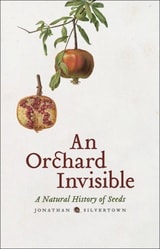
The story of seeds, in a nutshell, is a tale of evolution. From the tiny sesame that we sprinkle on our bagels to the forty-five-pound double coconut borne by the coco de mer tree, seeds are a perpetual reminder of the complexity and diversity of life on earth. With An Orchard Invisible, Jonathan Silvertown presents the oft-ignored seed with the natural history it deserves, one nearly as varied and surprising as the earth’s flora itself.
Beginning with the evolution of the first seed plant from fernlike ancestors more than 360 million years ago, Silvertown carries his tale through epochs and around the globe. In a clear and engaging style, he delves into the science of seeds: How and why do some lie dormant for years on end? How did seeds evolve? The wide variety of uses that humans have developed for seeds of all sorts also receives a fascinating look, studded with examples, including foods, oils, perfumes, and pharmaceuticals. An able guide with an eye for the unusual, Silvertown is happy to take readers on unexpected—but always interesting—tangents, from Lyme disease to human color vision to the Salem witch trials. But he never lets us forget that the driving force behind the story of seeds—its theme, even—is evolution, with its irrepressible habit of stumbling upon new solutions to the challenges of life.
"I have great faith in a seed," Thoreau wrote. "Convince me that you have a seed there, and I am prepared to expect wonders." Written with a scientist’s knowledge and a gardener’s delight, An Orchard Invisible offers those wonders in a package that will be irresistible to science buffs and green thumbs alike.