Results by title
54 books match the query 'Populism' and 5 start with a

A Century of Populist Demagogues
Eighteen European Portraits, 1918–2018Ivan T. Berend
Central European University Press, 2020
The renowned historian Ivan T. Berend discusses populist demagoguery through the presentation of eighteen politicians from twelve European countries spanning World War I to the present. Berend defines demagoguery, reflects on its connections with populism, and examines the common features and differences in the demagogues’ programs and language.
Mussolini and Hitler, the “model demagogues,” are only briefly discussed, as is the election of Donald Trump in the United States and its impact on Europe. The eighteen detailed portraits include two communists, two fascists, and several right-wing and anti-EU politicians, extending across the full range of demagoguery. The author covers Béla Kun, the leader of the Hungarian Soviet Republic in 1919, weaving through Codreanu and Gömbös from the 1930s, on to Stahremberg and Haider in Austria, and then more broadly throughout Europe from Ceaușescu, Milošević, Tuđjman, Izetbegović, Berlusconi, Wilders, to the two Le Pens, Farage, and Boris Johnson, Orbán and the two Kaczyńskis. Each case includes an analysis of the time and place and is illustrated with quotations from the demagogues’ speeches.
This book is a warning about the continuing threat of populist demagogues both for their subjects and for history itself. Berend insists on the crucial importance for Europe to understand the reality behind their promises and persuasive language as imperative to impeding their success.

A Hanging in Nacogdoches
Murder, Race, Politics, and Polemics in Texas's Oldest Town, 1870-1916By Gary B. Borders
University of Texas Press, 2006
On October 17, 1902, in Nacogdoches, Texas, a black man named James Buchanan was tried without representation, condemned, and executed for the murder of a white family—all in the course of three hours. Two white men played pivotal roles in these events: Bill Haltom, a leading local Democrat and the editor of the Nacogdoches Sentinel, who condemned lynching but defended lynch mobs, and A. J. Spradley, a Populist sheriff who, with the aid of hundreds of state militiamen, barely managed to keep the mob from burning Buchanan alive, only to escort him to the gallows following his abbreviated trial. Each man's story serves to illuminate a part of the path that led to the terrible parody of justice which lies at the heart of A Hanging in Nacogdoches.
The turn of the twentieth century was a time of dramatic change for the people of East Texas. Frightened by the Populist Party's attempts to unite poor blacks and whites in a struggle for economic justice, white Democrats defended their power base by exploiting racial tensions in a battle that ultimately resulted in the complete disenfranchisement of the black population of East Texas. In telling the story of a single lynching, Gary Borders dramatically illustrates the way politics and race combined to bring horrific violence to small southern towns like Nacogdoches.

A Populist Assault
Sarah E. Van De Vort Emery on American Democracy 1862–1895Pauline Adams and Emma Thornton
University of Wisconsin Press, 1982
Sarah E. Van De Vort Emery, a Michigan woman transplanted from the Finger Lakes region of New York, was for many years a voice for Populism in the late 19th century. Emery was a woman who believed and acted on her beliefs that freedom and the flowering of the human potential should not five way to the demands of the "money power."

A Prairie Populist
The Memoirs of Luna KellieJane Taylor Nelsen
University of Iowa Press, 1992
Kellie actively sought to organize Nebraska into cooperatives and educate rural people about land, transportation, and money reform. Her compelling, often heartbreaking memoirs—written on the backs of ornate red-and-gold Farmers' Alliance certificates in 1925—give us her own description of how she became motivated to join the Alliance and participate in the Populist party. Kellie writes of her homesteading and political life from the age of eighteen to forty, of failed crops, mortgaged fields, intense hardships, and her devastation at the death of her children.
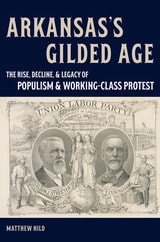
Arkansas’s Gilded Age
The Rise, Decline, and Legacy of Populism and Working-Class ProtestMatthew Hild
University of Missouri Press, 2018
The story of farmer and labor protest in Arkansas during the late nineteenth century offers lessons relevant to contemporary
working-class Americans in what some observers have called the “new Gilded Age.”