Results by title
54 books match the query 'Promise' and 4 start with a

A Promise And A Way Of Life
White Antiracist ActivismBecky Thompson
University of Minnesota Press, 2001
The first in-depth look at white people’s activism in fighting racism during the past fifty years.
Not since the Civil Rights Movement of the 1950s and 1960s, when many white college students went south to fight against Jim Crow laws, has white antiracist activity held the public’s attention. Yet there have always been white people involved in fighting racism. In this passionate work, Becky Thompson looks at white Americans who have struggled against racism, offering examples of both successes and failures, inspirations, practical philosophies, and a way ahead.
A Promise and a Way of Life weaves an account of the past half-century based on the life histories of thirty-nine people who have placed antiracist activism at the center of their lives. Through a rich and fascinating narrative that links individual experiences with social and political history, Thompson shows the ways, both public and personal, in which whites have opposed racism during several social movements: the Civil Rights and Black Power movements, multiracial feminism, the Central American peace movement, the struggle for antiracist education, and activism against the prison industry. Beginning with the diverse catalysts that started these activists on their journeys, this book demonstrates the contributions and limitations of white antiracism in key social justice movements.
Through these stories, crucial questions are raised: Does antiracist work require a repudiation of one’s whiteness or can that identity be transformed through political commitment and alliances? What do white people need to do to undermine white privilege? What would it take to build a multiracial movement in which white people are responsible for creating antiracist alliances while not co-opting people of color?
Unique in its depth and thoroughness, A Promise and a Way of Life is essential for anyone currently fighting racism or wondering how to do so. Through its demonstration of the extraordinary personal and social transformations ordinary people can make, it provides a new paradigm for movement activity, one that will help to incite and guide future antiracist activism.

A Promise in Haiti
A Reporter's Notes on Families and Daily LivesMark Curnutte
Vanderbilt University Press, 2011
A Promise in Haiti is Curnutte's story of his time, spanning the last decade, living among several families in Gonaives, a city of 200,000 people a hundred kilometers north of Port-au-Prince. He began traveling to Haiti as a volunteer with the aid organization Hands Together, eventually building trust and credibility with many Haitians. Curnutte introduces the reader to the Cenecharles family, strained by entrenched unemployment and the need to continually travel for work. He is invited into the home of the Henrisma family, and is forced to reconcile journalistic detachment with basic compassion as he contributes financially to help them. The reader is confronted with a complicated, conflicted written and photographic record of a worldview that evolves right on the page. As a reporter, Curnutte found parallels between the lives he encountered in Gonaives and the world of the Great Depression recounted in James Agee and Walker Evans's Let Us Now Praise Famous Men. Agee and Evans loom large as a challenge and inspiration to Curnutte.
The result is equal parts homage to that historic chronicle, on-the-ground reporting, and introspective narrative on the lessons Gonaives taught Curnutte about his own life and family. In late February 2010, Curnutte went back to Haiti on assignment, but conditions made it impossible for him to return to Gonaives. The resulting frustration provoked a meditation on the monumental challenges that face Haiti -- and on the destructive cycle of international attention that constantly moves on to "The Next Big Story."
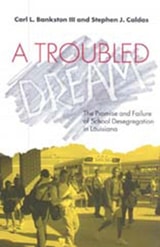
A Troubled Dream
The Promise and Failure of School Desegregation in LouisianaCarl L. Bankston
Vanderbilt University Press, 2002
Winner, Louisiana Literary Award 2003
Fifty years after Brown v. Board of Education, the United States still has a long way to go to attain true integration of our educational system.
Using extensive interviews and a wealth of statistical information, Bankston and Caldas examine the failed desegregation efforts in Louisiana as a case study to show how desegregation has followed the same unsuccessful pattern across the United States. Strong supporters of the dream of integration, Bankston and Caldas show that the practical difficulty with desegregation is that academic environments are created by all the students in a school from the backgrounds that all the students bring with them. Unfortunately, the disadvantages that minority children have to overcome affect schools more than schools can help remedy these disadvantages.
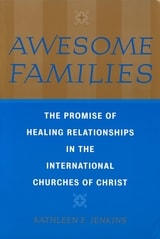
Awesome Families
The Promise of Healing Relationships in the International Churches of ChristKathleen Jenkins
Rutgers University Press, 2005
Denounced by some as a dangerous cult and lauded by others as a miraculous faith community, the International Churches of Christ was a conservative evangelical Christian movement that grew rapidly in the 1980s and 1990s.
Among its followers, promises to heal family relationships were central to the group's appeal. Members credit the church for helping them develop so-called "awesome families"-successful marriages and satisfying relationships with children, family of origin, and new church "brothers and sisters." The church engaged an elaborate array of services, including round-the-clock counseling, childcare, and Christian dating networks-all of which were said to lead to fulfilling relationships and exciting sex lives. Before the unified movement's demise in 2003-2004, the lure of blissful family-life led more than 100,000 individuals worldwide to be baptized into the church.
In Awesome Families, Kathleen Jenkins draws on four years of ethnographic research to explain how and why so many individuals-primarily from middle- to upper-middle-class backgrounds-were attracted to this religious group that was founded on principles of enforced community, explicit authoritative relationships, and therapeutic ideals. Weaving classical and contemporary social theory, she argues that members were commonly attracted to the structure and practice of family relationships advocated by the church, especially in the context of contemporary society where gender roles and family responsibilities are often ambiguous.
Tracing the rise and fall of this fast-growing religious movement, this timely study adds to our understanding of modern society and offers insight to the difficulties that revivalist movements have in sustaining growth.