Results by title
7 books match the query 'Concord'
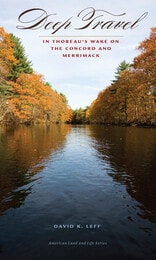
Deep Travel
In Thoreau's Wake on the Concord and MerrimackDavid K. Leff
University of Iowa Press, 2009
How we see depends on where we are in our lives and with whom we travel. Leff chose his companions wisely. In consecutive journeys his neighbor and friend Alan, a veteran city planner; his son Josh, an energetic eleven-year-old; and his sweetheart Pamela, a compassionate professional caregiver, added their perspectives to Leff’s own experiences as a government official in natural resources policy. Not so much sight seeing as sight seeking, together they explored a geography of the imagination as well as the rich natural and human histories of the rivers and their communities.
The heightened awareness of deep travel demands that we immerse ourselves fully in places and realize that they exist in time as well as space. Its mindfulness enriches the experience and makes the voyager worthy of the journey. Leff’s intriguing, contemplative deep travel along these historic rivers presents a methodology for exploration that will enrich any trip.
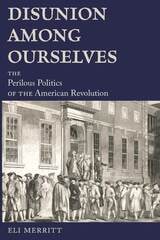
Disunion Among Ourselves
The Perilous Politics of the American RevolutionEli Merritt
University of Missouri Press, 2025
Winner of the 2024 Society of the Cincinnati Prize from the American Revolution Institute
Winner of the 2023 American Revolution Round Table of Philadelphia book award
In this eye-opening account, Eli Merritt reveals the deep political divisions that almost tore the Union apart during the American Revolution. So fractious were the founders’ political fights that they feared the War of Independence might end in disunion and civil war.
Instead of disbanding into separate regional confederacies, the founders managed to unite for the sake of liberty and self-preservation. In so doing, they succeeded in holding the young nation together. To achieve this, they forged grueling compromises, including Declaration of Independence in 1776, the Mississippi-Fisheries Compromise of 1779, and the ratification of the Articles of Confederation in 1781.
In addition to bringing new insights to the history of the American Revolution, Disunion Among Ourselves has inevitable resonances with our present era of political hyperpolarization and serves as a touchstone for contemporary politics, reminding us that the founders overcame far tougher times than our own through commitment to ethical constitutional democracy and compromise.
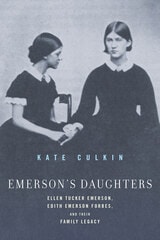
Emerson’s Daughters
Ellen Tucker Emerson, Edith Emerson Forbes, and Their Family LegacyKate Culkin
University of Massachusetts Press, 2025
Longlisted for the 2026 Plutarch Award
Ellen Tucker Emerson and Edith Emerson Forbes, the daughters of Lidian Jackson and Ralph Waldo Emerson, grew up in the heart of Concord, Massachusetts’s famed literary community. In a culture that celebrated self-reliance, Ellen and Edith formed a partnership that only strengthened as their paths diverged, with Ellen remaining in the family home and Edith marrying William Forbes, moving to Milton, Massachusetts, and having eight children. The partnership allowed them to tend to the demands and opportunities created by their father’s career, including serving as his secretaries and editors, and helped them shape his posthumous image. It also enabled them to adapt to historical developments stretching from the Civil War to American imperialism as well as personal ones, including Edith’s growing family and travel and study abroad, and inevitable ones brought on by the aging processes of their parents and themselves.
Emerson’s Daughters is a biography of a sisterhood, the first full-length study of Ellen’s and Edith’s lives. Building on archival research into the extensive correspondence between the sisters, it adds to the growing body of work on women’s contribution to Transcendentalism while opening a window onto the rich, and understudied, family life of the “Sage of Concord.”
Metaphysical Disputations III and IV
On Being's Passions in General and Its Principles and On Transcendental Unity in GeneralFrancisco Suarez
Catholic University of America Press, 2023
The Road to Concord
How Four Stolen Cannon Ignited the Revolutionary WarJ. L. Bell
Westholme Publishing, 2016
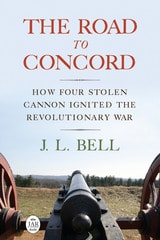
In the early spring of 1775, on a farm in Concord, Massachusetts, British army spies located four brass cannon belonging to Boston’s colonial militia that had gone missing months before. British general Thomas Gage had been searching for them, both to stymie New England’s growing rebellion and to erase the embarrassment of having let cannon disappear from armories under redcoat guard. Anxious to regain those weapons, he drew up plans for his troops to march nineteen miles into unfriendly territory. The Massachusetts Patriots, meanwhile, prepared to thwart the general’s mission. There was one goal Gage and his enemies shared: for different reasons, they all wanted to keep the stolen cannon as secret as possible. Both sides succeeded well enough that the full story has never appeared until now.
The Road to Concord: How Four Stolen Cannon Ignited the Revolutionary War by historian J. L. Bell reveals a new dimension to the start of America’s War for Independence by tracing the spark of its first battle back to little-known events beginning in September 1774. The author relates how radical Patriots secured those four cannon and smuggled them out of Boston, and how Gage sent out spies and search parties to track them down. Drawing on archives in the United States, United Kingdom, and Canada, the book creates a lively, original, and deeply documented picture of a society perched on the brink of war.
Traditions and Reminiscences of Concord, Massachusetts, 1779-1878
Edward Jarvis
University of Massachusetts Press, 1993
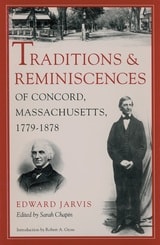
A statistician and pioneer in the treatment of the mentally ill, Edward Jarvis (1803–1884) decided late in life to record his recollections of Concord, Massachusetts, the town in which he was raised. Using Lemuel Shattuck's History of Concord as the springboard for his thoughts, Jarvis produced a remarkable document. Traditions and Reminiscences is encyclopedic in scope but intimate in style; it provides an astonishingly detailed account of life in early nineteenth-century Concord. Jarvis escorts us through the family home, making certain we understand the function and value of each item in the domestic scene. Then he is off to the neighbors' houses, to the schoolhouse, the church, the social clubs, the library, the post office, the town hall, and even the tavern, where he unabashedly counts patrons' drinks. Along the way we learn about neighborly cooperation—quiltings, husking bees, and barn raisings—about social manners and respectability, and about local vices. The result is a vast storehouse of information and a vivid portrait of life in an early nineteenth-century preindustrial community. The memoir also provides a first-hand witness to the crusade for moral reform that transformed mid-nineteenth-century New England.

Walden Warming
Climate Change Comes to Thoreau's WoodsRichard B. Primack
University of Chicago Press, 2014
In Walden Warming, Richard B. Primack uses Thoreau and Walden, icons of the conservation movement, to track the effects of a warming climate on Concord’s plants and animals. Under the attentive eyes of Primack, the notes that Thoreau made years ago are transformed from charming observations into scientific data sets. Primack finds that many wildflower species that Thoreau observed—including familiar groups such as irises, asters, and lilies—have declined in abundance or have disappeared from Concord. Primack also describes how warming temperatures have altered other aspects of Thoreau’s Concord, from the dates when ice departs from Walden Pond in late winter, to the arrival of birds in the spring, to the populations of fish, salamanders, and butterflies that live in the woodlands, river meadows, and ponds.
Primack demonstrates that climate change is already here, and it is affecting not just Walden Pond but many other places in Concord and the surrounding region. Although we need to continue pressuring our political leaders to take action, Primack urges us each to heed the advice Thoreau offers in Walden: to “live simply and wisely.” In the process, we can each minimize our own contributions to our warming climate.