Results by title
216 books match the query 'Social' and 23 start with a

A Book of Consolation
Seeing Our Quests for Love, Success, and Meaning in a New LightAndrew Stark
University of Chicago Press, 2027
An invitation to rest in the mystery that there is no single route to fulfillment, but many—often contradictory, unpredictable, endlessly available.
Our lives are restless. Though we strive for meaning, we are often unfulfilled: our loves fail, our careers stall, and our purpose eludes us. We may temporarily ease our frustration by blaming our methods or embracing our limitations, and we may even embrace the self-defeating lie that we must discover the one, linear path for success in love, work, or life. In A Book of Consolation, Andrew Stark offers a liberating third way between self-abandonment and complacency, revealed through a simple mystery: for each road where someone found fulfillment, someone else walked the opposite path to the same end.
Drawing on literature, popular culture, philosophy, and more, A Book of Consolation invites us to appreciate, even marvel at, the possibility that the routes to love, success, and meaning are so various that even inverse lives can satisfy us. Stark holds up a series of opposing journeys for consideration—from the contradictory loves in modern romantic comedies, to the regrets of Dolly Parton and Ernest Hemingway, to the mindsets behind Tiger Woods and Richard Nixon’s success. In juxtaposing these lives, Stark expands our sense of what counts as fulfillment and what alternatives may be available when our own paths falter. Rich in possibility but without prescription, A Book of Consolation encourages us to navigate the frustrations of our finitude by cultivating a faith that the paths to fulfillment are far more pluralized—and often more contradictory—than we know.
A Companion to John Dewey's "Democracy and Education"
D. C. Phillips
University of Chicago Press, 2016
Phillips bridges several critical pitfalls of Democracy and Education that often prevent contemporary readers from fully understanding it. Where Dewey sorely needs a detailed example to illustrate a point—and the times are many—Phillips steps in, presenting cases from his own classroom experiences. Where Dewey casually refers to the works of people like Hegel, Herbart, and Locke—common knowledge, apparently, in 1916—Phillips fills in the necessary background. And where Dewey gets convoluted or is even flat-out wrong, Phillips does what few other scholars would do: he takes Dewey to task. The result is a lively accompaniment that helps us celebrate and be enriched by some of the most important ideas ever offered in education.
A Decent Life
Morality for the Rest of UsTodd May
University of Chicago Press, 2019
In a world full of suffering and deprivation, it’s easy to despair—and it’s also easy to judge ourselves for not doing more. Even if we gave away everything we own and devoted ourselves to good works, it wouldn’t solve all the world’s problems. It would make them better, though. So is that what we have to do? Is anything less a moral failure? Can we lead a fundamentally decent life without taking such drastic steps?
Todd May has answers. He’s not the sort of philosopher who tells us we have to be model citizens who display perfect ethics in every decision we make. He’s realistic: he understands that living up to ideals is a constant struggle. In A Decent Life, May leads readers through the traditional philosophical bases of a number of arguments about what ethics asks of us, then he develops a more reasonable and achievable way of thinking about them, one that shows us how we can use philosophical insights to participate in the complicated world around us. He explores how we should approach the many relationships in our lives—with friends, family, animals, people in need—through the use of a more forgiving, if no less fundamentally serious, moral compass. With humor, insight, and a lively and accessible style, May opens a discussion about how we can, realistically, lead the good life that we aspire to.
A philosophy of goodness that leaves it all but unattainable is ultimately self-defeating. Instead, Todd May stands at the forefront of a new wave of philosophy that sensibly reframes our morals and redefines what it means to live a decent life.
A Democratic Theory of Truth
Linda M. G. Zerilli
University of Chicago Press, 2025
We say that we live in a “post-truth” era because disinformation threatens our confidence in the existence of a shared public world. Affirming objective truth may, therefore, seem necessary to save democracy. According to political theorist Linda M. G. Zerilli, such affirmation can stifle political debate and silence dissent. In fact, Zerilli argues that the unqualified insistence on objective truth is as dangerous for democracy as denying it.
Drawing on Arendt, Foucault, and Wittgenstein, A Democratic Theory of Truth challenges the concept of truth presupposed by the post-truth debate. It argues that we, the people, have an essential role in discovering and evaluating any truth relevant to the political realm. The result is a striking defense of plurality, dissent, and opinion in contemporary democratic societies.
A Legal Theory for Autonomous Artificial Agents
Samir Chopra and Laurence F. White
University of Michigan Press, 2011
“An extraordinarily good synthesis from an amazing range of philosophical, legal, and technological sources . . . the book will appeal to legal academics and students, lawyers involved in e-commerce and cyberspace legal issues, technologists, moral philosophers, and intelligent lay readers interested in high tech issues, privacy, [and] robotics.”
—Kevin Ashley, University of Pittsburgh School of Law
As corporations and government agencies replace human employees with online customer service and automated phone systems, we become accustomed to doing business with nonhuman agents. If artificial intelligence (AI) technology advances as today’s leading researchers predict, these agents may soon function with such limited human input that they appear to act independently. When they achieve that level of autonomy, what legal status should they have?
Samir Chopra and Laurence F. White present a carefully reasoned discussion of how existing philosophy and legal theory can accommodate increasingly sophisticated AI technology. Arguing for the legal personhood of an artificial agent, the authors discuss what it means to say it has “knowledge” and the ability to make a decision. They consider key questions such as who must take responsibility for an agent’s actions, whom the agent serves, and whether it could face a conflict of interest.
A Philosopher's Economist
Hume and the Rise of CapitalismMargaret Schabas and Carl Wennerlind
University of Chicago Press, 2020
Although David Hume’s contributions to philosophy are firmly established, his economics has been largely overlooked. A Philosopher’s Economist offers the definitive account of Hume’s “worldly philosophy” and argues that economics was a central preoccupation of his life and work. Margaret Schabas and Carl Wennerlind show that Hume made important contributions to the science of economics, notably on money, trade, and public finance. Hume’s astute understanding of human behavior provided an important foundation for his economics and proved essential to his analysis of the ethical and political dimensions of capitalism. Hume also linked his economic theory with policy recommendations and sought to influence people in power. While in favor of the modern commercial world, believing that it had and would continue to raise standards of living, promote peaceful relations, and foster moral refinement, Hume was not an unqualified enthusiast. He recognized many of the underlying injustices of capitalism, its tendencies to promote avarice and inequality, as well as its potential for political instability and absolutism.
Hume’s imprint on modern economics is profound and far-reaching, whether through his close friend Adam Smith or later admirers such as John Maynard Keynes and Friedrich Hayek. Schabas and Wennerlind’s book compels us to reconsider the centrality and legacy of Hume’s economic thought—for both his time and ours—and thus serves as an important springboard for reflections on the philosophical underpinnings of economics.
A Philosophy of Crisis
Miguel de Beistegui
University of Chicago Press, 2024
Crises abound—so many that it can be easy to lose perspective. In A Philosophy of Crisis, Miguel de Beistegui traces the intellectual development of ideas about crisis and identifies four distinct forms a crisis might take: crises of deviation, exception, contradiction, and extinction. Drawing on a range of examples (from economic crises to social uprisings, pandemics, and ecological devastation) and discourses (from ancient medicine to legal theory, political economy, philosophy, the earth sciences, and ecocriticism), A Philosophy of Crisis offers new conceptual tools for both understanding and avoiding the dangers of our crisis-saturated time.

Aazheyaadizi
Worldview, Language, and the Logics of DecolonizationMark D. Freeland
Michigan State University Press, 2020
Action versus Contemplation
Why an Ancient Debate Still MattersJennifer Summit and Blakey Vermeule
University of Chicago Press, 2018
It is truly an ancient debate: Is it better to be active or contemplative? To do or to think? To make an impact, or to understand the world more deeply? Aristotle argued for contemplation as the highest state of human flourishing. But it was through action that his student Alexander the Great conquered the known world. Which should we aim at? Centuries later, this argument underlies a surprising number of the questions we face in contemporary life. Should students study the humanities, or train for a job? Should adults work for money or for meaning? And in tumultuous times, should any of us sit on the sidelines, pondering great books, or throw ourselves into protests and petition drives?
With Action versus Contemplation, Jennifer Summit and Blakey Vermeule address the question in a refreshingly unexpected way: by refusing to take sides. Rather, they argue for a rethinking of the very opposition. The active and the contemplative can—and should—be vibrantly alive in each of us, fused rather than sundered. Writing in a personable, accessible style, Summit and Vermeule guide readers through the long history of this debate from Plato to Pixar, drawing compelling connections to the questions and problems of today. Rather than playing one against the other, they argue, we can discover how the two can nourish, invigorate, and give meaning to each other, as they have for the many writers, artists, and thinkers, past and present, whose examples give the book its rich, lively texture of interplay and reference.
This is not a self-help book. It won’t give you instructions on how to live your life. Instead, it will do something better: it will remind you of the richness of a life that embraces action and contemplation, company and solitude, living in the moment and planning for the future. Which is better? Readers of this book will discover the answer: both.
Aesthetics in Grief and Mourning
Philosophical Reflections on Coping with LossKathleen Marie Higgins
University of Chicago Press, 2024
In Aesthetics of Grief and Mourning, philosopher Kathleen Marie Higgins reflects on the ways that aesthetics aids people experiencing loss. Some practices related to bereavement, such as funerals, are scripted, but many others are recursive, improvisational, mundane—telling stories, listening to music, and reflecting on art or literature. Higgins shows how these grounding, aesthetic practices can ease the disorienting effects of loss, shedding new light on the importance of aesthetics for personal and communal flourishing.
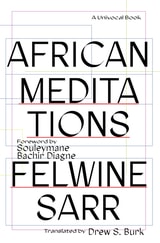
African Meditations
Felwine Sarr
University of Minnesota Press, 2022
An influential thinker’s fascinating reflections and meditations on reacclimating to his native Senegal as a young academic after years of study abroad
The call to morning prayer. A group run at daybreak along the Corniche in Dakar. A young woman shedding tears on a beach as her friends take a boat to Europe. In African Meditations, paths to enlightenment collide with tales of loss and ruminations, musical gatherings, and the everyday sights and sounds of life in West Africa as a young philosopher and creative writer seeks to establish himself as a teacher upon his return to Senegal, his homeland, after years of study abroad.
A unique contemporary portrait of an influential, multicultural thinker on a spiritual quest across continents—reflecting on his multiple literary influences along with French, African Francophone, and Senegalese tribal cultural roots in a homeland with a predominantly Muslim culture—African Meditations is a seamless blend of autobiography, journal entries, and fiction; aphorisms and brief narrative sketches; humor and Zen reflections.
Taking us from Saint-Louis to Dakar, Felwine Sarr encounters the rhythms of everyday life as well as its disruptions such as teachers’ strikes and power outages while traversing a semi-surrealistic landscape. As he reacclimates to his native country after a life in France, we get candid glimpses, both vibrant and hopeful, sublime and mundane, into his Zen journey to resecure a foothold in his roots and to navigate academia, even while gleaning something of the good life, of joy, amid the struggles of life in Senegal.
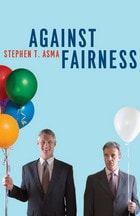
Against Fairness
Stephen T. Asma
University of Chicago Press, 2012
Watch an animated book trailer here: http://www.youtube.com/watch?v=GjPhTQ9zi5Q
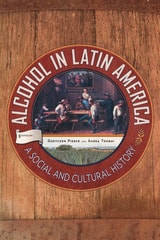
Alcohol in Latin America
A Social and Cultural HistoryEdited by Gretchen Pierce and Áurea Toxqui
University of Arizona Press, 2014
Alcohol in Latin America is the first interdisciplinary study to examine the historic role of alcohol across Latin America and over a broad time span. Six locations—the Andean region, Argentina, Brazil, Chile, Guatemala, and Mexico—are seen through the disciplines of anthropology, archaeology, art history, ethnohistory, history, and literature. Organized chronologically beginning with the pre-colonial era, it features five chapters on Mesoamerica and five on South America, each focusing on various aspects of a dozen different kinds of beverages.
An in-depth look at how alcohol use in Latin America can serve as a lens through which race, class, gender, and state-building, among other topics, can be better understood, Alcohol in Latin America shows the historic influence of alcohol production and consumption in the region and how it is intimately connected to the larger forces of history.
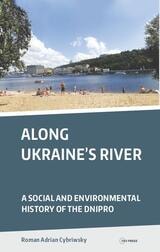
Along Ukraine's River
A Social and Environmental History of the DniproRoman Adrian Cybriwsky
Central European University Press, 2018
The River Dnipro (formerly better known by the Russian name of Dnieper) is intimately linked to the history and identity of Ukraine. Cybriwsky discusses the history of the river, from when it was formed and its many uses and modifications by human agencies from ancient times to the present.
From key vantage points along the river’s course—its source in western Russia, through Belarus and Ukraine, to the Black Sea—interesting stories shed light on past and present life in Ukraine. Scenes set along the river from Russian and Ukrainian literature are evoked, as well as musical compositions and works of art. Topics include the legacy of the region’s cultural ancestors as the Kyivan Rus, the period of Cossack dominion, the epic battles for the river’s bridges in World War II, the building of dams and huge reservoirs by the Soviet Union, and the crisis of Chornobyl (Chernobyl). The author argues that the Dnipro and the farmlands along it are Ukraine’s chief natural resources, and that the country's future depends on putting both to good use.
Written without academic pretence in an informal style with dashes of humor, Along Ukraine's River is illustrated with original line drawings, maps, and photographs.
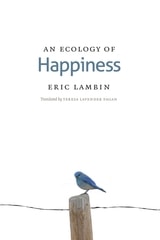
An Ecology of Happiness
Eric Lambin
University of Chicago Press, 2012
In this clever and wide-ranging work, Lambin draws on new scientific evidence in the fields of geography, political ecology, environmental psychology, urban studies, and disease ecology, among others, to answer such questions as: To what extent do we need nature for our well-being? How does environmental degradation affect our happiness? What can be done to protect the environment and increase our well-being at the same time? Drawing on case studies from Asia, Africa, Europe, and North America, Lambin makes a persuasive case for the strong link between healthy ecosystems and happy humans.
Unique in its scope and evenhanded synthesis of research from many fields, An Ecology of Happiness offers a compelling human-centered argument that is impossible to overlook when we marvel at murmurations of starlings or seek out the most brilliant fall foliage: nature makes our steps a little lighter and our eyes a little brighter. What better reason to protect an ecosystem or save a species than for our own pleasure?

An Essay for Ezra
Racial Terror in AmericaGrant Farred
University of Minnesota Press, 2021
An intensely personal, and philosophical, account of why white America’s racial unconscious is not so unconscious
An Essay for Ezra is a critique of terror that begins but by no means ends with the presidency of Donald J. Trump. A father addresses his son and a boy shares his observations in a dynamic dialogistic exchange that is a commentary of and for its time, taking the measure of racial terror and of white supremacy both in our moment and as a historical phenomenon.
Framed through the experiences of the author’s biracial son, An Essay for Ezra is intensely personal while also powerfully universal. Drawing on the social and political thought of James Baldwin and Martin Luther King, Grant Farred examines the temptation and the perils of essentialism and the need to discriminate—to engage the black mind as much as the black body. With that dialectic as his starting point, Farred engages the ideas of Jameson, Barthes, Derrida, Adorno, Kant, and other thinkers to derive an ethics of being in our time of social peril. His antiessentialist racial analysis is salient, especially when he deploys Dave Chappelle as a counterpoint to Baldwin—and Chappelle’s brilliant comic philosophic voice jabs at both racial and gender identity.
Standing apart for its willingness to explore terror in all its ambivalence, this theoretical reflection on racism, knowledge, ethics, and being in our neofascist present brings to bear the full weight of philosophical inquiry and popular cultural critique on black life in the United States.
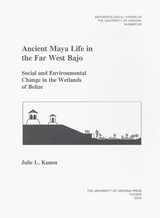
Ancient Maya Life in the Far West Bajo
Social and Environmental Change in the Wetlands of BelizeJulie L. Kunen
University of Arizona Press, 2004
In this lively story of life in the wetlands on the outskirts of the major site of La Milpa, Julie Kunen documents a hitherto unrecognized form of intensive agriculture in the Maya lowlands—one that relied on the construction of terraces and berms to trap soil and moisture around the margins of low-lying depressions called bajos. She traces the intertwined histories of residential settlements on nearby hills and ridges and agricultural terraces and other farming-related features around the margins of the bajo as they developed from the Late Preclassic perios (400 BC-AD 250) until the area's abandonment in the Terminal Classic period (about AD 850).
Kunen examines the organization of three bajo communities with respect to the use and management of resources critical to agricultural production. She argues that differences in access to spatially variable natural resources resulted in highly patterned settlement remains and that community founders and their descendents who had acquired the best quality and most diverse set of resources maintained an elevated status in the society.
The thorough integration of three lines of evidence—the settlement system, the agricultural system, and the ancient environment—breaks new ground in landscape research and in the study of Maya non-elite domestic organization. Kunen reports on the history of settlement and farming in a small corner of the Maya world but demonstrates that for any study of human-environment interactions, landscape history consists equally of ecological and cultural strands of influence.
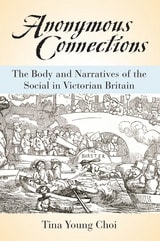
Anonymous Connections
The Body and Narratives of the Social in Victorian BritainTina Young Choi
University of Michigan Press, 2016
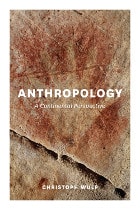
Anthropology
A Continental PerspectiveChristoph Wulf
University of Chicago Press, 2013

Archive Fever
A Freudian ImpressionJacques Derrida
University of Chicago Press, 1996
"Judaic mythos, Freudian psychoanalysis, and e-mail all get fused into another staggeringly dense, brilliant slab of scholarship and suggestion."—The Guardian
"[Derrida] convincingly argues that, although the archive is a public entity, it nevertheless is the repository of the private and personal, including even intimate details."—Choice
"Beautifully written and clear."—Jeremy Barris, Philosophy in Review
"Translator Prenowitz has managed valiantly to bring into English a difficult but inspiring text that relies on Greek, German, and their translations into French."—Library Journal

Archive Fever
A Freudian ImpressionJacques Derrida
University of Chicago Press, 1996
"Judaic mythos, Freudian psychoanalysis, and e-mail all get fused into another staggeringly dense, brilliant slab of scholarship and suggestion."—The Guardian
"[Derrida] convincingly argues that, although the archive is a public entity, it nevertheless is the repository of the private and personal, including even intimate details."—Choice
"Beautifully written and clear."—Jeremy Barris, Philosophy in Review
"Translator Prenowitz has managed valiantly to bring into English a difficult but inspiring text that relies on Greek, German, and their translations into French."—Library Journal
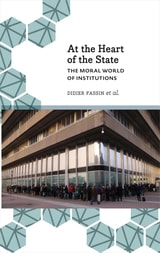
At the Heart of the State
The Moral World of InstitutionsDidier Fassin, et al.
Pluto Press, 2015
The state is often regarded as an abstract and neutral bureaucratic entity. Against this common sense idea, At the Heart of the State argues that it is also a concrete and situated reality, embodied in the work of its agents and inscribed in the issues of its time.
The result of a five-year investigation conducted by ten scholars, this book describes and analyses the police, the court system, the prison apparatus, the social services, and mental health facilities in France. Combining genealogy and ethnography, its authors show that these state institutions do not simply implement laws, rules and procedures: they mobilise values and affects, judgements and emotions. In other words, they reflect the morality of the state.
Of immense interest to both social scientists and political theorists, this work will make an important contribution to the ever expanding literature on the contemporary state.
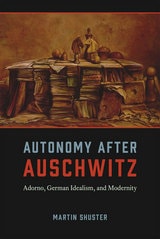
Autonomy After Auschwitz
Adorno, German Idealism, and ModernityMartin Shuster
University of Chicago Press, 2014
Shuster uncovers dangers in the notion of autonomy as it was originally conceived by Kant. Putting Adorno into dialogue with a range of European philosophers, notably Kant, Hegel, Horkheimer, and Habermas—as well as with a variety of contemporary Anglo-American thinkers such as Richard Rorty, Stanley Cavell, John McDowell, and Robert Pippin—he illuminates Adorno’s important revisions to this fraught concept and how his different understanding of autonomous agency, fully articulated, might open up new and positive social and political possibilities. Altogether, Autonomy after Auschwitz is a meditation on modern evil and human agency, one that demonstrates the tremendous ethical stakes at the heart of philosophy.