Results by title
116 books match the query 'Social Services & Welfare' and 6 start with a

A Home of Another Kind
One Chicago Orphanage and the Tangle of Child WelfareKenneth Cmiel
University of Chicago Press, 1995
The book begins with the fascinating history of the Chicago Nursery and Half-Orphan Asylum from 1860 through 1984, when it became a full-time research institute. Founded by a group of wealthy volunteers, the asylum was a Protestant institution for Protestant children—one of dozens around the country designed as places where single parents could leave their children if they were temporarily unable to care for them.
But the asylum, which later became known as Chapin Hall, changed dramatically over the years as it tried to respond to changing policies, priorities, regulations, and theories concerning child welfare. Cmiel offers a vivid portrait of how these changes affected the day-to-day realities of group living. How did the kind of care given to the children change? What did the staff and management hope to accomplish? How did they define "family"? Who were the children who lived in the asylum? What brought them there? What were their needs? How did outside forces change what went on inside Chapin Hall?
This is much more than a richly detailed account of one institution. Cmiel shatters a number of popular myths about orphanages. Few realize that almost all children living in nineteenth-century orphanages had at least one living parent. And the austere living conditions so characteristic of the orphanage were prompted as much by health concerns as by strict Victorian morals.

A Nation of Takers
America’s Entitlement EpidemicNicholas Eberstadt
Templeton Press, 2012

A Social Laboratory for Modern France
The Musée Social and the Rise of the Welfare StateJanet R. Horne
Duke University Press, 2001
Horne explains how Musée founders believed—and convinced others to believe—that the Third Republic would carry out the social mission of the French Revolution and create a new social contract for modern France, one based on the rights of citizenship and that assumed collective responsibility for the victims of social change. Challenging the persistent notion of the Third Republic as the stagnant backwater of European social reform, Horne instead depicts the intellectually sophisticated and progressive political culture of a generation that laid the groundwork for the rise of a hybrid welfare system, characterized by a partnership between private agencies and government. With a focus on the cultural origins of turn-of-the-century thought—including religion, republicanism, liberalism, solidarism, and early sociology—A Social Laboratory for Modern France demonstrates how French reformers grappled with social problems that are still of the utmost relevance today and how they initiated a process that gave the welfare state the task of achieving social cohesion within an industrializing republic.
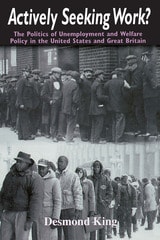
Actively Seeking Work?
The Politics of Unemployment and Welfare Policy in the United States and Great BritainDesmond King
University of Chicago Press, 1995
The goal of work-welfare policy in both countries has been to provide financial aid, training, and placement services for the unemployed. In order to muster support for these programs, however, work-welfare programs had to incorporate liberal requirements that they not interfere with private market forces, and that they prevent the "undeserving" from obtaining benefits. For King, the attempt to integrate these incompatible functions is the defining feature of British and American policies as well as the cause of their failure.

Administrative Burden
Policymaking by Other MeansPamela Herd
Russell Sage Foundation, 2018
Winner of the 2020 Outstanding Book Award Presented by the Public and Nonprofit Section of the National Academy of Management
Winner of the 2019 Louis Brownlow Book Award from the National Academy of Public Administration
Through in-depth case studies of federal programs and controversial legislation, the authors show that administrative burdens are the nuts-and-bolts of policy design. Regarding controversial issues such as voter enfranchisement or abortion rights, lawmakers often use administrative burdens to limit access to rights or services they oppose. For instance, legislators have implemented administrative burdens such as complicated registration requirements and strict voter-identification laws to suppress turnout of African American voters. Similarly, the right to an abortion is legally protected, but many states require women seeking abortions to comply with burdens such as mandatory waiting periods, ultrasounds, and scripted counseling. As Herd and Moynihan demonstrate, administrative burdens often disproportionately affect the disadvantaged who lack the resources to deal with the financial and psychological costs of navigating these obstacles.
However, policymakers have sometimes reduced administrative burdens or shifted them away from citizens and onto the government. One example is Social Security, which early administrators of the program implemented in the 1930s with the goal of minimizing burdens for beneficiaries. As a result, the take-up rate is about 100 percent because the Social Security Administration keeps track of peoples’ earnings for them, automatically calculates benefits and eligibility, and simply requires an easy online enrollment or visiting one of 1,200 field offices. Making more programs and public services operate this efficiently, the authors argue, requires adoption of a nonpartisan, evidence-based metric for determining when and how to institute administrative burdens, with a bias toward reducing them. By ensuring that the public’s interaction with government is no more onerous than it need be, policymakers and administrators can reduce inequality, boost civic engagement, and build an efficient state that works for all citizens.

Asylum, Prison, and Poorhouse
The Writings and Reform Work of Dorothea Dix in IllinoisDavid L. Lightner
Southern Illinois University Press, 1999
This illustrated collection of annotated newspaper articles and memorials by Dorothea Dix provides a forum for the great mid-nineteenth-century humanitarian and reformer to speak for herself.
Dorothea Lynde Dix (1802–87) was perhaps the most famous and admired woman in America for much of the nineteenth century. Beginning in the early 1840s, she launched a personal crusade to persuade the various states to provide humane care and effective treatment for the mentally ill by funding specialized hospitals for that purpose. The appalling conditions endured by most mentally ill inmates in prisons, jails, and poorhouses led her to take an active interest also in prison reform and in efforts to ameliorate poverty.
In 1846–47 Dix brought her crusade to Illinois. She presented two lengthy memorials to the legislature, the first describing conditions at the state penitentiary at Alton and the second discussing the sufferings of the insane and urging the establishment of a state hospital for their care. She also wrote a series of newspaper articles detailing conditions in the jails and poorhouses of many Illinois communities.
These long-forgotten documents, which appear in unabridged form in this book, contain a wealth of information on the living conditions of some of the most unfortunate inhabitants of Illinois. In his preface, David L. Lightner describes some of the vivid images that emerge from Dorothea Dix's descriptions of social conditions in Illinois a century and a half ago: "A helpless maniac confined throughout the bitter cold of winter to a dark and filthy pit. Prison inmates chained in hallways and cellars because no more men can be squeezed into the dank and airless cells. Aged paupers auctioned off by county officers to whoever will maintain them at the lowest cost."
Lightner provides an introduction to every document, placing each memorial and newspaper article in its proper social and historical context. He also furnishes detailed notes, making these documents readily accessible to readers a century and a half later. In his final chapter, Lightner assesses both the immediate and the continuing impact of Dix's work.