Results by title
84 books match the query 'Special education' and 11 start with a
A Constant Struggle
Deaf Education in New South Wales Since World War IINaomi Malone
Gallaudet University Press, 2019
A Nation Empowered, Volume 1
Evidence Trumps the Excuses Holding Back America's Brightest StudentsSusan G. Assouline, Nicholas Colangelo, Joyce VanTassel-Baska, Mary Sharp
University of Iowa Press, 2015
Volume 1 and 2 of A Nation Empowered: Evidence Trumps the Excuses Holding Back America's Brightest Students equips students, families, and educators with facts to refute biased excuses. A Nation Empowered shifts the impetus from conversation to action. Empowerement galvanizes determination with evidence. Volume 1 portrays the determination of students, educators, and parents to strive for excellence. Volume 2 reveals the evidence that trumps the excuses that hold bright students back.
A Nation Empowered, Volume 2
Evidence Trumps the Excuses Holding Back America's Brightest StudentsSusan G. Assouline, Nicholas Colangelo, Joyce VanTassel-Baska, and Ann Lupkowski-Shoplik
University of Iowa Press, 2015
Volume 1 and 2 of A Nation Empowered: Evidence Trumps the Excuses Holding Back America's Brightest Students equips students, families, and educators with facts to refute biased excuses. A Nation Empowered shifts the impetus from conversation to action. Empowerement galvanizes determination with evidence. Volume 1 portrays the determination of students, educators, and parents to strive for excellence. Volume 2 reveals the evidence that trumps the excuses that hold bright students back.
Accountability-Based Reforms
The Impact on Deaf and Hard of Hearing StudentsStephanie W. Cawthon
Gallaudet University Press, 2011
For years, school reform efforts targeted either students in regular education or those with special needs, but not both. As a result of the No Child Left Behind legislation (NCLB) and its focus on accountability, administrators established policies that would integrate the needs of students who previously were served under separate frameworks. Using the NCLB structure as a starting point, Stephanie W. Cawthon’s new book Accountability-Based Reforms: The Impact on Deaf and Hard of Hearing Students discusses key assumptions behind accountability reforms. She specifically examines how elements of these reforms affect students who are deaf or hard of hearing, their teachers, and their families.
Cawthon begins by providing a brief introduction to the deaf education context, offering detailed information on student demographics, settings, and academic outcomes for deaf students. She then outlines the evolution of accountability-based education reforms, following with a chapter on content standards, assessment accommodations, accountability as sanctions, and students with disabilities. The remaining chapters in Accountability-Based Reforms closely examine educational professionals, accountability, and students who are deaf or hard of hearing; school choice policies and parents; and deaf education and measures of success. Each chapter presents an overview of an important component of accountability reform, available research, and how it has been implemented in the United States. These chapters also offer recommendations for future action by educators, parents, researchers, and education policymakers.
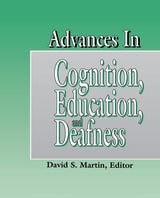
Advances in Cognition, Education, and Deafness
David S. Martin
Gallaudet University Press, 2001
The Second International Symposium on Cognition, Education, and Deafness in 1989 broadened and deepened the scope of investigation initiated at the first conference held five years earlier. Advances in Cognition, Education, and Deafness provides the results in a single integrated volume. The 39 scholars from 14 nations who attended offered consistent progress from the first symposium and new areas of research, especially in the study of applications in education and the new field of neuro-anatomical dimensions of cognition and deafness.
This important book has been organized under six major themes: Cognitive Assessment; Language and Cognition; Cognitive Development; Neuroscientific Issues; Cognitive Processes; and Cognitive Intervention Programs. This useful study also features programs designed to facilitate the learning of deaf individuals in cognitive realms, and questions about methodological problems facing researchers in deafness.
Advances in Cognition, Education, and Deafness also synthesizes this wealth of data with the added value of the objective perspective of a cognitive psychologist not directly involved in the field of deafness. Teachers, students, scholars, and researchers will consider this an indispensable reference for years to come.
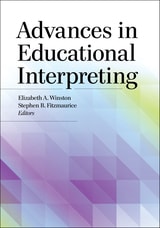
Advances in Educational Interpreting
Elizabeth A. Winston
Gallaudet University Press, 2021
Winston and Fitzmaurice argue massive systemic paradigm shifts in interpreted educations are as needed now as they were when the first volume was published, and that these changes require the collaborative efforts of everyone on the educational team, including: administrators, general education teachers, teachers of the deaf, interpreters, and counselors. The contributors to this volume address research-based challenges and make recommendations for how interpreting practitioners, and all members of the educational team, can enact meaningful changes in their work towards becoming part of a more comprehensive solution to deaf education.
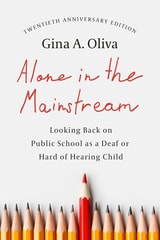
Alone in the Mainstream
Looking Back on Public School as a Deaf or Hard of Hearing ChildGina A. Oliva
Gallaudet University Press, 2024
In Alone in the Mainstream, author Gina A. Oliva documents her experience as a “solitaire,” the only deaf or hard of hearing student in her school. Oliva felt alone because she couldn’t communicate easily with her classmates and because she had no peers who shared a similar experience. As an adult, when she began her career at Gallaudet University, she realized that she wasn’t alone and that her experience was widely shared with other mainstreamed students. She decided to write about this commonality and invited other solitaires to reflect on their own experiences in emails and essays. Collective themes of isolation, low expectations, and low self-esteem emerged. Alone in the Mainstream blends Oliva’s personal narrative with the reflections of sixty other solitaires and makes the case that deaf and hard of hearing children need each other.
This twentieth anniversary edition is a reminder that little has changed for deaf and hard of hearing students in public school settings. Oliva brings this new edition up to date with observations, resources, and discussion questions that accompany her appeal for all deaf and hard of hearing children and their families to have access to sign language, to develop a deaf identity, and to be part of a deaf community.
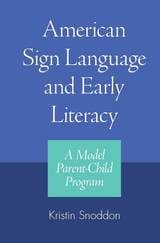
American Sign Language and Early Literacy
A Model Parent-Child ProgramKristin Snoddon
Gallaudet University Press, 2012
The usual definition of the term “literacy” generally corresponds with mastering the reading and writing of a spoken language. This narrow scope often engenders unsubstantiated claims that print literacy alone leads to, among other so-called higher-order thinking skills, logical and rational thinking and the abstract use of language. Thus, the importance of literacy for deaf children in American Sign Language (ASL) is marginalized, asserts author Kristin Snoddon in her new book American Sign Language and Early Literacy: A Model Parent-Child Program. As a contrast, Snoddon describes conducting an ethnographic, action study of the ASL Parent-Child Mother Goose program, provided by a Deaf service agency in Ontario, Canada to teach ASL literacy to deaf children.
According to current scholarship, literacy is achieved through primary discourse shared with parents and other intimates, which establishes a child’s initial sense of identity, culture, and vernacular language. Secondary discourse derives from outside agents and interaction, such as expanding an individual’s literacy to other languages. Snoddon writes that the focus of the ASL Parent-Child Mother Goose program is on teaching ASL through rhymes and stories and some facets of the culture of Deaf ASL users. This focus enabled hearing parents to impart first-language acquisition and socialization to their deaf children in a more natural primary discourse as if the parents were Deaf themselves. At the same time, hearing parents experience secondary discourses through their exposure to ASL and Deaf culture.
Snoddon also comments on current infant hearing screening and early intervention and the gaps in these services. She discusses gatekeeper individuals and institutions that restrict access to ASL for young Deaf children and their families. Finally, she reports on public resources for supporting ASL literacy and the implications of her findings regarding the benefits of early ASL literacy programming for Deaf children and their families.
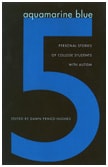
Aquamarine Blue 5
Personal Stories of College Students with AutismDawn Prince-Hughes
Ohio University Press, 2002
Rated Outstanding by the American Association of School Libraries
This is the first book to be written by autistic college students about the challenges they face. Aquamarine Blue 5 details the struggle of these highly sensitive students and shows that there are gifts specific to autistic students that enrich the university system, scholarship, and the world as a whole.
Dawn Prince-Hughes presents an array of writings by students who have been diagnosed with Asperger’s Syndrome or High-Functioning Autism, showing their unique ways of looking at and solving problems. In their own words, they portray how their divergent thinking skills could be put to great use if they were given an opportunity. Many such students never get the chance because the same sensitivity that gives them these insights makes the flicker of fluorescent lights and the sound of chalk on the board unbearable For simple—and easily remedied—reasons, we lose these students, who are as gifted as they are challenged.
Aquamarine Blue 5 is a showcase of the strength and resilient character of individuals with Asperger’s Syndrome. It will be an invaluable resource for those touched by this syndrome, their friends and families, and school administrators.
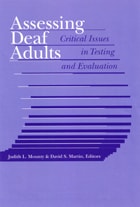
Assessing Deaf Adults
Critical Issues in Testing and EvaluationJudith L. Mounty
Gallaudet University Press, 2005
Section I frames the contexts facing deaf and hard of hearing individuals and those who test them, including a telling historical perspective. In Section II, chapters explore how deaf and hard of hearing candidates can meet the rigors of test-taking, how to level the playing field with a new approach to assessment, and what to consider to develop fully accessible licensing tests. The final chapter in this part examines the psychometric properties of intellectual assessments when used with deaf and hard of hearing people. Administrative Issues constitute Section III, beginning with legal considerations related to equity testing for deaf adults. An exploration of the potential of sign language interpretation in the testing environment follows.
Section IV provides case studies of deaf and hard of hearing adults from a variety of professions, including certification testing for therapeutic recreation, preparation strategies for university students, and ways to maximize access to licensure for social workers. A separate chapter addresses the impact of recent federal mandates on assessment of deaf and hard of hearing teachers and teaching candidates. The final section summarizes the current situation and presents recommendations to manage it, concluding with an epilogue on directions for the future.
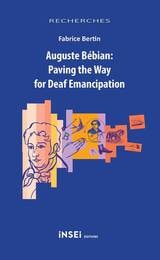
Auguste Bébian
Paving the Way for Deaf EmancipationFabrice Bertin
Gallaudet University Press, 2024
To some, he is a mythical figure; to others, he is unknown. Auguste Bébian (1789-1839) reflects society’s ambivalence toward Deaf history: sometimes recognized, often ignored. In the wake of Abbé de l’Épée, whose name is remembered in posterity and who demonstrated that the large-scale education of Deaf people was possible, Auguste Bébian was nonetheless a key player in an unprecedented upheaval, which in many ways went beyond the educational sphere. The goal of this research on Auguste Bébian, combining biographical elements and analysis of his thinking in unprecedented ways, is not to deconstruct the myth, but rather to decipher the messages it conveys, and to understand what it tells us, indirectly, about the Deaf experience.
Born in 1789 in Guadeloupe, part of the French West Indies, it was on the other side of the Atlantic Ocean, in France, that Auguste Bébian fulfilled most of his destiny. While living at the National Institution for the Deaf in Paris at the beginning of the 19th century, his daily contact with the young students made him the first known hearing person in France to achieve true mastery of sign language, the natural language of Deaf people, and a deep understanding of its inherent culture. On becoming a teacher, he constantly defended the use of sign language as a linguistic system in its own right in order to awaken the intelligence of Deaf children, to whom “we pay no more attention than to the sunlight that shines on us every day.” His numerous publications display a level of modernity rarely seen before or since. This biographical and historical study shows how the passion evinced by Auguste Bébian was a crucial link in the chain of events that led to the emancipation of Deaf people.