Results by title
75 books match the query 'Syntax' and 7 start with a
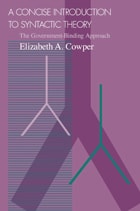
A Concise Introduction to Syntactic Theory
The Government-Binding ApproachElizabeth A. Cowper
University of Chicago Press, 1992
"Cowper exhibits the analytical devices of current principles-and-parameters approaches, takes readers carefully through the central elements of grammatical theory (including very recent work), and ushers them selectively into the technical literature. . . . A serious introduction for those who want to know the nuts and bolts of syntactic theory and to see why linguists are so excited these days."—David Lightfoot, University of Maryland
"An excellent short introduction to the Government and Binding model of syntactic theory. . . . Cowper's work succeeds in teaching syntactic argumentation and in showing the conceptual reasons behind specific proposals in modern syntactic theory."—Jaklin Kornfilt, Syracuse University
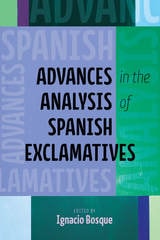
Advances in the Analysis of Spanish Exclamatives
Ignacio Bosque
The Ohio State University Press, 2017
The book begins by summarizing, commenting on, and evaluating previous descriptive and theoretical contributions on Spanish exclamatives. This introductory overview also contains a detailed classification of Spanish exclamative grammatical types, along with an analysis of their main properties. Special attention is devoted in the book throughoutto the syntactic structures displayed by exclamative patterns; the differences between exclamations and other speech acts (specifically questions and imperatives); the peculiar semantic denotation of exclamative words and their relationship to quantifiers denoting high degree; the semantics of adjectives and adverbs expressing extreme evaluation; the form and interpretation of negated and embedded exclamatives; the properties of optative utterances; and the different ways in which expressive contents are related to unexpected reactions of the speaker, as well as possible knowledge shared by interlocutors.
This groundbreaking volume provides a complete and accurate picture of Spanish exclamation by integrating its numerous component parts.
Analytic Syntax
Otto Jespersen
University of Chicago Press, 1984
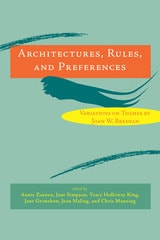
Architectures, Rules, and Preferences
Variations on Themes by Joan W. BresnanEdited by Annie Zaenen
CSLI, 2007
Aspects of Old English Poetic Syntax
WHERE CLAUSES BEGINMary Blockley
University of Illinois Press, 2001
Distinguished by a remarkable combination of erudition and lucidity, Aspects of Old English Poetic Syntax provides new insight into the rules that govern syntactic relationships and indicates how these rules differ for prose and verse. Blockley considers the functions of four of the most common and most syntactically important words in Old English, as well as such features of clauses as verb-initial order, negative contraction, and unexpressed but understood subjects. Picking up where Bruce Mitchell's classic Old English Syntax left off, Blockley shows how such common words and structures mark the relationships between phrases and clauses.
Blockley also considers how the poetic tradition compensated for the loss in written texts of the syntactic functions served by intonation and inflection. Arguing that verse relied instead on a prescriptively regulated, unambiguous syntax, she suggests principles that promise more complex and subtle interpretations of familiar texts such as Beowulf as well as a wealth of other Old English writings.
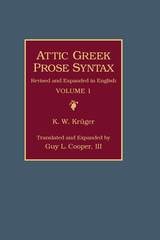
Attic Greek Prose Syntax
Revised and Expanded in English, Volume 1K. W. Kruger
University of Michigan Press, 1998
The language of classical Greek literature has been extensively studied since the Renaissance, and the most generally admired approach to Greek grammar and syntax has long been K. W. Krüger's Griechische Sprachlehre. In this translation Guy L. Cooper III accepts Krüger's simple and transparent organization, but greatly expands the substance of the earlier work by increasing the total number of citations from the original texts. Research since 1875, especially the contributions of Basil Lanneau Gildersleeve, is incorporated so as to create a reference work, in English, which covers the full range of this complex subject.
Krüger's original paragraph numbering has been maintained so that references in previously published works can be followed directly in the new work. However, every paragraph and chapter has been revised and expanded, opening up new subheadings within Krüger's format. The English has moved away from Krüger's laconic style to a more flowing, readable presentation, without jargon and unexplained technical language. A complete index of passages cited and the impressive number of citations make the work a running syntactic commentary on the whole range of Attic prose literature. The net result is a new comprehensive reference work, an essential reference for libraries and personal collections alike.
Guy L. Cooper III is Professor Emeritus of Classics, University of North Carolina at Asheville.
Volume 2
cloth ISBN 0-472-10844-1
Set of Volumes 1 & 2
cloth ISBN 0-472-10844-1
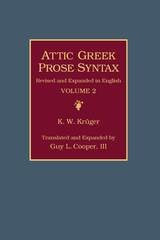
Attic Greek Prose Syntax
Revised and Expanded in English, Volume 2K. W. Kruger
University of Michigan Press, 1998
The language of classical Greek literature has been extensively studied since the Renaissance, and the most generally admired approach to Greek grammar and syntax has long been K. W. Krüger's Griechische Sprachlehre. In this translation Guy L. Cooper III accepts Krüger's simple and transparent organization, but greatly expands the substance of the earlier work by increasing the total number of citations from the original texts. Research since 1875, especially the contributions of Basil Lanneau Gildersleeve, is incorporated so as to create a reference work, in English, which covers the full range of this complex subject.
Krüger's original paragraph numbering has been maintained so that references in previously published works can be followed directly in the new work. However, every paragraph and chapter has been revised and expanded, opening up new subheadings within Krüger's format. The English has moved away from Krüger's laconic style to a more flowing, readable presentation, without jargon and unexplained technical language. A complete index of passages cited and the impressive number of citations make the work a running syntactic commentary on the whole range of Attic prose literature. The net result is a new comprehensive reference work, an essential reference for libraries and personal collections alike.
Guy L. Cooper III is Professor Emeritus of Classics, University of North Carolina at Asheville.