Results by title
56 books match the query 'Thought' and 7 start with a
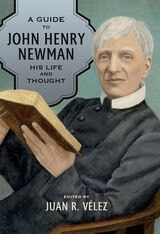
A Guide to John Henry Newman
His Life and ThoughtJuan R. Velez
Catholic University of America Press, 2022
John Henry Newman (1801-1890), renowned thinker and writer, Anglican clergyman and later Roman Catholic priest and cardinal, has had a lasting influence on both Anglicans and Catholics, in the fields of literature, education, and theology. On October 13, 2019, Pope Francis declared him a saint in Rome.
Appealing to both the student and the scholar, A Guide to John Henry Newman provides a wide range of subjects on Newman’s life and thought relevant for our times and complementary to biographies of Newman. The contributors include authors from many different disciplines such as theology, education, literature, history, and philosophy, highlighting the wide range of Newman’s work. These authors offer a positive assessment of Newman’s thought and contribute to the discussion of the recent scholarship of others.
A Guide to John Henry Newman will interest educated readers and professors alike, and serve as a text for college seminars for the purpose of studying Newman.
[more]
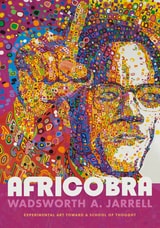
AFRICOBRA
Experimental Art toward a School of ThoughtWadsworth A. Jarrell
Duke University Press, 2020
Formed on the South Side of Chicago in 1968 at the height of the civil rights, Black power, and Black arts movements, the AFRICOBRA collective created a new artistic visual language rooted in the culture of Chicago's Black neighborhoods. The collective's aesthetics, especially the use of vibrant color, capture the rhythmic dynamism of Black culture and social life. In AFRICOBRA, painter, photographer, and collective cofounder Wadsworth A. Jarrell tells the definitive story of the group's creation, history, and artistic and political principles. From accounts of the painting of the groundbreaking Wall of Respect mural and conversations among group members to documentation of AFRICOBRA's exhibits in Chicago, New York, and Boston, Jarrell outlines how the collective challenged white conceptions of art by developing an artistic philosophy and approach wholly divested of Western practices. Featuring nearly one hundred color images of artworks, exhibition ephemera, and photographs, this book is at once a sourcebook history of AFRICOBRA and the story of visionary artists who rejected the white art establishment in order to create uplifting art for all Black people.
[more]
An African Perspective on the Thought of Benedict XVI
Agbaw-ebai
St. Augustine's Press, 2023
Catholicism continues to experience an exponential growth in Africa. Going by the figures and the intensity of religious practice, Africa can unarguably be described as the new center of the Christianity in general, and Catholicism in particular. With over 236 million Catholics, Africa considers itself as having come of age and capable of making its voice heard on matters pertaining to global Catholicism/Christianity. And if there is a contemporary theologian greatly loved and admired by African scholars, Joseph Ratzinger/Benedict XVI ranks premium on that list. His convening a second synod on Africa on the theme of justice, peace and reconciliation, further endeared him to the African theologians. This book is a testimony to the affection that the Church in Africa has for Benedict XVI. In effect, as Africa finds its voice on the stage of global Catholicism, the theology of Joseph Ratzinger/Benedict XVI provides a fruitful space for Africa's engagement with the wider Church. Benedict XVI described Africa as the spiritual lung of the world. This volume testifies to the vitality and healthiness of that lung, a must read for all interested in African Catholicism and its definite impact on global Christianity as a whole.
[more]
An Imaginative Whig
Reassessing the Life and Thought of Edmund BurkeEdited & Intro by Ian Crowe
University of Missouri Press, 2005
This collection of essays shifts the focus of scholarly debate away from the themes that have traditionally dominated the study of Edmund Burke. In the past, largely ideology-based or highly textual studies have tended to paint Burke as a “prophet” or “precursor” of movements as diverse as conservatism, political pragmatism, and romanticism. In contrast, these essays address prominent issues in contemporary society—multiculturalism, the impact of postmodern and relativist methodologies, the boundaries of state-church relationships, and religious tolerance in modern societies—by emphasizing Burke’s earlier career and writings and focusing on his position on historiography, moral philosophy, jurisprudence, aesthetics, and philosophical skepticism.
The essays in this collection, written by some of today’s most renowned Burke scholars, will radically challenge our deeply rooted assumptions about Burke, his thought, and his place in the history of Western political philosophy.
[more]
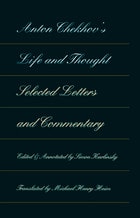
Anton Chekhov's Life and Thought
Selected Letters and CommentariesAnton Chekhov
Northwestern University Press, 1996
First published in 1973, this collection of Chekhov's correspondence is widely regarded as the best introduction to this great Russian writer. Weighted heavily toward the correspondence dealing with literary and intellectual matters, this extremely informative collection provides fascinating insight into Chekhov's development as a writer. Michael Henry Heim's excellent translation and Simon Karlinsky's masterly headnotes make this volume an essential text for anyone interested in Chekhov.
[more]
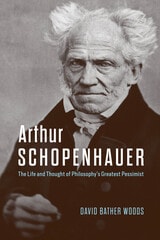
Arthur Schopenhauer
The Life and Thought of Philosophy’s Greatest PessimistDavid Bather Woods
University of Chicago Press, 2025
An engaging biography of one of the most influential Western philosophers and a thought-provoking exploration of how to live with Arthur Schopenhauer’s pessimism.
Arthur Schopenhauer (1788–1860) almost wasn’t one of the greatest philosophers of the nineteenth century. Born in the Free City of Danzig to a family of shipping merchants, he was destined for a life of imports and exports until his father died in a suspected suicide. After much deliberation, the young Schopenhauer invested his inheritance in himself and his philosophical vocation. But the long road to recognition was a difficult one, with Schopenhauer spending all but the last decade of his life in total obscurity. Yet his ideas and style went on to influence great thinkers, including Friedrich Nietzsche, Ludwig Wittgenstein, and Sigmund Freud, as well as artists such as the composer Richard Wagner and writers Marcel Proust, Thomas Mann, Samuel Beckett, and many more.
A singular and remarkably influential thinker, Schopenhauer is usually described as an extreme pessimist. He questioned the purpose of existence in a world where pain and suffering are inescapable and happiness is all too brief. In this engaging philosophical biography, David Bather Woods reevaluates Schopenhauer’s pessimism in the context of his life experiences, revealing the philosopher’s relentless fascination with the world and making a case for his contemporary relevance. Bather Woods weaves together Schopenhauer’s ideas with the story of how he came to be, including such topics as love, loneliness, morality, politics, gender, sexuality, death, suicide, fame, and madness. In doing so, this book answers some of life’s most challenging questions about how to deal with pain and loss, and how to live with ourselves and each other.
Despite his pessimistic outlook on human existence, Schopenhauer didn’t give up on life. Rather, he recognized that the question of how to live becomes even more pressing, and he worked to provide an answer. Bather Woods shows how Schopenhauer’s life informed his ideas and how they still resonate today.
[more]
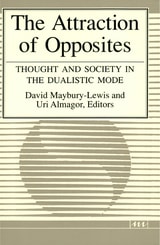
Attraction of Opposites
Thought and Society in the Dualistic ModeDavid Maybury-Lewis and Uri Almagor, Editors
University of Michigan Press, 1989
The Attraction of Opposites considers a puzzling phenomenon: Why do societies all over the world organize their social thought and institutions in patterns of opposites? The essays collected in this volume examine contemporary societies throughout the world that organize their social theories or institutions in binary form. Through analysis of these rich materials, the distinguished contributors explore the enduring human attraction to dualism. They consider whether this is due to the natural “twoness” of things and, if not, why polarity should play such a prominent role in both ancient cosmologies and modern philosophies, in early empires and in modern two-party systems. This study of dual organization tells us something important about human beings, illuminating a mode of thought and social organization that has represented an attractive option throughout human history.
[more]