Results by title
80 books match the query 'Transition' and 5 start with a
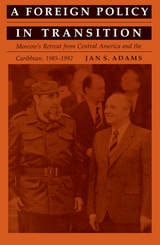
A Foreign Policy in Transition
Moscow's Retreat from Central America and the Carribbean, 1985-1992Jan S. Adams
Duke University Press, 1992
During his years of leadership in the Soviet Union, Mikhail Gorbachev initiated revolutionary changes in that country's foreign and domestic policies. A Foreign Policy in Transition charts the changing Soviet policies toward Central America and the Caribbean during the Gorbachev years, examines the effects of these policies on individual countries, and looks to the role that Russia and the other Soviet-successor states will play in this region in the 1990s.
Jan S. Adams analyzes the factors shaping Gorbachev's foreign policy in Central America by surveying Soviet political views old and new, by describing Gorbachev's bold restructuring of the Soviet foreign policy establishment, and by assessing the implications of his policy of perestroika. A series of country studies demonstrates how changes in Soviet policies and domestic and economic circumstances contributed to significant shifts in the internal conditions and external relations of the Central American and Caribbean nations. Adams discusses in detail such topics as the reduction of Soviet military and economic aid to the region and pressures exerted by Moscow on client states to effect the settlement of regional conflicts by political rather than military means.
The author concludes by speculating about which trends in foreign policy by Russia and other Soviet-successor states toward Central America and the Caribbean may persist in the post-Soviet period, discussing as the implications of these changes for future U.S. policy in the region.
[more]
Accidental Occidental
Economics and Culture of Transition in Mitteleuropa, the Baltic and the Balkan AreaLajos Bokros
Central European University Press, 2013
Besides providing a historical record of the long road from the economic agenda of the 1917 Bolshevik revolution to the present transition from communism, this book can be considered a staunch defense of market capitalism and liberal democracy. Any celebration of the current transition in Eastern Europe necessarily affirms the superiority of a market system over a non-market one and of a democratic system over a non-democratic one. The author does not deny the failures, shortcomings or imperfections of market economy and democracy. Nor does he take the survival of market capitalism and liberal democracy for granted. On the contrary, by highlighting the valiant and painful process of transition and attempting to understand its economics and culture, he seeks to contribute to the theoretical (academic) and practical (political) defense of Western civilization.
[more]

Altering States
Ethnographies of Transition in Eastern Europe and the Former Soviet UnionDaphne Berdahl, Matti Bunzl, and Martha Lampland, Editors
University of Michigan Press, 2000
The dominant focus in transition studies to date has been on economic and political factors -- analyses generally conducted at the national or international level. The essays in Altering States instead bring us a closer look at what has been happening in everyday life in urban contexts in Germany, the Czech Republic, Slovakia, Austria, Hungary, Romania, Armenia, and Russia. The contributors to the volume -- all anthropologists -- use ethnographic methods to make visible problems and challenges that have until now been obscured. From synagogue restoration in Eastern Europe to gay tourism in Prague to the politics of rock music in Hungary, specific, local topics lead the authors to confront difficult questions of individual agency and discursive practices in the move away from socialism. Broader themes touched on include race and ethnicity, sexuality and postcoloniality, the politics of environmental restoration, and memory and remembrance in the politics of history. Altering States will fill an important gap in the study of transition in Eastern Europe and the former Soviet Union. It will appeal to anthropologists, political scientists, and sociologists and will be accessible to undergraduate and graduate students alike.
[more]
American Women in Transition
Suzanne M. Bianchi
Russell Sage Foundation, 1986
This is the first in a series of eighteen projected volumes, to be published over the next two years, aimed at converting the vast statistical yield of the 1980 Census into authoritative analyses of major changes and trends in American life. A collaborative research effort, funded by public and private foundations, this series revives a tradition of independent Census analysis (the last such project was undertaken in 1960) and offers an unparalleled array of studies on various ethnic, geographic, and status dimensions of the U.S. population. It is entirely appropriate that the inaugural volume in this series should document trends in the status of American women. Dramatic social and demographic changes over the past two decades make American Women in Transition a landmark, an invaluable one-volume summary and assessment of women's move from the private domain to the public. Clearly and in detail, the authors describe women's increasing educational attainment and labor force participation, their lagging earning power, their continued commitment to marriage and family, and the "balancing act" necessitated by this overlap of roles. Supplementing 1980 Census data with even more recent surveys from the Census Bureau and other federal agencies, Bianchi and Spain are able to extend these trends into the 1980s and sketch the complex challenges posed by such lasting and historic changes. This definitive and sensitive study is certain to become a standard reference work on American women today, and an essential foundation for future scholarship and policy concerning the status of women in our society. A Volume in the Russell Sage Foundation Census Series
[more]
Araucanian Culture in Transition
Mischa Titiev
University of Michigan Press, 1951
In this classic work, renowned anthropologist Mischa Titiev presents his research on the Araucanian tribe of Chile. Based on fieldwork he did in 1948, he describes many aspects of the Araucanian culture, from land use and kinship to ceremonies and games. Illustrated.
[more]