Results by title
147 books match the query 'Urban & Land Use Planning' and 11 start with a
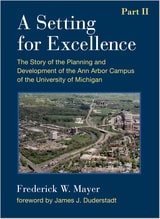
A Setting For Excellence, Part II
The Story of the Planning and Development of the Ann Arbor Campus of the University of MichiganFrederick W. Mayer
University of Michigan Press, 2017
By tracing the development of the Ann Arbor campus from its early days to the present, within the context of the evolution of higher education in America, Mayer provides a strong argument for the importance of rigorous and enlightened campus planning as a critical element of the learning environment of the university. His comprehensive history of campus planning, illustrated with photos, maps, and diagrams from Michigan’s history, is an outstanding contribution to the university’s history as it approaches its bicentennial.
Against the Commons
A Radical History of Urban PlanningÁlvaro Sevilla-Buitrago
University of Minnesota Press, 2022
An alternative history of capitalist urbanization through the lens of the commons
Characterized by shared, self-managed access to food, housing, and the basic conditions for a creative life, the commons are essential for communities to flourish and protect spaces of collective autonomy from capitalist encroachment. In a narrative spanning more than three centuries, Against the Commons provides a radical counterhistory of urban planning that explores how capitalism and spatial politics have evolved to address this challenge.
Highlighting episodes from preindustrial England, New York City and Chicago between the 1850s and the early 1900s, Weimar-era Berlin, and neoliberal Milan, Álvaro Sevilla-Buitrago shows how capitalist urbanization has eroded the egalitarian, convivial life-worlds around the commons. The book combines detailed archival research with provocative critical theory to illuminate past and ongoing struggles over land, shared resources, public space, neighborhoods, creativity, and spatial imaginaries.
Against the Commons underscores the ways urbanization shapes the social fabric of places and territories, lending particular awareness to the impact of planning and design initiatives on working-class communities and popular strata. Projecting history into the future, it outlines an alternative vision for a postcapitalist urban planning, one in which the structure of collective spaces is ultimately defined by the people who inhabit them.
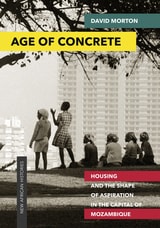
Age of Concrete
Housing and the Shape of Aspiration in the Capital of MozambiqueDavid Morton
Ohio University Press, 2019
Age of Concrete is a history of the making of houses and homes in the subúrbios of Maputo (Lourenço Marques), Mozambique, from the late 1940s to the present. Often dismissed as undifferentiated, ahistorical “slums,” these neighborhoods are in fact an open-air archive that reveals some of people’s highest aspirations. At first people built in reeds. Then they built in wood and zinc panels. And finally, even when it was illegal, they risked building in concrete block, making permanent homes in a place where their presence was often excruciatingly precarious.
Unlike many histories of the built environment in African cities, Age of Concrete focuses on ordinary homebuilders and dwellers. David Morton thus models a different way of thinking about urban politics during the era of decolonization, when one of the central dramas was the construction of the urban stage itself. It shaped how people related not only to each other but also to the colonial state and later to the independent state as it stumbled into being.
Original, deeply researched, and beautifully composed, this book speaks in innovative ways to scholarship on urban history, colonialism and decolonization, and the postcolonial state. Replete with rare photographs and other materials from private collections, Age of Concrete establishes Morton as one of a handful of scholars breaking new ground on how we understand Africa’s cities.
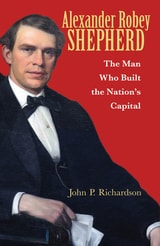
Alexander Robey Shepherd
The Man Who Built the Nation’s CapitalJohn P. Richardson
Ohio University Press, 2016
With Alexander Robey Shepherd, John P. Richardson gives us the first full-length biography of his subject, who as Washington, D.C.’s, public works czar (1871–74) built the infrastructure of the nation’s capital in a few frenetic years after the Civil War. The story of Shepherd is also the story of his hometown after that cataclysm, which left the city with churned-up streets, stripped of its trees, and exhausted.
An intrepid businessman, Shepherd became president of Washington’s lower house of delegates at twenty-seven. Garrulous and politically astute, he used every lever to persuade Congress to realize Peter L’Enfant’s vision for the capital. His tenure produced paved and graded streets, sewer systems, trees, and gaslights, and transformed the fetid Washington Canal into one of the city’s most stately avenues. After bankrupting the city, a chastened Shepherd left in 1880 to develop silver mines in western Mexico, where he lived out his remaining twenty-two years.
In Washington, Shepherd worked at the confluence of race, party, region, and urban development, in a microcosm of the United States. Determined to succeed at all costs, he helped force Congress to accept its responsibility for maintenance of its stepchild, the nation’s capital city.
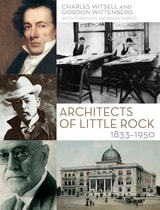
Architects of Little Rock
1833-1950Charles Witsell
University of Arkansas Press, 2014
Published in collaboration with the Fay Jones School of Architecture.
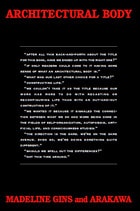
Architectural Body
Madeline Gins and Shusaku Arakawa
University of Alabama Press, 2002
This revolutionary work by artist-architects Arakawa and Madeline Gins demonstrates the inter-connectedness of innovative architectural design, the poetic process, and philosophical inquiry. Together, they have created an experimental and widely admired body of work--museum installations, landscape and park commissions, home and office designs, avant-garde films, poetry collections--that challenges traditional notions about the built environment. This book promotes a deliberate use of architecture and design in dealing with the blight of the human condition; it recommends that people seek architectural and aesthetic solutions to the dilemma of mortality.
In 1997 the Guggenheim Museum presented an Arakawa/Gins retrospective and published a comprehensive volume of their work titled Reversible Destiny: We Have Decided Not to Die. Architectural Body continues the philosophical definition of that project and demands a fundamental rethinking of the terms “human” and “being.” When organisms assume full responsibility for inventing themselves, where they live and how they live will merge. The artists believe that a thorough re-visioning of architecture will redefine life and its limitations and render death passe. The authors explain that “Another way to read reversible destiny . . . Is as an open challenge to our species to reinvent itself and to desist from foreclosing on any possibility.”
Audacious and liberating, this volume will be of interest to students and scholars of 20th-century poetry, postmodern critical theory, conceptual art and architecture, contemporary avant-garde poetics, and to serious readers interested in architecture's influence on imaginative expression.
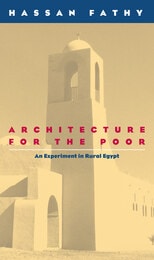
Architecture for the Poor
An Experiment in Rural EgyptHassan Fathy
University of Chicago Press, 1976
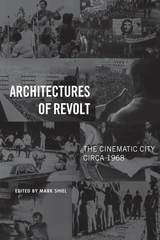
Architectures of Revolt
The Cinematic City circa 1968Mark Shiel
Temple University Press, 2018
Coinciding with the fiftieth anniversary of the worldwide mass protest movements of 1968—against war, imperialism, racism, poverty, misogyny, and homophobia—the exciting anthology Architectures of Revolt explores the degree to which the real events of political revolt in the urban landscape in 1968 drove change in the attitudes and practices of filmmakers and architects alike.
In and around 1968, as activists and filmmakers took to the streets, commandeering public space, buildings, and media attention, they sought to re-make the urban landscape as an expression of utopian longing or as a dystopian critique of the established order. In Architectures of Revolt, the editor and contributors chronicle city-specific case studies from Paris, Berlin, Milan, and Chicago to New York, Los Angeles, Mexico City, and Tokyo. The films discussed range from avant-garde and agitprop shorts to mainstream narrative feature films. All of them share a focus on the city and, often, particular streets and buildings as places of political contestation and sometimes violence, which the medium of cinema was uniquely equipped to capture.
Contributors include: Stephen Barber, Stanley Corkin, Jesse Lerner, Jon Lewis, Gaetana Marrone, Jennifer Stob, Andrew Webber, and the editor.
Atlanta Unbound
Enabling Sprawl through Policy and PlanningCarlton Wade Basmajian
Temple University Press, 2015
Autophobia
Love and Hate in the Automotive AgeBrian Ladd
University of Chicago Press, 2008
Avenues of Translation
The City in Iberian and Latin American WritingGalasso, Regina
Bucknell University Press, 2019
Cities both near and far communicate in a variety of ways. Travel between, through, and among urban centers initiates contact, and cities themselves are sites of ever-changing cultural and historical encounters. Predictable and surprising challenges and opportunities arise when city borders are crossed, voices meet, and artistic traditions find their counterparts. Using the Latin word for “translation,” translatio, or “to carry across,” as a point of departure, Avenues of Translation explores how translation perpetuates, diversifies, deepens, and expands the literary production of cities in their greater cultural context, and how translation shapes an understanding of and access to a city's past and present literary and cultural practices. Thinking about translation and the city is a way to tell the backstories of the cities, texts, and authors that are united by acts of translation.
Published by Bucknell University Press. Distributed worldwide by Rutgers University Press.