Results by title
122 books match the query 'Voices' and 5 start with a

A Captive Audience
Voices of Japanese American Youth in World War II ArkansasAli Welky
Butler Center for Arkansas Studies, 2015
Intended for young-adult readers, this book explores important dimensions of Arkansas and U.S. history, including human rights and what it means to be an American.

A Dialogue of Voices
Feminist Literary Theory and BakhtinKaren Hohne and Helen Wussow, Editors
University of Minnesota Press, 1994
A Dialogue of Voices was first published in 1994. Minnesota Archive Editions uses digital technology to make long-unavailable books once again accessible, and are published unaltered from the original University of Minnesota Press editions.
The work of the Russian theorist Mikhail Bakhtin, particularly his notions of dialogics and genre, has had a substantial impact on contemporary critical practices. Until now, however, little attention has been paid to the possibilities and challenges Bakhtin presents to feminist theory, the task taken up in A Dialogue of Voices. The original essays in this book combine feminism and Bakhtin in unique ways and, by interpreting texts through these two lenses, arrive at new theoretical approaches. Together, these essays point to a new direction for feminist theory that originates in Bakhtin-one that would lead to a feminine être rather than a feminine écriture.
Focusing on feminist theorists such as Hélène Cixous, Teresa de Lauretis, Julia Kristeva, and Monique Wittig in conjunction with Bakhtin's concepts of dialogism, heteroglossia, and chronotope, the authors offer close readings of texts from a wide range of multicultural genres, including nature writing, sermon composition, nineteenth-century British women's fiction, the contemporary romance novel, Irish and French lyric poetry, and Latin American film. The result is a unique dialogue in which authors of both sexes, from several countries and different eras, speak against, for, and with one another in ways that reveal their works anew as well as the critical matrices surrounding them.Karen Hohne is an independent scholar and artist living in Moorhead, Minnesota. Helen Wussow is an assistant professor of English at Memphis State University.
A Leaf of Voices
Stories of the American Civil War in the Words of Those Who Lived and Died, 1861-65Jennifer McSpadden
Indiana Historical Society Press, 2014
A Nation within a Nation
Voices of the Oneidas in WisconsinL. Gordon McLester III
Wisconsin Historical Society Press, 2010
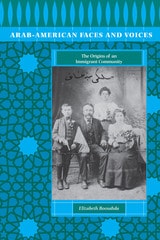
Arab-American Faces and Voices
The Origins of an Immigrant CommunityBy Elizabeth Boosahda
University of Texas Press, 2003
As Arab Americans seek to claim their communal identity and rightful place in American society at a time of heightened tension between the United States and the Middle East, an understanding look back at more than one hundred years of the Arab-American community is especially timely. In this book, Elizabeth Boosahda, a third-generation Arab American, draws on over two hundred personal interviews, as well as photographs and historical documents that are contemporaneous with the first generation of Arab Americans (Syrians, Lebanese, Palestinians), both Christians and Muslims, who immigrated to the Americas between 1880 and 1915, and their descendants.
Boosahda focuses on the Arab-American community in Worcester, Massachusetts, a major northeastern center for Arab immigration, and Worcester's links to and similarities with Arab-American communities throughout North and South America. Using the voices of Arab immigrants and their families, she explores their entire experience, from emigration at the turn of the twentieth century to the present-day lives of their descendants. This rich documentation sheds light on many aspects of Arab-American life, including the Arab entrepreneurial motivation and success, family life, education, religious and community organizations, and the role of women in initiating immigration and the economic success they achieved.