Results by title
130 books match the query 'Women's rights' and 8 start with a
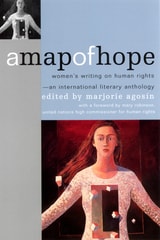
A Map of Hope
Women's Writing on Human Rights—An International Literary AnthologyAgosín, Marjorie
Rutgers University Press, 1999
The first international anthology to explore women’s human rights from a literary perspective.
More than half a century after the United Nations Declaration of Human Rights, women throughout the world still struggle for social and political justice. Many fight back with the only tools of resistance they possess—words. A Map of Hope presents a collection of 77 extraordinary literary works documenting the ways women writers have spoken out about human rights issues.
Writers young and old, known and unknown, explore the dimensions of terror, the unspeakable atrocities of war, and the possibilities of resistance and refusal against all odds. Their poems, essays, memoirs, and brief histories examine issues that affect the condition of women in war, prison camps, exile, and as victims of domestic and political violence.
A Map of Hope presents diverse women writers who have created a literature of global consciousness and justice. Their works give a face, an image, and a human dimension to the dehumanization of human rights violations. The collection allows readers to hear voices that have decided to make a difference. It goes beyond geography and ethnic groups; writers from around the globe are united by the universal dimensions of horror and deprivation, as well as the unique common struggle for justice and solidarity.
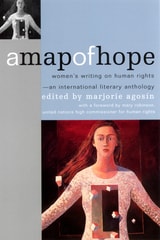
A Map of Hope
Women's Writing on Human Rights—An International Literary AnthologyAgosín, Marjorie
Rutgers University Press, 1999
The first international anthology to explore women’s human rights from a literary perspective.
More than half a century after the United Nations Declaration of Human Rights, women throughout the world still struggle for social and political justice. Many fight back with the only tools of resistance they possess—words. A Map of Hope presents a collection of 77 extraordinary literary works documenting the ways women writers have spoken out about human rights issues.
Writers young and old, known and unknown, explore the dimensions of terror, the unspeakable atrocities of war, and the possibilities of resistance and refusal against all odds. Their poems, essays, memoirs, and brief histories examine issues that affect the condition of women in war, prison camps, exile, and as victims of domestic and political violence.
A Map of Hope presents diverse women writers who have created a literature of global consciousness and justice. Their works give a face, an image, and a human dimension to the dehumanization of human rights violations. The collection allows readers to hear voices that have decided to make a difference. It goes beyond geography and ethnic groups; writers from around the globe are united by the universal dimensions of horror and deprivation, as well as the unique common struggle for justice and solidarity.
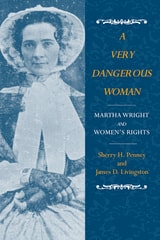
A Very Dangerous Woman
Martha Wright and Women's RightsSharon H. Penney
University of Massachusetts Press, 2004
In telling Wright's story, the authors make good use of her lively letters to her family, friends, and colleagues, including Susan B. Anthony and Elizabeth Cady Stanton. These letters reveal Wright's engaging wit and offer an insider's view of nineteenth-century reform and family life. Her correspondence with slaveholding relatives in the South grew increasingly contentious with the approach of the Civil War. One nephew became a hero of the Confederacy with his exploits at the Battle of Fredericksburg, and her son in the Union artillery was seriously wounded at Gettysburg while repelling Pickett's Charge.
Wright's life never lacked for drama. She survived a shipwreck, spent time at a frontier fort, experienced the trauma of the deaths of a fiancé, her first husband, and three of her seven children, and navigated intense conflicts within the women's rights and abolition movements. Throughout her tumultuous career, she drew on a reservoir of humor to promote her ideas and overcome the many challenges she faced. This accessible biography, written with the general reader in mind, does justice to her remarkable life.
A Voice Of Their Own
The Woman Suffrage Press, 1840-1910Martha Solomon
University of Alabama Press, 1991
Abortion Rights as Religious Freedom
Peter S. Wenz
Temple University Press, 1992
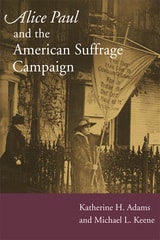
Alice Paul and the American Suffrage Campaign
Katharine H. Adams and Michael L. Keene
University of Illinois Press, 2007
Past biographies, histories, and government documents have ignored Alice Paul's contribution to the women's suffrage movement, but this groundbreaking study scrupulously fills the gap in the historical record. Masterfully framed by an analysis of Paul's nonviolent and visual rhetorical strategies, Alice Paul and the American Suffrage Campaign narrates the remarkable story of the first person to picket the White House, the first to attempt a national political boycott, the first to burn the president in effigy, and the first to lead a successful campaign of nonviolence.
Katherine H. Adams and Michael L. Keene also chronicle other dramatic techniques that Paul deftly used to gain publicity for the suffrage movement. Stunningly woven into the narrative are accounts of many instances in which women were in physical danger. Rather than avoid discussion of Paul's imprisonment, hunger strikes, and forced feeding, the authors divulge the strategies she employed in her campaign. Paul's controversial approach, the authors assert, was essential in changing American attitudes toward suffrage.
Angelina Grimke
Rhetoric, Identity, and the Radical ImaginationStephen H. Browne
Michigan State University Press, 1999
Abolitionist, women's rights activist, and social reformer, Angelina Grimké (1805-79) was among the first women in American history to seize the public stage in pursuit of radical social reform. "I will lift up my voice like a trumpet," she proclaimed, "and show this people their transgressions." And when she did lift her voice in public, on behalf of the public, she found that, in creating herself, she might transform the world. In the process, Grimké crossed the wires of race, gender, and power, and produced explosions that lit up the world of antebellum reform. Among the most remarkable features of Angelina Grimké's rhetorical career was her ability to stage public contests for the soul of America—bringing opposing ideas together to give them voice, depth, and range to create new and more compelling visions of social change.
Angelina Grimké: Rhetoric, Identity, and the Radical Imagination is the first full-length study to explore the rhetorical legacy of this most unusual advocate for human rights. Stephen Browne examines her epistolary and oratorical art and argues that rhetoric gave Grimké a means to fashion not only her message but her very identity as a moral force.
Apology for the Woman Writing and Other Works
Marie le Jars de Gournay
University of Chicago Press, 2002
This volume presents translations of four of Gournay's works that address feminist issues. Two of these appear here in English for the first time—The Promenade of Monsieur de Montaigne and The Apology for the Woman Writing. One of the first modern psychological novels, the best-selling Promenade was also the first to explore female sexual feeling. With the autobiographical Apology, Gournay defended every aspect of her life, from her moral conduct to her household management. The book also includes Gournay's last revisions (1641) of her two best-known feminist treatises, The Equality of Men and Women and The Ladies' Complaint. The editors provide a general overview of Gournay's career, as well as individual introductions and extensive annotations for each work.