Results by title
52 books match the query 'Women in motion pictures' and 4 start with a
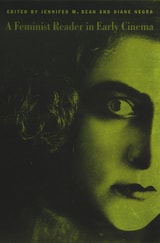
A Feminist Reader in Early Cinema
Jennifer M. Bean and Diane Negra, eds.
Duke University Press, 2002
While fostering new ways of thinking about film history, A Feminist Reader in Early Cinema illuminates the many questions that the concept of "early cinema" itself raises about the relation of gender to modernism, representation, and technologies of the body. The contributors bring a number of disciplinary frameworks to bear, including not only film studies but also postcolonial studies, dance scholarship, literary analysis, philosophies of the body, and theories regarding modernism and postmodernism.
Reflecting the stimulating diversity of early cinematic styles, technologies, and narrative forms, essays address a range of topics—from the dangerous sexuality of the urban flâneuse to the childlike femininity exemplified by Mary Pickford, from the Shanghai film industry to Italian diva films—looking along the way at birth-control sensation films, French crime serials, "war actualities," and the stylistic influence of art deco. Recurring throughout the volume is the protean figure of the New Woman, alternately garbed as childish tomboy, athletic star, enigmatic vamp, languid diva, working girl, kinetic flapper, and primitive exotic.
Contributors. Constance Balides, Jennifer M. Bean, Kristine Butler, Mary Ann Doane, Lucy Fischer, Jane Gaines, Amelie Hastie, Sumiko Higashi, Lori Landay, Anne Morey, Diane Negra, Catherine Russell, Siobhan B. Somerville, Shelley Stamp, Gaylyn Studlar, Angela Dalle Vacche, Radha Vatsal, Kristen Whissel, Patricia White, Zhang Zhen
A Fine Romance
Five Ages of Film FeminismPatricia Mellencamp
Temple University Press, 1996
Aftershocks of the New
Feminism and Film HistoryPetro, Patrice
Rutgers University Press, 2001
The beginning of this century has brought with it a host of assumptions about the newness of our technologies, globalized economies, and transnational media practices. Our own time is a period marked by experiences of fragmentation, sensation, and shock. The essays here are joined by a common concern to chart another side to modernity—precisely after the shock of the new—when the new ceases to be shocking, and when the extraordinary and the sensational become linked to the boring and the everyday. Patrice Petro explores how the mechanisms of modernism, German cinema, and feminist film theory have evolved, and she discusses the directions in which they are headed.
Petro’s essays—some published here for the first time—raise such questions as: What roles do television and other media play in film studies? What is the place of feminist film theory in our conceptions of film history? How is German film theory situated within international film theory?
Rather than continue to sensationalize sensation, Aftershocks of the New aims to lower the volume of debates over the place of cinema within the culture of modernity. And it accomplishes this by locating them within a more complex matrix of contending sensibilities, voices, and impulses.
Art in the Cinematic Imagination
By Susan Felleman
University of Texas Press, 2006
Bringing an art historical perspective to the realm of American and European film, Art in the Cinematic Imagination examines the ways in which films have used works of art and artists themselves as cinematic and narrative motifs. From the use of portraits in Vertigo to the cinematic depiction of women artists in Artemisia and Camille Claudel, Susan Felleman incorporates feminist and psychoanalytic criticism to reveal individual and collective perspectives on sex, gender, identity, commerce, and class.
Probing more than twenty films from the postwar era through contemporary times, Art in the Cinematic Imagination considers a range of structurally significant art objects, artist characters, and art-world settings to explore how the medium of film can amplify, reinvent, or recontextualize the other visual arts. Fluently speaking across disciplines, Felleman's study brings a broad array of methodologies to bear on questions such as the evolution of the "Hollywood Love Goddess" and the pairing of the feminine with death on screen.
A persuasive approach to an engaging body of films, Art in the Cinematic Imagination illuminates a compelling and significant facet of the cinematic experience.