Results by title
28164 books match the query 'History' and 2536 start with a
A Political History of the Texas Republic, 1836-1845
By Stanley Siegel
University of Texas Press, 1956
This book is unique among the histories of the Texas Republic: it is the first to examine the fledgling nation from the point of view of its dynamic political life. Policies with far-reaching results were formulated in the nine years of Texas' independence, and the author clearly presents the many thorny issues that were to plague Texas for generations.
The political history of the Republic is one of strong figures vying with each other for popular support of their divergent policies. The author details the personal feuds and animosities that resulted and shows the effects of these differences on the governing of the nation. Thoughtful use of diaries, memoirs, and other contemporary sources gives the reader an excellent understanding of the sense of personal concern the citizens of the Republic felt toward the political issues of the day.
A Politics of Virtue
Hinduism, Sexuality, and Countercolonial Discourse in FijiJohn D. Kelly
University of Chicago Press, 1991
changing conditions of political possibility by examining the
connection between politics and sexual morality in the British
colony of Fiji from 1929 to 1932.

A Populist Assault
Sarah E. Van De Vort Emery on American Democracy 1862–1895Pauline Adams and Emma Thornton
University of Wisconsin Press, 1982
Sarah E. Van De Vort Emery, a Michigan woman transplanted from the Finger Lakes region of New York, was for many years a voice for Populism in the late 19th century. Emery was a woman who believed and acted on her beliefs that freedom and the flowering of the human potential should not five way to the demands of the "money power."
A Portal to Paradise
Alden C. Hayes
University of Arizona Press, 1999
From his vantage point near the tiny twin communities of Portal and Paradise on the eastern slopes of the Chiricahuas, Hayes brings the famous and the not-so-famous together in a profile of this striking landscape, showing how place can be a powerful formative influence on people's lives. When Hayes first arrived in 1941 to manage his new father-in-law's apple orchard, he met folks who had been born in Arizona before it became a state. Even if most had never personally worried about Indian attacks, they had known people who had. Over the years, Hayes heard the handed-down stories about the area's early days of Anglo settlement. He also researched census records, newspaper archives, and the files of the Arizona Historical Society to uncover the area's natural history, prehistory, Spanish and Mexican regimes, and particularly its Anglo history from the mid nineteenth century to the beginning of World War II. His book is a rich account of the region and more, a celebration of rural life, brimming with tales of people whose stories were shaped by the landscape.
Today the Chiricahuas are a magnet for outdoor enthusiasts and the site of the American Museum of Natural History's Southwestern Research Station—and still a rugged area that remains off the beaten track. Hayes brings his straightforward and articulate style to this captivating account of earlier days in southeastern Arizona and opens up a portal to paradise for readers everywhere.
A Portrait in Four Movements
The Chicago Symphony under Barenboim, Boulez, Haitink, and MutiAndrew Patner
University of Chicago Press, 2019
The Chicago Symphony Orchestra has been led by a storied group of conductors. And from 1994 to 2015, through the best work of Daniel Barenboim, Pierre Boulez, Bernard Haitink, and Riccardo Muti, Andrew Patner was right there. As a classical music critic for the Chicago Sun-Times and WFMT radio, Patner was able to trace the arc of the CSO’s changing repertories, all while cultivating a deep rapport with its four principal conductors.
This book assembles Patner’s reviews of the concerts given by the CSO during this time, as well as transcripts of his remarkable radio interviews with these colossal figures. These pages hold tidbits for the curious, such as Patner’s “driving survey” that playfully ranks the Maestri he knew on a scale of “total comfort” to “fright level five,” and the observation that Muti appears to be a southpaw on the baseball field. Moving easily between registers, they also open revealing windows onto the sometimes difficult pasts that brought these conductors to music in the first place, including Boulez’s and Haitink’s heartbreaking experiences of Nazi occupation in their native countries as children. Throughout, these reviews and interviews are threaded together with insights about the power of music and the techniques behind it—from the conductors’ varied approaches to research, preparing scores, and interacting with other musicians, to how the sound and personality of the orchestra evolved over time, to the ways that we can all learn to listen better and hear more in the music we love. Featuring a foreword by fellow critic Alex Ross on the ethos and humor that informed Patner’s writing, as well as an introduction and extensive historical commentary by musicologist Douglas W. Shadle, this book offers a rich portrait of the musical life of Chicago through the eyes and ears of one of its most beloved critics.
A Portrait of Abraham Lincoln
Eyewitness AccountsEdited by Jonathan W. White, Lainey Hostetler, and Alanna Griffin, with a foreword by Michael Burlingame
University of Illinois Press, 2027
Deeply researched and accessible, A Portrait of Abraham Lincoln is a valuable collection for anyone interested in a towering historical figure.
A Power Stronger Than Itself
The AACM and American Experimental MusicGeorge E. Lewis
University of Chicago Press, 2008
Founded in 1965 and still active today, the Association for the Advancement of Creative Musicians (AACM) is an American institution with an international reputation. George E. Lewis, who joined the collective as a teenager in 1971, establishes the full importance and vitality of the AACM with this communal history, written with a symphonic sweep that draws on a cross-generational chorus of voices and a rich collection of rare images.
Moving from Chicago to New York to Paris, and from founding member Steve McCall’s kitchen table to Carnegie Hall, A Power Stronger Than Itself uncovers a vibrant, multicultural universe and brings to light a major piece of the history of avant-garde music and art.
A Power to Do Justice
Jurisdiction, English Literature, and the Rise of Common LawBradin Cormack
University of Chicago Press, 2008
A Power to Do Justice shows how Renaissance writers engaged the practical and conceptual dynamics of jurisdiction, both as a subject for critical investigation and as a frame for articulating literature’s sense of itself. Reassessing the relation between English literature and law from More to Shakespeare, Cormack argues that where literary texts attend to jurisdiction, they dramatize how boundaries and limits are the very precondition of law’s power, even as they clarify the forms of intensification that make literary space a reality.
Tracking cultural responses to Renaissance jurisdictional thinking and legal centralization, A Power to Do Justice makes theoretical, literary-historical, and methodological contributions that set a new standard for law and the humanities and for the cultural history of early modern law and literature.
A Pragmatic Alliance
Jewish-Lithuanian political cooperation at the beginning of the 20th centuryVladas Sirutavicius
Central European University Press, 2011
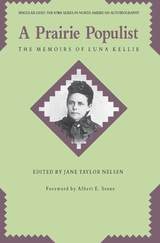
A Prairie Populist
The Memoirs of Luna KellieJane Taylor Nelsen
University of Iowa Press, 1992
Kellie actively sought to organize Nebraska into cooperatives and educate rural people about land, transportation, and money reform. Her compelling, often heartbreaking memoirs—written on the backs of ornate red-and-gold Farmers' Alliance certificates in 1925—give us her own description of how she became motivated to join the Alliance and participate in the Populist party. Kellie writes of her homesteading and political life from the age of eighteen to forty, of failed crops, mortgaged fields, intense hardships, and her devastation at the death of her children.

A Preface to Theology
W. Clark Gilpin
University of Chicago Press, 1996
Gilpin approaches this goal indirectly, by investigating the historic social roles of Protestant theologians and the educational institutions in which they have pursued their scholarship and teaching. Ranging from analyses of the New England Puritan Cotton Mather to contemporary theologians as "public intellectuals," Gilpin proposes that we find out what theology is by asking what theologians do.
By showing how particular cultural problems have always shaped the work of theologians, Gilpin's work profoundly illuminates the foundations of American academic theology, providing insights that will help guide its future.
A Prehistoric Sequence in the Middle Pecos Valley, New Mexico
Arthur J. Jelinek
University of Michigan Press, 1967
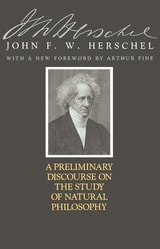
A Preliminary Discourse on the Study of Natural Philosophy
John F. W. Herschel
University of Chicago Press, 1987
"Herschel's book . . . brilliantly analyzes both the history and nature of science."—Keith Stewart Thomson, American Scientist

A Prelude to the Welfare State
The Origins of Workers' CompensationPrice V. Fishback and Shawn Everett Kantor
University of Chicago Press, 2000
In this highly original and persuasive work, Price V. Fishback and Shawn Everett Kantor challenge widespread historical perceptions, arguing that, rather than being an early progressive victory, workers' compensation succeeded because all relevant parties—labor and management, insurance companies, lawyers, and legislators—benefited from the legislation. Thorough, rigorous, and convincing, A Prelude to the Welfare State: The Origins of Workers' Compensation is a major reappraisal of the causes and consequences of a movement that ultimately transformed the nature of social insurance and the American workplace.
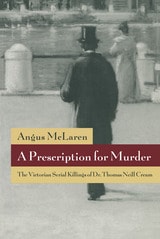
A Prescription for Murder
The Victorian Serial Killings of Dr. Thomas Neill CreamAngus McLaren
University of Chicago Press, 1993
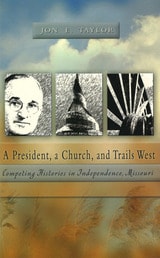
A President, a Church and Trails West
Competing Histories in Independence, MissouriJon E. Taylor
University of Missouri Press, 2008
Over the past century, three nationally significant histories have vied for space and place in Independence, Missouri. Independence was declared Zion by Joseph Smith, served as a gathering and provisioning point for trails west, and was called home by President Harry S. Truman for sixty-four years. Historian Jon E. Taylor has integrated research from newspapers, public documents, oral histories, and private papers to detail how the community has preserved and remembered these various legacies.
Truman’s legacy would appear to have been secured in Independence via three significant designations—his presidential library opened there in 1957, his neighborhood was designated a national historic landmark in 1972, and his home was declared a national historic site in 1982. However, Taylor argues that Truman’s seeming dominance in the community’s memory is in fact endangered by competition from the other aspects of the town’s historical heritage.
Taylor considers the role Mormon history has played in the city's history and chronicles how the Reorganized Church of Jesus Christ of Latter Day Saints returned to Independence to fulfill Joseph Smith's dream of creating Zion in the city, a situation that impacted neighborhoods near the Truman home. Taylor also examines the city's fascination with the Santa Fe, Oregon, and California trails, detailing how that history was lost and remembered and is now immortalized on the Independence square and in the National Frontier Trails Museum.
In the 1980s, the city council reduced the size of the Truman Heritage District, created to maintain Truman’s association with his neighborhood, after church opposition. At the same time, city officials pushed to make Independence a major tourist destination, a move largely dependent upon the city capitalizing on its association with Truman. These inconsistent policies and incongruous goals have led to innumerable changes in the landscape Truman enjoyed during his legendary morning walks.
A President, a Church, and Trails West chronicles one city’s struggle to preserve its history and the built environment. Taylor places the role of preservation in Independence not only within the larger context of preservation in the United States but also within the context of American environmental history. This volume is sure to appeal to anyone interested in public history, historic preservation, history and memory, and local history.
A Presidential Civil Service
FDR's Liaison Office for Personnel ManagementMordecai Lee
University of Alabama Press, 2016
Revealing the overlooked agency that transformed presidential personnel management and modern federal governance.
A Presidential Civil Service offers a comprehensive and definitive study of President Franklin Delano Roosevelt’s Liaison Office for Personnel Management (LOPM). Established in 1939 following the release of Roosevelt’s Brownlow Committee report, LOPM became a key milestone in the evolution of the contemporary executive-focused civil service.
The Progressive Movement of the nineteenth and early twentieth centuries comprised groups across the political spectrum with quite different. All, however, agreed on the need for a politically autonomous and independent federal Civil Service Commission (CSC) to eliminate patronage and political favoritism. In A Presidential Civil Service, public administration scholar Mordecai Lee explores two models open to later reformers: continuing a merit-based system isolated from politics or a management-based system subordinated to the executive and grounded in the growing field of managerial science.
Roosevelt’s 1937 Brownlow Committee, formally known as the President’s Committee on Administrative Management, has been widely studied including its recommendation to disband the CSC and replace it with a presidential personnel director. What has never been documented in detail was Roosevelt’s effort to implement that recommendation over the objections of Congress by establishing the LOPM as a nonstatutory agency.
The role and existence of LOPM from 1939 to 1945 has been largely dismissed in the history of public administration. Lee’s meticulously researched A Presidential Civil Service, however, persuasively shows that LOPM played a critical role in overseeing personnel policy. It was involved in every major HR initiative before and during World War II. Though small, the agency’s deft leadership almost always succeeded at impelling the CSC to follow its lead.
Roosevelt’s actions were in fact an artful and creative victory, a move finally vindicated when, in 1978, Congress abolished the CSC and replaced it with an Office of Personnel Management headed by a presidential appointee. A Presidential Civil Service offers a fascinating account and vital reassessment of the enduring legacy of Roosevelt’s LOPM.
A Primer for Teaching African History
Ten Design PrinciplesTrevor R. Getz
Duke University Press, 2018
A Primer for Teaching Digital History
Ten Design PrinciplesJennifer Guiliano
Duke University Press, 2022

A Primer for Teaching Environmental History
Ten Design PrinciplesEmily Wakild and Michelle K. Berry
Duke University Press, 2018
A Primer for Teaching Indian Ocean World History
Ten Design PrinciplesEdward A. Alpers and Thomas F. McDow
Duke University Press, 2024
A Primer for Teaching Pacific Histories
Ten Design PrinciplesMatt K.Matsuda
Duke University Press, 2020

A Primer for Teaching Women, Gender, and Sexuality in World History
Ten Design PrinciplesMerry E. Wiesner-Hanks and Urmi Engineer Willoughby
Duke University Press, 2018
A Primer for Teaching World History
Ten Design PrinciplesAntoinette Burton
Duke University Press, 2012

A Prison in the Woods
Environment and Incarceration in New York's North CountryClarence Jefferson Hall
University of Massachusetts Press, 2020
Clarence Jefferson Hall Jr. reveals that the introduction of correctional facilities—especially in the last three decades of the twentieth century—unearthed long-standing conflicts over the proper uses of Adirondack nature, particularly since these sites have contributed to deforestation, pollution, and habitat decline, even as they've provided jobs and spurred economic growth. Additionally, prison plans have challenged individuals' commitment to environmental protection, tested the strength of environmental regulations, endangered environmental and public health, and exposed tensions around race, class, place, and belonging in the isolated prison towns of America's largest state park.
A Private War
An American Code Officer in the Belgian CongoRobert Laxalt
University of Nevada Press, 1998
In this vivid memoir, Laxalt recalls his service during WWII as a code officer in the Belgian Congo. In this remote jungle outpost, a secret war was being fought for control of the world’s future. Deep in the Congo lay a mine that produced a little-known substance called uranium, and for reasons no one then understood, the Allies and the Germans were struggling ferociously to control this mine and its ore. The cloth edition is a limited numbered, signed edition.
A Privilege of Intellect
Conscience and Wisdom in Newman’s NarrativeD. A. Drennen
University of Scranton Press, 2010
Based on decades of research, A Privilege of Intellect is D. A. Drennen’s portrait of the English cardinal John Henry Newman (1801–90), whose conversion to the Roman Catholic Church in 1845 significantly boosted the presence of the Catholic Church in England and caused many Anglicans to follow his example. Newman—who will be beatified this fall—devoted his life both to the Church and to the university, demonstrating that religious faith and intellectual pursuits could exist in harmony. Drennen’s biography combines theology with psychology and philosophy and will appeal to anyone interested in the history of the Church of England and the Roman Catholic Church.
A Prodigy's Calling
The Early Musical Biography of Cosmas Magaya, Zimbabwean Mbira MasterPaul F. Berliner
University of Chicago Press, 2024
Ethnomusicologist Paul F. Berliner has been studying Zimbabwean mbira for more than fifty years. When he first arrived in what was then Rhodesia after the nation declared independence from the United Kingdom, he met Cosmas Magaya, a mbira player who would become his teacher and lifelong collaborator. A Prodigy’s Calling chronicles the early years of Magaya’s life, documenting the master mbira player’s journey from child prodigy to established expert. As a child, Magaya was immersed in mbira music through his father’s work as a healer and spirit medium. As Magaya grew, so too did his world; his performances extended beyond the family compound as his skill and knowledge increased, bringing him into contact with a society fraught with decolonial conflict.
Following Magaya’s childhood, readers will learn how his upbringing guided his journey through the community’s social networks and how his early sensibilities, proclivities, and talents shaped his development. At the same time, his deepening engagement with music and the ancestors was affected by overlapping tensions between Shona cosmology and Christian ideology, rural and urban lifestyles, and the escalating African nationalist struggle and the white supremacist state. While Magaya’s story reflects profound social changes in the nation, it is also a story of musical apprenticeship. Readers following Magaya’s discovery of ever finer details in the music’s richly layered patterns will enhance their ability to hear mbira music’s forms, variations, and sonic qualities. Linocut illustrations by South African artist Lucas Bambo bring the narrative to life, and Berliner’s spirited storytelling is accompanied by QR codes that take readers directly to recordings of music as Magaya learns it. Appendices for musicians interested in learning or improving their mbira playing complement the story of Magaya’s early life. Inviting the reader into the very tradition it recounts, the book offers intimate insights into the relationships among music, Shona cosmology, and colonial politics in everyday life.

A Professional Professoriate
Unionization, Bureaucratization, and the AAUPPhilo A. Hutcheson
Vanderbilt University Press, 2000
Hutcheson examines how tensions between the requirements of institutional bureaucracies and the norms of the academic profession resulted in contentiousness and conflict within the national AAUP, between administrators and faculty members on individual campuses, within the ranks of faculties themselves, and even deep in the consciences of many concerned individuals. The book analyzes the association's ability to respond effectively and to balance the values of collegial representation with the powers of collective bargaining. It thus offers a detailed and authoritative examination of the AAUP's search for ways to sustain professionalism while dealing with the fundamental changes in the nature of the professoriate in the post-World War II era.
A Professor at the End of Time
The Work and Future of the ProfessoriateBest, John
Rutgers University Press, 2017

A Professor in the Wilderness
Peter Damian Before the Gregorian ReforJohn Howe
Catholic University of America Press, 2027
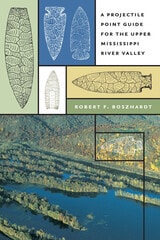
A Projectile Point Guide for the Upper Mississippi River Valley
Robert F. Boszhardt
University of Iowa Press, 2003
The most common relics of the 12,000-year occupancy of the Upper Mississippi River Valley may be the chipped stone projectile points that Native Americans fastened to the ends of their spears, darts, and arrow shafts. This useful guide provides a key to identifying the various styles of points found along the Upper Mississippi River in the Driftless region stretching roughly from Dubuque, Iowa, to Red Wing, Minnesota, but framed within a somewhat larger area extending from the Rock Island Rapids at the modern Moline-Rock Island area to the Falls of St. Anthony at Minneapolis-St. Paul.
Logging tens of thousands of miles and visiting private collectors from all walks of life since 1982, Robert Boszhardt has documented thousands of projectile points found in this region. In addition to drawings of each style, he provides other accepted names as well as names of related points, age, distribution, a description (including length and width), material, and references for each type. The guide is meant for the many avocational archaeologists who collect projectile points in the Upper Midwest and will be a useful reference tool for professional field archaeologists as well.
Emphasizing the preservation of sites as well as a mutual exchange of information between professional and avocational archaeologists, this guide will reveal projectile points as clues to the past, time markers which embody crucial information about the cultures of the Mississippi River Valley's early inhabitants.
A Promise And A Way Of Life
White Antiracist ActivismBecky Thompson
University of Minnesota Press, 2001
The first in-depth look at white people’s activism in fighting racism during the past fifty years.
Not since the Civil Rights Movement of the 1950s and 1960s, when many white college students went south to fight against Jim Crow laws, has white antiracist activity held the public’s attention. Yet there have always been white people involved in fighting racism. In this passionate work, Becky Thompson looks at white Americans who have struggled against racism, offering examples of both successes and failures, inspirations, practical philosophies, and a way ahead.
A Promise and a Way of Life weaves an account of the past half-century based on the life histories of thirty-nine people who have placed antiracist activism at the center of their lives. Through a rich and fascinating narrative that links individual experiences with social and political history, Thompson shows the ways, both public and personal, in which whites have opposed racism during several social movements: the Civil Rights and Black Power movements, multiracial feminism, the Central American peace movement, the struggle for antiracist education, and activism against the prison industry. Beginning with the diverse catalysts that started these activists on their journeys, this book demonstrates the contributions and limitations of white antiracism in key social justice movements.
Through these stories, crucial questions are raised: Does antiracist work require a repudiation of one’s whiteness or can that identity be transformed through political commitment and alliances? What do white people need to do to undermine white privilege? What would it take to build a multiracial movement in which white people are responsible for creating antiracist alliances while not co-opting people of color?
Unique in its depth and thoroughness, A Promise and a Way of Life is essential for anyone currently fighting racism or wondering how to do so. Through its demonstration of the extraordinary personal and social transformations ordinary people can make, it provides a new paradigm for movement activity, one that will help to incite and guide future antiracist activism.
A Promise at Sobibór
A Jewish Boy’s Story of Revolt and Survival in Nazi-Occupied PolandPhilip “Fiszel” Bialowitz, with Joseph Bialowitz; Foreword by Wladyslaw Bartoszewski
University of Wisconsin Press, 2012
A Promise at Sobibór is the story of Fiszel Bialowitz, a teenaged Polish Jew who escaped the Nazi gas chambers. Between April 1942 and October 1943, about 250,000 Jews from European countries and the Soviet Union were sent to the Nazi death camp at Sobibór in occupied Poland. Sobibór was not a transit camp or work camp: its sole purpose was efficient mass murder. On October 14, 1943, approximately half of the 650 or so prisoners still alive at Sobibór undertook a daring and precisely planned revolt, killing SS officers and fleeing through minefields and machine-gun fire into the surrounding forests, farms, and towns. Only about forty-two of them, including Fiszel, are known to have survived to the end of the war.
Philip (Fiszel) Bialowitz, now an American citizen, tells his eyewitness story here in the real-time perspective of his own boyhood, from his childhood before the war and his internment in the brutal Izbica ghetto to his harrowing six months at Sobibór—including his involvement in the revolt and desperate mass escape—and his rescue by courageous Polish farmers. He also recounts the challenges of life following the war as a teenaged displaced person, and his eventual efforts as a witness to the truth of the Holocaust.
In 1943 the heroic leaders of the revolt at Sobibór, Sasha Perchersky and Leon Feldhendler, implored fellow prisoners to promise that anyone who survived would tell the story of Sobibór: not just of the horrific atrocities committed there, but of the courage and humanity of those who fought back. Bialowitz has kept that promise.
Best Books for General Audiences, selected by the American Association for School Libraries
Best Books for High Schools, selected by the American Association for School Libraries
Best Books for Special Interests, selected by the Public Library Association
A Promise in Haiti
A Reporter's Notes on Families and Daily LivesMark Curnutte
Vanderbilt University Press, 2011
A Promise in Haiti is Curnutte's story of his time, spanning the last decade, living among several families in Gonaives, a city of 200,000 people a hundred kilometers north of Port-au-Prince. He began traveling to Haiti as a volunteer with the aid organization Hands Together, eventually building trust and credibility with many Haitians. Curnutte introduces the reader to the Cenecharles family, strained by entrenched unemployment and the need to continually travel for work. He is invited into the home of the Henrisma family, and is forced to reconcile journalistic detachment with basic compassion as he contributes financially to help them. The reader is confronted with a complicated, conflicted written and photographic record of a worldview that evolves right on the page. As a reporter, Curnutte found parallels between the lives he encountered in Gonaives and the world of the Great Depression recounted in James Agee and Walker Evans's Let Us Now Praise Famous Men. Agee and Evans loom large as a challenge and inspiration to Curnutte.
The result is equal parts homage to that historic chronicle, on-the-ground reporting, and introspective narrative on the lessons Gonaives taught Curnutte about his own life and family. In late February 2010, Curnutte went back to Haiti on assignment, but conditions made it impossible for him to return to Gonaives. The resulting frustration provoked a meditation on the monumental challenges that face Haiti -- and on the destructive cycle of international attention that constantly moves on to "The Next Big Story."

A Promising Problem
The New Chicana/o HistoryEdited by Carlos Kevin Blanton
University of Texas Press, 2016
Chicana/o history has reached an intriguing juncture. While academic and intellectual studies are embracing new, highly nuanced perspectives on race, class, gender, education, identity, and community, the field itself continues to be viewed as a battleground, subject to attacks from outside academia by those who claim that the discipline promotes racial hatred and anti-Americanism. Against a backdrop of deportations and voter suppression targeting Latinos, A Promising Problem presents the optimistic voices of scholars who call for sophisticated solutions while embracing transnationalism and the reality of multiple, overlapping identities.
Showcasing a variety of new directions, this anthology spans topics such as growth and reassessment in Chicana/o history manifested in a disruption of nationalism and geographic essentialism, the impact of legal history, interracial relations and the experiences of Latino subpopulations in the US South, race and the politics of religious history, transborder feminism in the early twentieth century, and aspirations for a field that increasingly demonstrates the relational dynamics of cultural production. As they reflect on the state of their field, the contributors offer significant insights into sociology, psychology, anthropology, political science, education, and literature, while tracing the history of activism throughout the last century and debating the very concepts of “Chicano” and “Chicano history.” Although the political landscape is fraught with closed-off rhetoric, A Promising Problem encourages diversity of thought and opens the possibilities of historical imagination.
A Prophet of the People
Isaiah Shembe and the Making of a South African ChurchLauren V. Jarvis
Michigan State University Press, 2024

A Prussian Observes the American Civil War
The Military Studies of Justus ScheibertEdited & Translated by Frederic Trautmann
University of Missouri Press, 2001
Prussia, like much of nineteenth-century Germany, was governed by the belief that knowledge, and thus understanding, was best derived from direct observation and communicated through documentation. Justus Scheibert, an officer in the Royal Prussian Engineers, was therefore sent to the United States for seven months to observe the Civil War and report the effects of artillery on fortifications. His interests, however, surpassed that limited assignment, and his observations, as well as the writings translated in this work, went on to include tactics, strategy, logistics, intelligence, combined operations, and the medical service.
Scheibert, an expert on warfare, had access to the Confederate high command, including such luminaries as Robert E. Lee, J. E. B. Stuart, and Stonewall Jackson. He brought to the war not only the fresh perspective of a foreigner, but also the insightful eye of a career military officer and a skillful author and correspondent. Although he was personally sympathetic to the South, Scheibert researched both sides of the conflict in order to write unbiased, informed commentary for his fellow Prussian officers. His firsthand account of many aspects of the Civil War included a theoretical discussion of every branch of service and the Confederate high command, illustrated with his personal observations.
Sheibert's narrative portrays soldiers, weaponry, and battles, including the first, and one of the few, studies of combined operations in the Civil War. Trautmann combines two of Scheibert's publications, The Civil War in the North American States: A Military Study for the German Officer (1874) and Combined Operations by Army and Navy: A Study Illustrated by the War on the Mississippi, 1861-1863 (ca. 1887), which for decades influenced German military writing. Trautmann's translations evince the grace and achieve the readability of Scheibert's intricate and complex works.
A Prussian Observes the American Civil War makes an important addition to Civil War studies and will appeal greatly to professional historians and those interested in, and dedicated to, Civil War and military studies.
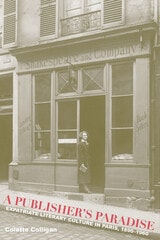
A Publisher's Paradise
Expatriate Literary Culture in Paris, 1890-1960Colette Colligan
University of Massachusetts Press, 2014
From 1890 to 1960, some of Anglo-America's most heated cultural contests over books, sex, and censorship were staged not at home, but abroad in the City of Light. Paris, with its extraordinary liberties of expression, became a special place for interrogating the margins of sexual culture and literary censorship, and a wide variety of English language “dirty books” circulated through loose expatriate publishing and distribution networks.
A Publisher's Paradise explores the political and literary dynamics that gave rise to this expatriate cultural flourishing, which included everything from Victorian pornography to the most daring and controversial modernist classics. Colette Colligan tracks the British and French politicians and diplomats who policed Paris editions of banned books and uncovers offshore networks of publishers, booksellers, authors, and readers. She looks closely at the stories the “dirty books” told about this publishing haven and the smut peddlers and literary giants it brought together in transnational cultural formations. The book profiles an eclectic group of expatriates living and publishing in Paris, from relatively obscure figures such as Charles Carrington, whose list included both The Picture of Dorian Gray and the pornographic novel Randiana, to bookshop owner Sylvia Beach, famous for publishing James Joyce's Ulysses in 1922.
A Publisher's Paradise is a compelling exploration of the little-known history of foreign pornography in Paris and the central role it played in turning the city into a modernist outpost for literary and sexual vanguardism, a reputation that still lingers today in our cultural myths of midnight in Paris.
A Queen Mother Defiant
Irene Drusilla Namaganda and the Remaking of Power and Gender in Colonial UgandaNakanyike B. Musisi
University of Wisconsin Press, 2026
In 1941, Irene Drusilla Namaganda, the reigning queen mother of British-occupied Buganda, shocked the kingdom when she revealed she was six months pregnant—only fifteen months after the king’s death. The father of her child, a schoolteacher nearly two decades her junior, quickly became the focal point for a scandal that engulfed the monarchy. The ensuing political crisis led to Namaganda’s removal from the office of queen mother (Nnamasole) and her companion’s exile, spurring her own departure.
Drawing from extensive archival research and in-depth oral interviews, this long-awaited biography analyzes Namaganda’s roles as wife, mother, widow, and prominent yet controversial cultural-political icon. Nakanyike Musisi moves beyond the scandal to explore how the monarch’s character and personal choices defied expectations of royal women and redefined motherhood, power, and tradition. She challenges dominant narratives in African political history and gender studies to show how African women navigated competing systems of authority and in doing so reshaped both the institution of monarchy and broader cultural and historical landscapes.
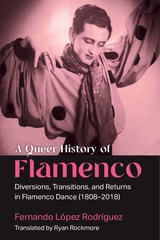
A Queer History of Flamenco
Diversions, Transitions, and Returns in Flamenco Dance (1808–2018)Fernando López Rodríguez, translation by Ryan Rockmore
University of Michigan Press, 2024
Tracing flamenco’s development from its birth up to the contemporary era, the book places flamenco within significant historical periods such as the Spanish Civil War, Franco’s dictatorship, the transition to democracy, and the economic crisis of 2008, up to contemporary performances of the late 2010s. In taking a queer approach to History, the author abandons antiquated debates about purities and impurities; anecdotes about the lives of artists that are completely detached from their processes of creation; and myths about geniuses who seem to make art alone and completely detached from their collaborators and the historical, social, economic and artistic moment in which they lived. A Queer History of Flamenco is not only about the present and the queerness of people living, performing, or creating in it, but also about flamenco’s past in which so many queer artists and practices and their lives have remained unearthed and unaddressed.
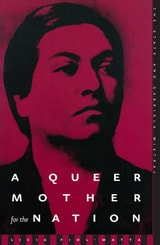
A Queer Mother For The Nation
The State And Gabriela MistralLicia Fiol-Matta
University of Minnesota Press, 2002
Chilean writer Gabriela Mistral (1889-1957), the first Latin American to win theNobel Prize for Literature, was a poetic idol for generations of Latin Americans who viewed her as Womanhood incarnate, the national schoolteacher-mother. How this distinctly masculine woman who never gave birth came to occupy this role, and what Mistral’s image, poetry, and life have to say about the relations-and realities-of race, gender, and sexual politics in her time, are the questions Licia Fiol-Matta pursues in this book, recreating the story of a woman whose misrepresentation is at least as intriguing, and as instructive, as her fame.
A Queer Mother for the Nation weaves a nuanced understanding of how Mistral cooperated with authority and fashioned herself as the figure of Motherhood in collaboration with the state. Drawing on Mistral’s little-known political and social essays, her correspondence and photographs, Fiol-Matta reconstructs Mistral’s relationship to state politics. Her work questions the notion of queer bodies as outlaws, and insists on the many ways in which queer subjects have participated in and sustained the normative discourses they seem to rebel against
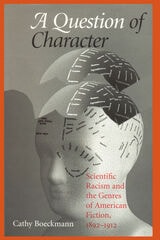
A Question of Character
Scientific Racism and the Genres of American Fiction, 1892-1912Catherine Ann Boeckmann
University of Alabama Press, 2005
Boeckmann links character, literary genre, and science, revealing how major literary works both contributed to and disrupted the construction of race in turn-of-the-century America.
In A Question of Character, Cathy Boeckmann establishes a strong link between racial questions and the development of literary traditions at the end of the 19th century in America. This period saw the rise of "scientific racism," which claimed that the races were distinguished not solely by exterior appearance but also by a set of inherited character traits. As Boeckmann explains, this emphasis on character meant that race was not only a thematic concern in the literature of the period but also a generic or formal one as well.
Boeckmann explores the intersections between race and literary history by tracing the language of character through both scientific and literary writing. Nineteenth-century pseudo-sciences such as phrenology and physiognomy had a vocabulary for discussing racial character that overlapped conceptually with the conventions for portraying race in literature. Through close readings of novels by Thomas Dixon, Mark Twain, William Dean Howells, Charles Chesnutt, and James Weldon Johnson—each of which deals with a black character "passing" as white—Boeckmann shows how this emphasis on character relates to the shift from romantic and sentimental fiction to realism. Because each of these genres had very specific conventions regarding the representation of character, genres often dictated how races could be depicted.
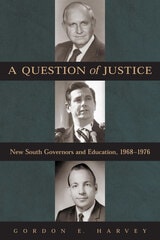
A Question of Justice
New South Governors and Education, 1968-1976Gordon E. Harvey
University of Alabama Press, 2005
The governors who used education to transform the modern South.
In southern politics, 1970 marked a watershed. A group of southern governors entered office that year and changed both the way the nation looked at the South and the way the constituents of those states viewed themselves. Reubin Askew in Florida, John West in South Carolina, Jimmy Carter in Georgia, and Albert Brewer in Alabama all represented a new breed of progressive moderate politician that helped demolish Jim Crow segregation and the dual economies, societies, and educational systems notorious to the Sunbelt South. Historian Gordon Harvey explores the political lives and legacies of three of these governors, examining the conditions that led to such a radical change in political leadership, the effects their legislative agendas had on the identity of their states, and the aftermath of their terms in elected office.
A common thread in each governor's agenda was educational reform. Albert Brewer's short term as Alabama governor resulted in a sweeping education package that still stands as the most progressive the state has seen. Reubin Askew, far more outspoken than Brewer, won the Florida gubernatorial election through a campaign that openly promoted desegregation, busing, and tax reform as a means of equal school funding. John West's commitment to a policy of inclusion helped allay fears of both black and white parents and made South Carolina's one of the smoothest transitions to integrated schools.
As members of the first generation of New South governors, Brewer, Askew, and West played the role of trailblazers. Their successful assaults on economic and racial injustice in their states were certainly aided by such landmark events as Brown v. Board of Education, the civil rights movement, and the expansion of voting rights-all of which sounded the death knell for the traditional one-party segregated South. But in this critical detailing of their work for justice, we learn how these reform-minded men made education central to their gubernatorial terms and, in doing so, helped redefine the very character of the place they called home.

A Quiet Challenge
Edward W. Brooke and the Politics of Civil RightsJordan O'Neal Alexander
University of Massachusetts Press, 2026
The first full-length biography of a consequential figure in twentieth-century American politics
In 1962, Edward W. Brooke (1919–2015) upended political convention by becoming the first popularly elected African American attorney general of Massachusetts. His victory was striking not only because Massachusetts was an overwhelmingly white state with a small Black population, but also because Brooke was a Republican and an Episcopalian in a deeply Democratic, Irish Catholic political culture. Navigating these contradictions, Brooke crafted a distinctive political style—measured, pragmatic, and quietly transformative—that reshaped civil rights politics in the North. In A Quiet Challenge, Jordan O’Neal Alexander offers the first full-length biography of Brooke, revealing him as a Black Republican whose carefully calibrated approach to race, law, and governance won broad white support while often distancing him from Boston’s Black community.
As attorney general, Brooke sought to uphold the rule of law while advancing principles of fairness, equality, and public safety, an approach that reflected both political constraint and moral resolve. Brooke again defied expectations in 1966 when he won election to the United States Senate, becoming the first popularly elected African American senator since Reconstruction. Serving two terms during the height of the civil rights movement, he emerged as a powerful national voice on issues of racial justice. He played a key role in blocking two Supreme Court nominees aligned with President Richard Nixon’s “southern strategy,” even as his support for school desegregation and busing during the Boston Busing Crisis contributed to his eventual political decline. Throughout his career, Brooke remained committed to building a society in which Black Americans—and all Americans—could fully participate and prosper. This volume demonstrates how Brooke’s restrained, yet persistent political strategy helped expand the possibilities for Black leadership within mainstream American politics.
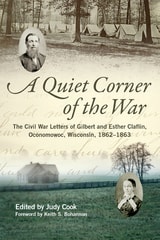
A Quiet Corner of the War
The Civil War Letters of Gilbert and Esther Claflin, Oconomowoc, Wisconsin, 1862–1863Gilbert Claflin and Esther Claflin; Edited by Judy Cook; Foreword by Keith S. Bohannon
University of Wisconsin Press, 2013
In 2002, Judy Cook discovered a packet of letters written by her great-great-grandparents, Gilbert and Esther Claflin, during the American Civil War. An unexpected bounty, these letters from 1862–63 offer visceral witness to the war, recounting the trials of a family separated. Gilbert, an articulate and cheerful forty-year-old farmer, was drafted into the Union Army and served in the Thirty-Fourth Wisconsin Infantry garrisoned in western Kentucky along the Mississippi. Esther had married Gilbert when she was fifteen; now a woman with two teenage sons, she ran the family farm near Oconomowoc, Wisconsin, in Gilbert’s absence.
In his letters, Gilbert writes about food, hygiene, rampant desertions by drafted men, rebel guerrilla raids, and pastimes in the daily life of a soldier. His comments on interactions with Confederate prisoners and ex-slaves before and after the Emancipation Proclamation reveal his personal views on monumental events. Esther shares in her letters the challenges and joys of maintaining the farm, accounts of their boys Elton and Price, concerns about finances and health, and news of their local community and extended family. Esther’s experiences provide insight into family, farm, and village life in the wartime North, an often overlooked aspect of Civil War history.
Judy Cook has made the letters accessible to a wider audience by providing historical context with notes and appendixes. The volume includes a foreword by Civil War historian Keith S. Bohannon.
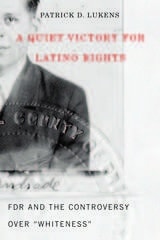
A Quiet Victory for Latino Rights
FDR and the Controversy Over "Whiteness"Patrick D. Lukens
University of Arizona Press, 2012
In 1935 a federal court judge handed down a ruling that could have been disastrous for Mexicans, Mexican Americans, and all Latinos in the United States. However, in an unprecedented move, the Roosevelt administration wielded the power of "administrative law" to neutralize the decision and thereby dealt a severe blow to the nativist movement. A Quiet Victory for Latino Rights recounts this important but little-known story.
To the dismay of some nativist groups, the Immigration Act of 1924, which limited the number of immigrants who could be admitted annually, did not apply to immigrants from Latin America. In response to nativist legal maneuverings, the 1935 decision said that the act could be applied to Mexican immigrants. That decision, which ruled that the Mexican petitioners were not "free white person[s]," might have paved the road to segregation for all Latinos.
The League of United Latin American Citizens (LULAC), founded in 1929, had worked to sensitize the Roosevelt administration to the tenuous position of Latinos in the United States. Advised by LULAC, the Mexican government, and the US State Department, the administration used its authority under administrative law to have all Mexican immigrants—and Mexican Americans—classified as "white." It implemented the policy when the federal judiciary "acquiesced" to the New Deal, which in effect prevented further rulings.
In recounting this story, complete with colorful characters and unlikely bedfellows, Patrick D. Lukens adds a significant chapter to the racial history of the United States.
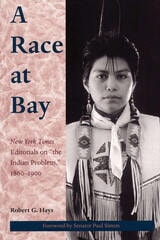
A Race at Bay
New York Times Editorials on "the Indian Problem," 1860 - 1900Robert G. Hays. Foreword by Paul Simon
Southern Illinois University Press, 1997
Robert G. Hays chronicles the "Indian problem" precisely as it was explained to Americans through the editorial columns of the New York Times between 1860 and 1900, the years when battles between white settlers and Native Americans split a nation and its spirit apart.
Covering the final forty-one years of the nineteenth century, Hays’s collection of Times editorials gives readers what current accounts cannot: perspectives by contemporary writers with unique insights into the public images of Native Americans and their place in a nation bent on expansion. The authentic voices of a national newspaper’s daily record speak with an urgency both immediate and real.
These editorials express the unbridled bitterness and raw ambition of a nation immersed in an agenda of conquest. They also resonate with the struggle to find a common ground. Some editorials are patronizing and ironic: "Yet it seems pitiful to cage so fine a savage among a herd of vulgar criminals in a penitentiary." Others include a willingness to poke fun: "Many persons on the platform were astonished to find that an ‘illiterate barbarian’ could handle the weapon of sarcasm. The truth is that the Indians spoke far better than ninety-nine out of a hundred members of congress." And yet others evince an attitude of respect, which set the tone for reconciling national ambition with natural rights.
In some instances, the Times allowed Native Americans to tell their own stories, as in this eloquent, moving account of the testimony of Satanta, the warrior chief of the Kiowas: "A certain dim foreboding of the Indians’ fate swept across his mind, and in its passage lit his eyes up with a fierce light, and his voice rose to a pitch of frenzy as he exclaimed: ‘We don’t want to settle—I love to roam over the prairie; there I am free and happy."
History demonstrates that the costs of owning one’s soil and one’s destiny remain without measure. Many of the problems blocking the progress of Native Americans continue unsolved: unemployment, infant mortality, suicide, crime, alcoholism, and poverty. Following such works as Helen Hunt Jackson’s A Century of Dishonor and Dee Brown’s Bury My Heart at Wounded Knee, Hays looks back on the records of national history for the roots of our challenges today.
A Radical History of the World
Neil Faulkner
Pluto Press, 2018
“Staggeringly ambitious.”―New Internationalist
“One of the finest historians on the left.”—John Newsinger, author, The Blood Never Dried
Rejecting the top-down approach of conventional history, Neil Faulkner contends that it is the mass action of ordinary people that drives the transformative events of our many histories. This is a history of power, abuse, and greed, but also one of liberation, progress, and solidarity.
From the hunter-gatherers two million years ago to the ancient empires of Persia and China, and from the Russian Revolution to modern imperialism, humans have always struggled to create a better society than what came before. All over the world at numerous points in the past, a different way of life has become an absolute necessity, over and over again. This is a history of the humans in these struggles—the hominid and the hunter, the emperor and the slave, the dictator and the revolutionary.
Reading against the grain of mainstream histories, Neil Faulkner reveals that what happened in the past has never been predetermined. From antiquity to feudalism, and from fascism to our precarious political present, choices have always been numerous and complex, and the possible outcomes have ranged broadly between liberation and barbarism. His chapters include:
*Hunters and Farmers
*The First Class Societies
*Ancient Empires
*The Medieval World
*European Feudalism
*The First Wave of Bourgeois Revolutions
*Absolutist Europe and Capitalist Globalization
*The Rise of Industrial Capitalism
*The Revolutionary Wave
*The Great Depression and the Rise of Fascism
*World War and Cold War
*The New World Disorder
*Capitalism’s Greatest Crisis? The Early Twenty-First Century
In our fraught political present—as we face the loss of civil liberties and environmental protections, the rise of ethnonationalism, and the looming threat of nuclear war—we need the perspective of these histories now more than ever. The lesson of A Radical History of the World is that, if we created our past, we can also create a better future.
A Radical Spirit
The History and Potential of the Latter Day Saint TraditionEdited by Andrew Bolton, Taunalyn Ford, and Patrick Q. Mason
University of Illinois Press, 2027
Early followers of Joseph Smith believed their new faith could organize society from the ground up and create a religious community shaped by justice, equality, and spiritual transformation. The essayists look at the movement’s diverse influences—religious, philosophical, and cultural—alongside the economic, gender, and racial issues that informed its radicalism. They also trace the competing pressures inside and outside the movement that helped determine which radical ideas survived and which faded or were later enhanced.
Eye-opening and expansive, A Radical Spirit rediscovers implications of the original heart of the Restoration tradition that thrived among the marginalized poor in the USA, Canada and in Europe—a radical Spirit of Jesus that offers possibilities for our times.
Contributors: Andrew Bolton, Gerard Charmley, Rebekah Clark, Taunalyn Ford, Russell Arben Fox, Erik J. Freeman, David J. Howlett, Brad A. Martell, Lori Martell, Patrick Q. Mason, Michael Ratcliffe, Jennifer Reeder, Joseph M. Spencer, Jordan T. Watkins, Walker Wright