Results by title
8642 books match the query '20th Century' and 836 start with a
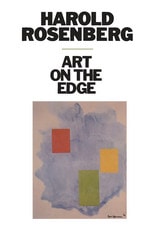
Art on the Edge
Creators and SituationsHarold Rosenberg
University of Chicago Press, 1983
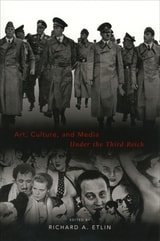
Art, Culture, and Media Under the Third Reich
Edited by Richard A. Etlin
University of Chicago Press, 2002
Contributors address nearly every facet of the arts and mass media under the Third Reich—efforts to define degenerate music and art; the promotion of race hatred through film and public assemblies; views of the racially ideal garden and landscape; race as portrayed in popular literature; the reception of art and culture abroad; the treatment of exiled artists; and issues of territory, conquest, and appeasement. Familiar subjects such as the Munich Accord, Nuremberg Party Rally Grounds, and Lebensraum (Living Space) are considered from a new perspective. Anyone studying the history of Nazi Germany or the role of the arts in nationalist projects will benefit from this book.
Contributors:
Ruth Ben-Ghiat
David Culbert
Albrecht Dümling
Richard A. Etlin
Karen A. Fiss
Keith Holz
Kathleen James-Chakraborty
Paul B. Jaskot
Karen Koehler
Mary-Elizabeth O'Brien
Jonathan Petropoulos
Robert Jan van Pelt
Joachim Wolschke-Bulmahn and Gert Gröning
Art, Music, and Literature, 1897-1902
Theodore Dreiser. Edited by Yoshinobu Hakutani
University of Illinois Press, 2007
In this volume, liberally seasoned with period illustrations, Yoshinobu Hakutani has collected and annotated a rich selection of Theodore Dreiser's pre-fame writings on the cultural milieu of his day.
In these brief essays, Dreiser sallies into the vibrant world of creative work in turn-of-the-century America. He inspects the eccentric and revealing paraphernalia of artists' studios, probes the work habits of writers, and goes behind the scenes in the popular song-writing business, where this week's celebrity is next week's has-been. He profiles famous figures and introduces numerous women artists, novelists, and musicians, including the prolific and tireless Amelia Barr (mother of fourteen children and author of thirty-two novels), the illustrator Alice B. Stephens, and the opera singer Lillian Nordica. Hakutani's notes provide biographical detail on dozens of now-obscure individuals mentioned by Dreiser.
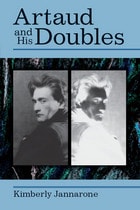
Artaud and His Doubles
Kimberly Jannarone
University of Michigan Press, 2012
Artaud and His Doublesis a radical re-thinking of one of the most influential theater figures of the twentieth century. Placing Artaud's writing within the specific context of European political, theatrical, and intellectual history, the book reveals Artaud's affinities with a disturbing array of anti-intellectual and reactionary writers and artists whose ranks swelled catastrophically between the wars in Western Europe.
Kimberly Jannarone shows that Artaud's work reveals two sets of doubles: one, a body of peculiarly persistent received interpretations from the American experimental theater and French post-structuralist readings of the 1960s; and, two, a darker set of doubles—those of Artaud's contemporaries who, in the tumultuous, alienated, and pessimistic atmosphere enveloping much of Europe after World War I, denounced the degradation of civilization, yearned for cosmic purification, and called for an ecstatic loss of the self. Artaud and His Doubleswill generate provocative new discussions about Artaud and fundamentally challenge the way we look at his work and ideas.
Arte Programmata
Freedom, Control, and the Computer in 1960s ItalyLindsay Caplan
University of Minnesota Press, 2022
Tracing the evolution of the Italian avant-garde’s pioneering experiments with art and technology and their subversion of freedom and control
In postwar Italy, a group of visionary artists used emergent computer technologies as both tools of artistic production and a means to reconceptualize the dynamic interrelation between individual freedom and collectivity. Working contrary to assumptions that the rigid, structural nature of programming limits subjectivity, this book traces the multifaceted practices of these groundbreaking artists and their conviction that technology could provide the conditions for a liberated social life.
Situating their developments within the context of the Cold War and the ensuing crisis among the Italian left, Arte Programmata describes how Italy’s distinctive political climate fueled the group’s engagement with computers, cybernetics, and information theory. Creating a broad range of immersive environments, kinetic sculptures, domestic home goods, and other multimedia art and design works, artists such as Bruno Munari, Enzo Mari, and others looked to the conceptual frameworks provided by this new technology to envision a way out of the ideological impasses of the age.
Showcasing the ingenuity of Italy’s earliest computer-based art, this study highlights its distinguishing characteristics while also exploring concurrent developments across the globe. Centered on the relationships between art, technology, and politics, Arte Programmata considers an important antecedent to the digital age.
Artful Assassins
Murder as Art in Modern MexicoFernando Fabio Sanchez
Vanderbilt University Press, 2010
Sanchez argues that the seemingly hopeless cycle of violence experienced by Mexico in the 20th century, as reflected in its "crime genre," reveals a broader intrinsic cultural and political failure that suggests grave implications for the current state of crisis. Tracing the development of a national Mexican identity from the 1910 Mexican Revolution onward, Sanchez focuses on the indelible presence of violence and crime underlying the major works that contributed to a larger communal narrative.
Artful Assassins ultimately offers a panoramic overview of the evolution of Mexican arts and letters, as well as nationalism, by claiming murder and assassination as literary and cinematic motifs. The collapse of post-revolutionary political unity was presaged all along in Mexican culture, Sanchez argues. It need only to have been sought in the art of the nation.
Artful Noise
Percussion Literature in the Twentieth CenturyThomas Siwe
University of Illinois Press, 2020
Percussionist Thomas Siwe organizes and analyzes the groundbreaking musical literature that arose during the twentieth century. Focusing on innovations in style and the evolution of the percussion ensemble, Siwe offers a historical overview that connects the music to scoring techniques, new instrumentation and evolving technologies as well as world events. Discussions of representative pieces by seminal composers examines the resources a work requires, its construction, and how it relates to other styles that developed during the same period. In addition, Siwe details the form and purpose of many of the compositions while providing background information on noteworthy artists. Each chapter is supported with musical examples and concludes with a short list of related works specifically designed to steer musicians and instructors alike toward profitable explorations of composers, styles, and eras.
Arthur C. Clarke
Gary Westfahl
University of Illinois Press, 2018
Gary Westfahl closely examines Clarke's remarkable career, ranging from his forgotten juvenilia to the passages he completed for a final novel, The Last Theorem. As Westfahl explains, Clarke’s science fiction offered original perspectives on subjects like new inventions, space travel, humanity’s destiny, alien encounters, the undersea world, and religion. While not inclined to mysticism, Clarke necessarily employed mystical language to describe the fantastic achievements of advanced aliens and future humans. Westfahl also contradicts the common perception that Clarke’s characters were bland and underdeveloped, arguing that these reticent, solitary individuals, who avoid conventional relationships, represent his most significant prediction of the future, as they embody the increasingly common lifestyle of people in the twenty-first century.

Arthur M. Schlesinger Jr. and the Ideological History of American Liberalism
Stephen P. Depoe
University of Alabama Press, 1994
Arthur M. Schlesinger, Jr., is a historian and political advocate whose ideas and activities have significantly influenced the shape and direction of American liberalism during the past fifty years. A central feature of Schlesinger’s ideological perspective is his belief that American history has been marked by alternating periods of conservative and liberal dominance, which he has termed the “tides of national politics.” Throughout his career, Schlesinger has used the “tides of national politics” to defend the legitimacy and superiority of active liberal government and leadership.
The study investigates how the “tides” concept has functioned in both Schlesinger’s historical scholarship and his partisan political discourse. Depoe also explores the ways in which the “tides” concept has shaped and channeled Schlesinger’s political thought over time, leading him toward certain definitions of situations and away from others. Finally, Depoe offers Schlesinger’s life and work as a case study of the highs and lows of postwar American liberalism. By tracing Schlesinger’s responses to Eisenhower-era conservatism, Kennedy’s New Frontier, and the problems of Vietnam and violence during the 1960s, and the gradual delegitimation of liberalism from the 1970s to the present, this book offers a road map that can guide the reader toward a better understanding of the past, present, and future of liberalism in America.
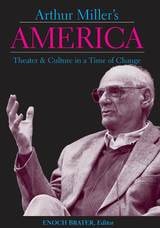
Arthur Miller's America
Theater and Culture in a Time of ChangeEnoch Brater, Editor
University of Michigan Press, 2005
Arthur Miller's America collects new writing by leading international critics and scholars that considers the dramatic world of icon, activist, and playwright Arthur Miller's theater as it reflects the changing moral equations of his time. Written on the occasion of Miller's 85th year, the original essays and interviews in Arthur Miller's America treat the breadth of Miller's work, including his early political writings for the campus newspaper at the University of Michigan, his famous work with John Huston, Clark Gable and Marilyn Monroe on The Misfits, and his signature plays like Death of a Salesman and All My Sons.
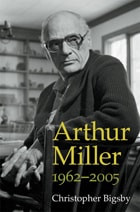
Arthur Miller
1962-2005Christopher Bigsby
University of Michigan Press, 2013
Christopher Bigsby's masterful two-volume biography of Arthur Miller sheds new light on one of the twentieth century's most acclaimed literary figures. Plays such as Death of a Salesman, A View from the Bridge, and The Crucible brought Miller an international following, and events such as his refusal to provide information to the House Un-American Activities Committee and his marriage to Marilyn Monroe kept him in the public eye. The second half of his life, the focus of this volume, proved no less fascinating. In 1962, Monroe died, and he married photographer Inge Morath, a relationship that transformed him as a writer and as a person. His activism in support of political and social causes only increased during the period, including criticism of U.S. foreign policy in Vietnam and contemporary conflicts in the Middle East. In this period of his life, he also became renowned for his work in support of dissident writers in Russia, Czechoslovakia, China, and elsewhere.
The second volume of this magisterial biography offers a compelling narrative of a singular American life, a life story enriched by the biographer's uncommon access to Miller and his unpublished papers while researching this book. The result is an authoritative biography that provides illuminating detail and invaluable insights into the Miller the artist and Miller the man.
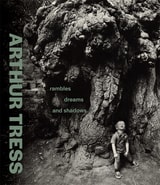
Arthur Tress
Rambles, Dreams, and ShadowsJames A. Ganz
J. Paul Getty Trust, The, 2023
Arthur Tress (b. 1940) is a singular figure in the landscape of postwar American photography. His seminal series, The Dream Collector, depicts Tress’s interests in dreams, nightmares, fantasies, and the unconscious and established him as one of the foremost proponents of magical realism at a time when few others were doing staged photography.
This volume presents the first critical look at Tress’s early career, contextualizing the highly imaginative, fantastic work he became known for while also examining his other interrelated series: Appalachia: People and Places; Open Space in the Inner City; Shadow; and Theater of the Mind. James A. Ganz, Mazie M. Harris, and Paul Martineau plumb Tress’s work and archives, studying ephemera, personal correspondence, unpublished notes, diaries, contact sheets, and more to uncover how he went from earning his living as a social documentarian in Appalachia to producing surreal work of “imaginative fiction.” This abundantly illustrated volume imparts a fuller understanding of Tress’s career and the New York photographic scene of the 1960s and 1970s.
This volume is published to accompany an exhibition on view at the J. Paul Getty Museum at the Getty Center from October 31, 2023, to February 18, 2024.

Arthur Vandenberg
The Man in the Middle of the American CenturyHendrik Meijer
University of Chicago Press, 2017
Originally the editor and publisher of the Grand Rapids Herald, Vandenberg was appointed and later elected to the Senate in 1928, where he became an outspoken opponent of the New Deal and a leader among the isolationists who resisted FDR’s efforts to aid European allies at the onset of World War II. But Vandenberg soon recognized the need for unity at the dawn of a new world order; and as a Republican leader, he worked closely with Democratic administrations to build the strong bipartisan consensus that established the Marshall Plan, the United Nations, and NATO. Vandenberg, as Meijer reveals, was instrumental in organizing Congressional support for these monumental twentieth-century foreign policy decisions.
Vandenberg’s life and career offer powerful lessons for today, and Meijer has given us a story that suggests an antidote to our current democratic challenges. After reading this poignant biography, many will ask: Where is the Vandenberg of today?
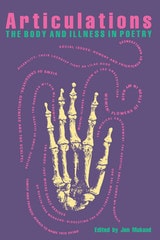
Articulations
The Body and Illness in PoetryJon Mukand
University of Iowa Press, 1994
In 1987 poet and physician Jon Mukand published Sutured Words, a volume of contemporary poems to help patients, their families and friends, and all health care professionals embrace the complexity of healing, illness, and death. Robert Coles called the collection “a wonderful source of inspiration and instruction for any of us who are trying to figure out what our work means”; Norman Cousins was impressed by the “discernment and high quality of the selections.” Now, in Articulations, Mukand adds more than a hundred new poems to the strongest poems from Sutured Words to give us a lyrical, enlightened understanding of the human dimensions of suffering and illness
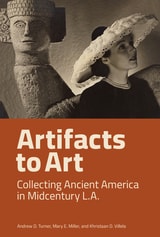
Artifacts to Art
Collecting Ancient America in Midcentury L.A.Andrew D. Turner
J. Paul Getty Trust, The, 2026
By the mid-twentieth century, ancient Mexican artifacts had undergone a striking transformation. Once dismissed as anthropological curiosities, sought after more for their ethnographic value than aesthetic merit, they had become prized artworks that were prominently displayed in major US museums, featured in advertisements and Hollywood films, and shown adorning the homes of celebrities.
At the center of this shift was Earl Stendahl, a savvy Los Angeles art dealer who played a pivotal role in shaping public and institutional perceptions of these objects. Through strategic marketing and a keen eye for opportunity, he repositioned these artifacts, selling them to an elite clientele that included movie stars, wealthy collectors, and museum curators. In doing so, he helped define a new canon of “ancient American art.”
Beneath this glamorous facade, however, lies a darker narrative of the looting, smuggling, and forgery that fueled this midcentury craze, exposing how the desire for authenticity and prestige often came at the expense of ethical collecting practices and cultural heritage. This book brings together art history, museum studies, and the politics of the antiquities trade, offering both a social history and a critical examination of how ancient Mexico’s past was sold in twentieth-century America.
This volume is published to accompany an exhibition on view at the Getty Research Institute at the Getty Center from June 23 to October 18, 2026.
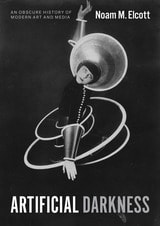
Artificial Darkness
An Obscure History of Modern Art and MediaNoam M. Elcott
University of Chicago Press, 2016
In exploring how artificial darkness shaped modern art, film, and media, Noam M. Elcott addresses seminal and obscure works alongside their sites of production—such as photography darkrooms, film studios, and laboratories—and their sites of reception, including theaters, cinemas, and exhibitions. He argues that artists, scientists, and entertainers like Étienne-Jules Marey, Richard Wagner, Georges Méliès, and Oskar Schlemmer revolutionized not only images but also everything surrounding them: the screen, the darkness, and the experience of bodies and space. At the heart of the book is “the black screen,” a technology of darkness that spawned today’s blue and green screens and has undergirded numerous advanced art and film practices to this day.
Turning familiar art and film narratives on their heads, Artificial Darkness is a revolutionary treatment of an elusive, yet fundamental, aspect of art and media history.

Artificial Paradise
Science Fiction and American RealitySharona Ben-Tov
University of Michigan Press, 1995
Artificial Southerner
Equivocations and Love SongsPhilip Martin
University of Arkansas Press, 2001
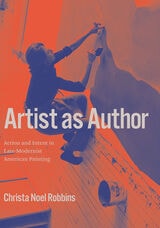
Artist as Author
Action and Intent in Late-Modernist American PaintingChrista Noel Robbins
University of Chicago Press, 2021
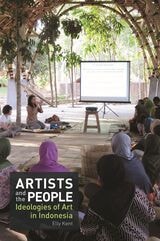
Artists and the People
Ideologies of Art in IndonesiaElly Kent
National University of Singapore Press, 2022
Exploring the work of established and emerging artists in Indonesia’s vibrant art world, this book examines why so many artists in the world’s largest archipelagic nation choose to work directly with people in their art practices. While the social dimension of Indonesian art makes it distinctive in the globalized world of contemporary art, Elly Kent is the first to explore this engagement in Indonesian terms. What are the historical, political, and social conditions that lie beneath these polyvalent practices? How do formal and informal institutions, communities, and artist-run initiatives contribute to the practices and discourses behind socially engaged art in Indonesia? Drawing on interviews with artists, translations of archival material, visual analyses, and participation in artists’ projects, this book presents a unique, interdisciplinary examination of ideologies of art in Indonesia.
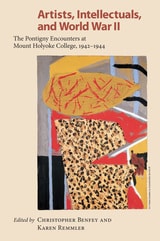
Artists, Intellectuals, and World War II
The Pontigny Encounters at Mount Holyoke College, 1942-1944Christopher E. G. Benfey
University of Massachusetts Press, 2006
Sixty years ago, at the height of World War II, an extraordinary series of gatherings took place at Mount Holyoke College in western Massachusetts. During the summers of 1942–1944, leading European figures in the arts and sciences met at the college with their American counterparts for urgent conversations about the future of human civilization in a precarious world.
Two Sorbonne professors, the distinguished medievalist Gustave Cohen and the existentialist philosopher Jean Wahl, organized these “Pontigny” sessions, named after an abbey in Burgundy where similar symposia had been held in the decades before the war. Among the participants—many of whom were Jewish or had Jewish backgrounds—were the philosophers Hannah Arendt and Rachel Bespaloff, the poets Marianne Moore and Wallace Stevens, the anthropologist Claude Lévi-Strauss and the linguist Roman Jakobson, and the painters Marc Chagall and Robert Motherwell.
In this collection of original essays, Stanley Cavell and Jacques Derrida lead an international group of scholars—including Jed Perl, Mary Ann Caws, Jeffrey Mehlman, and Elisabeth Young-Bruehl—in assessing the lasting impact and contemporary significance of Pontigny-en- Amérique. Rachel Bespaloff, a tragic figure who wrote a major work on the Iliad, is restored to her rightful place beside Arendt and Simone Weil. Anyone interested in the “intellectual resistance” of Francophone intellectuals and artists, and the inspiring support from such American figures as Stevens and Moore, will want to read this pioneering work of scholarship and historical re-creation.
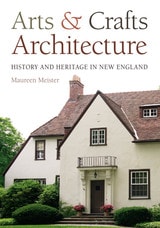
Arts and Crafts Architecture
History and Heritage in New EnglandMaureen Meister
University Press of New England, 2014
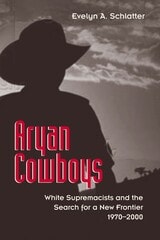
Aryan Cowboys
White Supremacists and the Search for a New Frontier, 1970–2000By Evelyn A. Schlatter
University of Texas Press, 2006
During the last third of the twentieth century, white supremacists moved, both literally and in the collective imagination, from midnight rides through Mississippi to broadband-wired cabins in Montana. But while rural Montana may be on the geographical fringe of the country, white supremacist groups were not pushed there, and they are far from "fringe elements" of society, as many Americans would like to believe. Evelyn Schlatter's startling analysis describes how many of the new white supremacist groups in the West have co-opted the region's mythology and environment based on longstanding beliefs about American character and Manifest Destiny to shape an organic, home-grown movement.
Dissatisfied with the urbanized, culturally progressive coasts, disenfranchised by affirmative action and immigration, white supremacists have found new hope in the old ideal of the West as a land of opportunity waiting to be settled by self-reliant traditional families. Some even envision the region as a potential white homeland. Groups such as Aryan Nations, The Order, and Posse Comitatus use controversial issues such as affirmative action, anti-Semitism, immigration, and religion to create sympathy for their extremist views among mainstream whites—while offering a "solution" in the popular conception of the West as a place of freedom, opportunity, and escape from modern society. Aryan Cowboys exposes the exclusionist message of this "American" ideal, while documenting its dangerous appeal.

As American as Mom, Baseball, and Apple Pie
Constructing Community in Contemporary American Horror FictionLinda J. Holland-Toll
University of Wisconsin Press, 2001
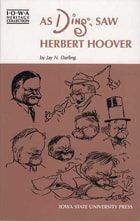
As Ding Saw Herbert Hoover
Jay N. Darling
University of Iowa Press, 1996
Ding Darling was a Pulitzer Prize-winning editorial cartoonist whose work appeared daily on the front page of the Des Moines Register between 1906 and 1949 and also was syndicated in 135 newspapers across the country. A brief encounter with Herbert Hoover during World War I was the beginning of a friendship that lasted until Ding’s death in 1962. After Hoover’s election as president, Ding’s relationship changed somewhat from one of strictly a friend to one of an unofficial advisor. On at least three occasions, the Darlings were overnight guests at the White House. Although their friendship deepened after the years of the presidency, Ding did not agree with Hoover on everything. In As “Ding” Saw Herbert Hoover, Ding interprets the career of Hoover as food administrator, cabinet member, candidate, and president in 57 cartoons, personal recollections, and a running commentary of the times as told in the day-by-day headlines.
As Legend Has It
History, Heritage, and the Construction of Swedish American IdentityJennifer Eastman Attebery
University of Wisconsin Press, 2023
The legends Swedish Americans tell about their past are both similar to and distinct from those of others who migrated westward; they participated in settler colonialism while maintaining a sense of their specific, Swedish ethnicity. Unlike racial minority groups, Swedish Americans could claim membership in a majority white community without abandoning their cultural heritage. Their legends and local histories reflect that positioning. Attebery reveals how Swedish American legends are embedded within local history writing, how ostension and rhetoric operate in historical legends, and how vernacular local history writing works in tandem with historical legends to create a common message about a communal past. This impeccably researched study points to ways in which legends about the past possess qualities unique to their subgenre yet can also operate similarly to contemporary legends in their social impact.
As Told By Herself
Women’s Childhood Autobiography, 1845-1969Lorna Martens
University of Wisconsin Press, 2022
Stopping just before second-wave feminism brought an explosion in women's childhood autobiographical writing, As Told by Herself explores the genre's roots and development from the mid-nineteenth century, and recovers many works that have been neglected or forgotten. The result illustrates how previous generations of women—in a variety of places and circumstances—understood themselves and their upbringing, and how they thought to present themselves to contemporary and future readers.
Ashes Taken for Fire
Aesthetic Modernism and the Critique of IdentityKevin M. Bell
University of Minnesota Press, 2007
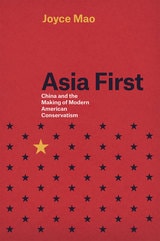
Asia First
China and the Making of Modern American ConservatismJoyce Mao
University of Chicago Press, 2015
Mao explores the deep resonance American conservatives felt with the defeat of Chiang Kai-Shek and his exile to Taiwan, which they lamented as the loss of China to communism and the corrosion of traditional values. In response, they fomented aggressive anti-communist positions that urged greater action in the Pacific, a policy known as “Asia First.” While this policy would do nothing to oust the communists from China, it was powerfully effective at home. Asia First provided American conservatives a set of ideals—American sovereignty, selective military intervention, strident anti-communism, and the promotion of a technological defense state—that would bring them into the global era with the positions that are now their hallmark.
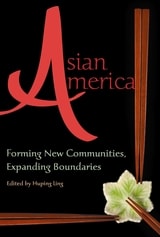
Asian America
Forming New Communities, Expanding BoundariesLing, Huping
Rutgers University Press, 2009
Asian America is the first comprehensive look at post-1960s Asian American communities in the United States and Canada. From Chinese Americans in Chicagoland to Vietnamese Americans in Orange County, this multi-disciplinary collection spans a wide comparative and panoramic scope. Contributors from an array of academic fields focus on global views of Asian American communities as well as on territorial and cultural boundaries.
Presenting groundbreaking perspectives, Asian America revises worn assumptions and examines current challenges Asian American communities face in the twenty-first century.
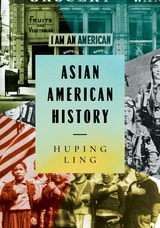
Asian American History
Huping Ling
Rutgers University Press, 2023
Asian American History provides a comprehensive historical dive into Asian immigration to the United States, exploring it in international and domestic contexts and alongside the significant elements that define Asian America: imperialism and global capitalist expansion; labor and capital; race and ethnicity; immigration and exclusion; family and work; community and gender roles; assimilation and multiculturalism; panethnicity and identity; transnationalism and globalization; and new challenges and opportunities. Huping Ling traces the roots of Asian immigration from the late 1700s through intervening centuries of racial prejudice, wartime experiences, legal restrictions, and social mobility into the 2010s. It is an up-to-date and easily accessible resource for high school and college students as well as anyone who is interested in Asian American history.
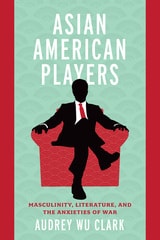
Asian American Players
Masculinity, Literature, and the Anxieties of WarAudrey Wu Clark
The Ohio State University Press, 2023
The player is a womanizer, a trickster, a gambler—but can Asian American men fully participate in this kind of masculinity? In Asian American Players, Audrey Wu Clark showcases how the literary figure of the Asian American player unsettles the hegemony of white American masculinity through mimicry, even as that masculinity socially and politically alienates him. She examines gendered and racialized US militarism through works written during major postmodern American wars, investigating how books by John Okada, David Henry Hwang, Chang-rae Lee, Frances Khirallah Noble, and Viet Thanh Nguyen (re)fashion Asian American masculinity in ways that ultimately mimic masculinist American foreign policy and military strategies during corresponding wars. She unearths a dual picture of Asian American players: as traces of the anxiety of America’s quest for empowerment and continued military and industrial dominance in the international arena and as those tarred as inferior and disloyal outsiders within this mirrored global dominance. She thus finds new inroads into understanding US imperialism and militarism and identifies ways that key literary figures have written against insidious tropes.
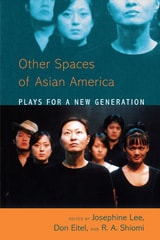
Asian American Plays for a New Generation
Plays for a New GenerationEdited by Josephine Lee, Don Eitel and R. A. Shiomi
Temple University Press, 2011
Asian American plays provide an opportunity to think about how racial issues are engaged through theatrical performance physical contact, bodily labor, and fleshly desire as well as through the more standard elements of plot, setting, characterization, staging, music, and action.
Asian American Plays for a New Generation showcases seven exciting new plays that dramatize timely themes that are familiar to Asian Americans. The works variously address immigration, racism, stereotyping, identity, generational tensions, assimilation, and upward mobility as well as post-9/11 paranoia, racial isolation, and adoptee experiences.
Each of these works engages directly and actively with Asian American themes through performance to provide an important starting point for building relationships, raising political awareness, and creating active communities that can foster a sense of connection or even rally individuals to collective action.
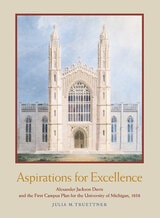
Aspirations for Excellence
Alexander Jackson Davis and the First Campus Plan for the University of Michigan, 1838Julia M. Truettner
University of Michigan Press, 2003
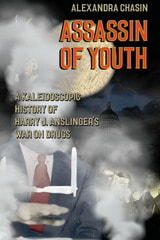
Assassin of Youth
A Kaleidoscopic History of Harry J. Anslinger’s War on DrugsAlexandra Chasin
University of Chicago Press, 2016
In Assassin of Youth, Alexandra Chasin gives us a lyrical, digressive, funny, and ultimately riveting quasi-biography of Anslinger. Her treatment of the man, his times, and the world that arose around and through him is part cultural history, part kaleidoscopic meditation. Each of the short chapters is anchored in a historical document—the court decision in Webb v. US (1925), a 1935 map of East Harlem, FBN training materials from the 1950s, a personal letter from the Treasury Department in 1985—each of which opens onto Anslinger and his context. From the Pharmacopeia of 1820 to death of Sandra Bland in 2015, from the Pennsylvania Railroad to the last passenger pigeon, and with forays into gangster lives, CIA operatives, and popular detective stories, Chasin covers impressive ground. Assassin of Youth is as riotous and loose a history of drug laws as can be imagined—and yet it culminates in an arresting and precise revision of the emergence of drug prohibition.
Today, even as marijuana is slowly being legalized, we still have not fully reckoned with the racist and xenophobic foundations of our cultural appetite for the severe punishment of drug offenders. In Assassin of Youth, Chasin shows us the deep, twisted roots of both our love and our hatred for drug prohibition.
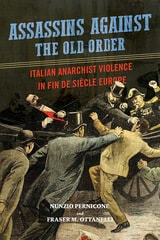
Assassins against the Old Order
Italian Anarchist Violence in Fin de Siecle EuropeNunzio Pernicone, Fraser Ottanelli
University of Illinois Press, 2018
Nunzio Pernicone and Fraser M. Ottanelli dig into the transnational experiences and the historical, social, cultural, and political conditions behind the phenomenon of anarchist violence in Italy. Looking at political assassinations in the 1890s, they illuminate the public effort to equate anarchy's goals with violent overthrow. Throughout, Pernicone and Ottanelli combine a cutting-edge synthesis of the intellectual origins, milieu, and nature of Italian anarchist violence with vivid portraits of its major players and their still-misunderstood movement.
A bold challenge to conventional thinking, Assassins against the Old Order demolishes a century of myths surrounding anarchist violence and its practitioners.
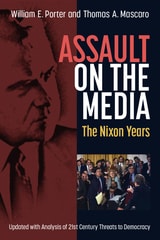
Assault on the Media
The Nixon YearsWilliam E. Porter and Thomas A. Mascaro
University of Michigan Press, 2024
Informed by a half-century of historical analyses and released documents, this expanded edition of William E. Porter’s award-winning Assault on the Media analyzes new documents of significance; synthesizes recent historical analyses; incorporates legal evaluations by journalism scholars; and traces how Nixon-era plans cultivated the divisive state of 21st-century society and amplified assaults on journalism. It also evaluates lasting concerns about the Supreme Court’s Pentagon Papers decision and journalists cited for contempt as a form of prior restraint; the currencies of power and race in protecting confidential sources; and regulatory decisions that hamper effective journalism. Assault on the Media not only documents the incidents and circumstances of governmental intimidation, harassment, and regulation of the news media during the Nixon presidency, but it offers insights into the long-term effects and their relevance today.
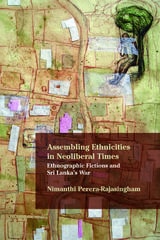
Assembling Ethnicities in Neoliberal Times
Ethnographic Fictions and Sri Lanka’s WarNimanthi Perera-Rajasingham
Northwestern University Press, 2019
Assembling Ethnicities in Neoliberal Times: Ethnographic Fictions and Sri Lanka’s War argues that the bloody war fought between the Sri Lankan state and the separatist Tamil Tigers from 1983 to 2009 should be understood as structured and animated by the forces of global capitalism. Using Aihwa Ong’s theorization of neoliberalism as a mobile technology and assemblage, this book explores how contemporary globalization has exacerbated forces of nationalism and racism.
Nimanthi Perera-Rajasingham finds that ethnographic fictions have both internalized certain colonial Orientalist impulses and critically engaged with categories of objective gazing, empiricism, and temporal distancing. She demonstrates that such fictions take seriously the task of bearing witness and documenting the complex productions of ethnic identities and the devastations wrought by warfare. To this end, Assembling Ethnicities
explores colonial-era travel writing by Robert Knox (1681) and Leonard Woolf (1913); contemporary works by Michael Ondaatje, Romesh Gunesekera, Shobasakthi, Dharmasiri Bandaranayake, and Thamotharampillai Shanaathanan; and cultural festivals and theater, including vernacular performances of Euripides’s The Trojan Women and women workers’ theater.
The book interprets contemporary fictions to unpack neoliberalism’s entanglements with nationalism and racism, engaging current issues such as human rights, the pastoral, Tamil militancy, immigrant lives, feminism and nationalism, and postwar developmentalism.

Asylum, Prison, and Poorhouse
The Writings and Reform Work of Dorothea Dix in IllinoisDavid L. Lightner
Southern Illinois University Press, 1999
This illustrated collection of annotated newspaper articles and memorials by Dorothea Dix provides a forum for the great mid-nineteenth-century humanitarian and reformer to speak for herself.
Dorothea Lynde Dix (1802–87) was perhaps the most famous and admired woman in America for much of the nineteenth century. Beginning in the early 1840s, she launched a personal crusade to persuade the various states to provide humane care and effective treatment for the mentally ill by funding specialized hospitals for that purpose. The appalling conditions endured by most mentally ill inmates in prisons, jails, and poorhouses led her to take an active interest also in prison reform and in efforts to ameliorate poverty.
In 1846–47 Dix brought her crusade to Illinois. She presented two lengthy memorials to the legislature, the first describing conditions at the state penitentiary at Alton and the second discussing the sufferings of the insane and urging the establishment of a state hospital for their care. She also wrote a series of newspaper articles detailing conditions in the jails and poorhouses of many Illinois communities.
These long-forgotten documents, which appear in unabridged form in this book, contain a wealth of information on the living conditions of some of the most unfortunate inhabitants of Illinois. In his preface, David L. Lightner describes some of the vivid images that emerge from Dorothea Dix's descriptions of social conditions in Illinois a century and a half ago: "A helpless maniac confined throughout the bitter cold of winter to a dark and filthy pit. Prison inmates chained in hallways and cellars because no more men can be squeezed into the dank and airless cells. Aged paupers auctioned off by county officers to whoever will maintain them at the lowest cost."
Lightner provides an introduction to every document, placing each memorial and newspaper article in its proper social and historical context. He also furnishes detailed notes, making these documents readily accessible to readers a century and a half later. In his final chapter, Lightner assesses both the immediate and the continuing impact of Dix's work.
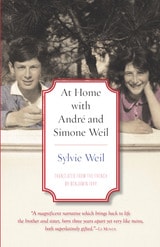
At Home with André and Simone Weil
Sylvie Weil, translated from the French by Benjamin Ivry
Northwestern University Press, 2010
“It is quite incorrect to believe that the dead are gone forever and never return to speak to the living. They return to speak to the living all the time; indeed, it is their main activity.” Thus writes Sylvie Weil in this illuminating memoir, in which contemporary readers can hear the voices of her famed philosopher aunt Simone and mathematician father André.
Born into a freethinking Jewish family in France in 1909, Simone Weil was one of the twentieth century’s most original philosophers, influencing Albert Camus, T. S. Eliot, Simone de Beauvoir, Pope John XXIII, Czesław Miłosz, and Susan Sontag. She fought for workers’ rights and, later, the Spanish Republican cause. Before her death at age thirty-four, Simone Weil turned increasingly to mysticism and religion, especially Roman Catholicism, exploring themes of sacrifice, asceticism, and the virtues of manual labor. She never converted, however, and Sylvie Weil writes from a Jewish perspective, emphasizing Simone’s Jewish heritage.
Using previously unpublished family correspondence and conversations, Sylvie Weil paints the most vivid, private portrait of her aunt in print. The book illuminates Simone’s relationship with others, especially with her brother, André. Loving and unsparing, affectionate and incisive, At Home with André and Simone Weil is an insightful memoir about a family of intellectual luminaries.
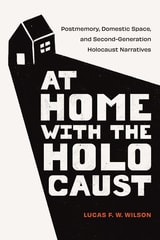
At Home with the Holocaust
Postmemory, Domestic Space, and Second-Generation Holocaust NarrativesLucas F. W. Wilson
Rutgers University Press, 2025
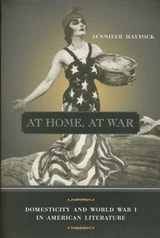
At Home, At War
Domesticity and World War I in American LiteratureJennifer Haytock
The Ohio State University Press, 2003
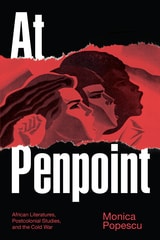
At Penpoint
African Literatures, Postcolonial Studies, and the Cold WarMonica Popescu
Duke University Press, 2020
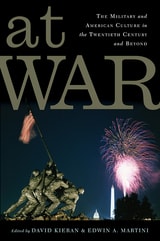
At War
The Military and American Culture in the Twentieth Century and BeyondKieran, David
Rutgers University Press, 2018
At War offers short, accessible essays addressing the central issues in the new military history—ranging from diplomacy and the history of imperialism to the environmental issues that war raises and the ways that war shapes and is shaped by discourses of identity, to questions of who serves in the U.S. military and why and how U.S. wars have been represented in the media and in popular culture.
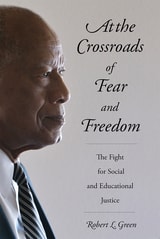
At the Crossroads of Fear and Freedom
The Fight for Social and Educational JusticeRobert L. Green
Michigan State University Press, 2016
This memoir relates previously untold stories about major Civil Rights campaigns that helped put an end to voting rights violations and Jim Crow education; explains how Green has helped urban school districts improve academic achievement levels; and explains why this history should inform our choices as we attempt to reform and improve American education. Green’s quest began when he helped the Kennedy Administration resolve a catastrophic education-related impasse and has continued through his service as one of the participants at an Obama administration summit on a current academic crisis.
It is commonly said that education is the new Civil Rights battlefield. Green’s memoir, At the Crossroads of Fear and Freedom: The Fight for Social and Educational Justice, helps us understand that educational equity has always been a central objective of the Civil Rights movement.
At the Crossroads of the Avant-Garde
Ivan Aksyonov and Russian ModernismLars Kleberg, Charles Rougle
Northwestern University Press, 2026
This kaleidoscopic biography offers readers a compelling microhistory of a revolutionary moment in art and politics through its portrait of an enigmatic but influential figure: Ivan Aksyonov authored the first book-length study about Pablo Picasso, translated Elizabethan drama, and was a literary adviser to Vsevolod Meyerhold, as well as a teacher of Sergei Eisenstein in Meyerhold’s institute and an important critic, before dying in 1935. Lars Kleberg traces Aksyonov’s influences, interlocutors, and creative output in multiple genres and media to bring a complicated and fascinating character back to life. Kleberg invites us to reconsider the avant-garde and to understand the political and artistic ferment of the revolutionary era and its aftermath in new, deeper ways.

At the Edge of the Abyss
A Concentration Camp Diary, 1943-1944David Koker; Edited by Robert Jan van Pelt; Translated from the Dutch by Michiel Horn and John Irons
Northwestern University Press, 2012
Finalist for 2012 National Jewish Book Award in the Holocaust category
David Koker's diary is one of the most notable accounts of life in a German concentration camp written by a Jew during the years of the Holocaust. First brought to attention when the Dutch historian Jacob Presser-Koker's history teacher in high school-quoted from Koker's diary in his monumental history, published in English as The Destruction of the Dutch Jews (1968), the diary itself became a part of the Dutch literary canon when it was published in 1977 as Dagboek geschreven in Vught (Diary Written in Vught). It has remained in print ever since, and is notable for its literary qualities, weaving poetry and powerful observations of the emotional life of a camp prisoner, including reflections after an in-person visit by Heinrich Himmler. Surprisingly, the book has never before been translated into English.
During his time in the Vught concentration camp, the 21-year-old David recorded on an almost daily basis his observations, thoughts, and feelings. He mercilessly probed the abyss that opened around him and, at times, within himself. David's diary covers almost a year, both charting his daily life in Vught as it developed over time and tracing his spiritual evolution as a writer. Until early February 1944, David was able to smuggle some 73,000 words from the camp to his best friend Karel van het Reve, a non-Jew.
With an informative introduction, annotation, and list of dramatis personae by Robert Jan van Pelt, At the Edge of the Abyss offers an immediate and wholly original look into the life of a concentration camp prisoner.

At the Heart of It
Ordinary People, Extraordinary LivesWalt Harrington
University of Missouri Press, 1996
Delving into the everyday lives of real, everyday people, Walt Harrington skillfully draws the reader into an intimate relationship with the men and women profiled in this powerful collection of stories--people like V. I. Smith, a homicide detective; Deane Guy, a stock car racer; Jackie Jordan, a social worker in family services; and Sheri D'Amato, a girls' soccer coach.
Originally appearing in the Washington Post Magazine, these stories, which capture a cross section of Americans, stand out in the field of journalism because of the unique way in which Walt Harrington uses unheralded, individual lives to elaborate on the great human issues of the day. In "Mothers and Daughters" three generations of women discuss how society affected the choices they made and who they became. "The Mystery of Goodness" follows a Harvard-educated lawyer who handles death-row cases for very little money because he feels the system is unfair to African Americans. In "To Have and Have Not" a young couple with two small children struggle to make ends meet. Harrington describes in detail the creation of a poem by Rita Dove, then United States Poet Laureate, in "The Shape of Her Dreaming."
Harrington has adeptly combined sociology and journalism into beautiful prose. As "literary journalism," the stories employ scene, dialogue, and physical description within a narrative framework. At the same time, they also adhere to all the traditional journalistic standards of accuracy, fairness, and balance. As a result, At the Heart of It represents a subgenre that is rarely practiced and seldom understood even within the profession of journalism.
All of these stories are snapshots, pieces of everyday life in America that are intended to be a mirror held to the lives of readers. These are not stories about which you can remain neutral; even the most casual readers will be moved by the glimpses Walt Harrington provides us of ourselves.
At the Limit of the Obscene
German Realism and the Disgrace of MatterErica Weitzman
Northwestern University Press, 2021
As German-language literature turned in the mid-nineteenth century to the depiction of the profane, sensual world, a corresponding anxiety emerged about the terms of that depiction—with consequences not only for realist poetics but also for the conception of the material world itself. At the Limit of the Obscene examines the roots and repercussions of this anxiety in German realist and postrealist literature. Through analyses of works by Adalbert Stifter, Gustav Freytag, Theodor Fontane, Arno Holz, Gottfried Benn, and Franz Kafka, Erica Weitzman shows how German realism’s conflicted representations of the material world lead to an idea of the obscene as an excess of sensual appearance beyond human meaning: the obverse of the anthropocentric worldview that German realism both propagates and pushes to its crisis. At the Limit of the Obscene thus brings to light the troubled and troubling ontology underlying German realism, at the same time demonstrating how its works continue to shape our ideas about representability, alterity, and the relationship of human beings to the non-human well into the present day.
At the Limits of Cure
Bharat Jayram Venkat
Duke University Press, 2021